Column addition is the written method for adding numbers that are too big to add in your head. Write the numbers one under the other with the digits lined up, add the ones first, then the tens, then the hundreds, and carry any 10 into the next column. For example, 476 + 358 = 834: 6 + 8 = 14, write 4 and carry 1; 7 + 5 + 1 = 13, write 3 and carry 1; 4 + 3 + 1 = 8.
Practise five levels below, from Year 2 sums with no carrying to Year 5 numbers over 10,000. Every question is already set out in columns, and Show method explains each column, including where the carried 1 goes.
Next exercise
The inverse: subtract in columns with exchanging, and check your additions.
Column addition step by step
- Line up the digits by place value. Ones under ones, tens under tens. With 2,385 + 647, the 7 goes under the 5, not under the 2.
- Start with the ones column, on the right. 5 + 7 = 12. Write the 2 in the answer and carry the 1 (one ten) under the tens column.
- Add the tens, including the carried digit. 8 + 4 + 1 = 13. Write 3 and carry 1 into the hundreds.
- Keep going left. Hundreds: 3 + 6 + 1 = 10, write 0 and carry 1. Thousands: 2 + 1 = 3.
- Read the answer: 2,385 + 647 = 3,032. Check it by estimating: about 2,400 + 600 = 3,000.
What carrying really means
When a column adds up to 10 or more, there are too many digits for one place. Twelve ones are the same as one ten and two ones, so the ten moves to the tens column. Schools sometimes call this regrouping or exchanging, and many write the carried digit small, under the line, so it is not forgotten. Children who understand this with base-ten blocks or place value counters rarely forget to carry.
Column addition from Year 2 to Year 5
| Year | What children add | National Curriculum wording |
|---|---|---|
| Year 2 | Two 2-digit numbers, often in columns without carrying | Recording addition in columns is in the non-statutory guidance, as preparation for formal written methods. |
| Year 3 | Numbers with up to 3 digits | Add and subtract numbers with up to 3 digits, using formal written methods of columnar addition and subtraction. |
| Year 4 | Numbers with up to 4 digits | Add and subtract numbers with up to 4 digits using the formal written methods of columnar addition and subtraction where appropriate. |
| Year 5 | Numbers with more than 4 digits | Add and subtract whole numbers with more than 4 digits, including using formal written methods (columnar addition and subtraction). |
Source: Mathematics programmes of study (GOV.UK).
Mistakes to look out for
- Starting from the left. Adding the hundreds first means the carries arrive too late. Always start with the ones.
- Numbers of different lengths lined up on the left. 1,436 + 87 must have the 7 under the 6. Squared paper with one digit per square helps.
- Forgetting the carried digit, or writing the whole 12 in one column. If an answer digit is 10 or more, something has gone wrong.
- No estimate. A quick rounded estimate catches answers that are ten times too big or too small.
Check with the inverse
Subtraction undoes addition: if 2,385 + 647 = 3,032, then 3,032 − 647 should give 2,385. This is a good habit, and our column subtraction page practises the method needed for the check.
Printable column addition worksheets
Each worksheet is A4 with the answer key on page 2. The missing-digit puzzles are harder than they look and work well as a challenge for children who find the standard sheets easy.
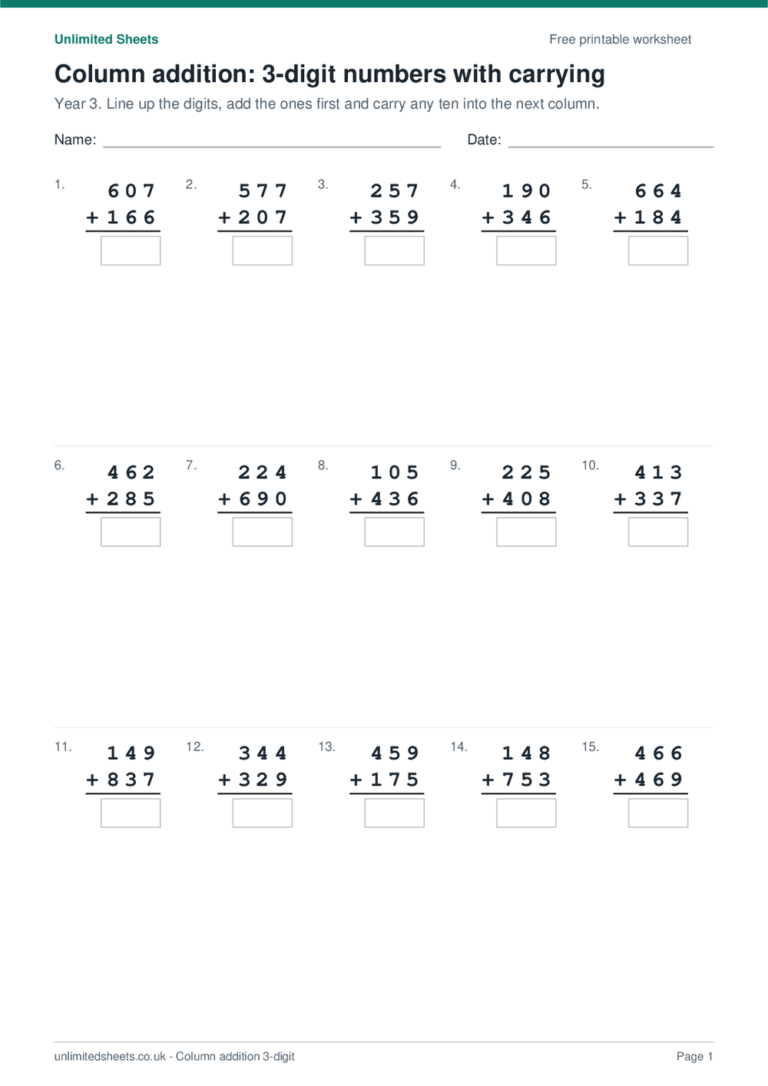
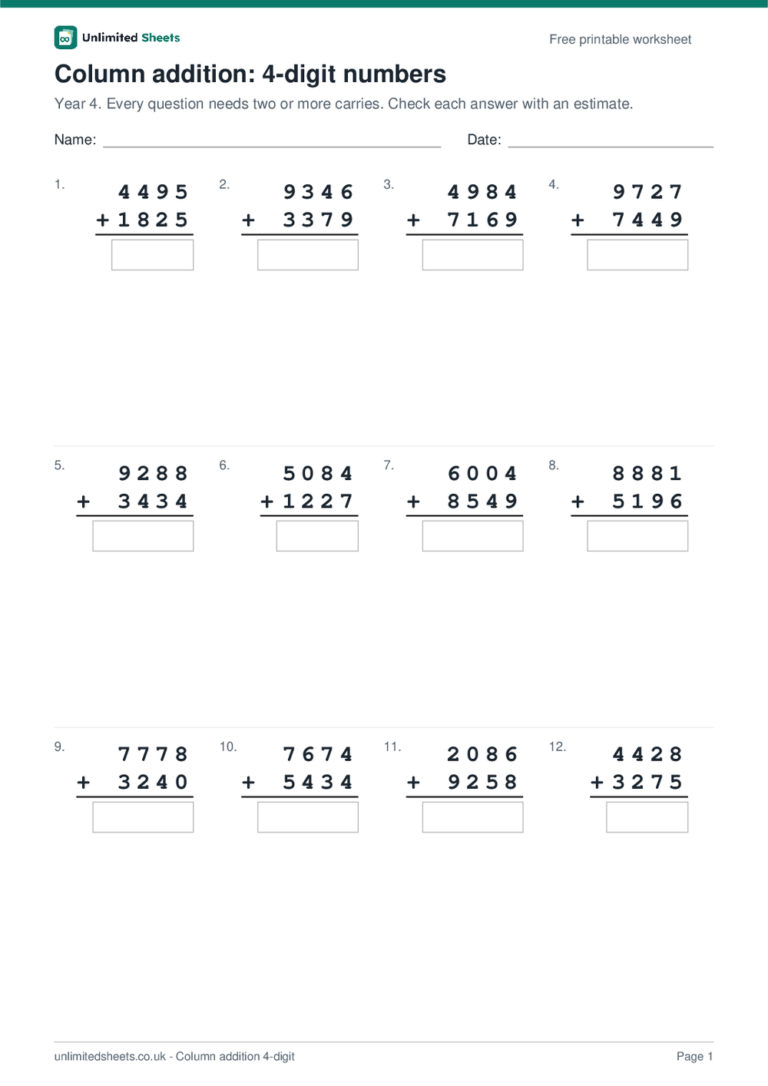
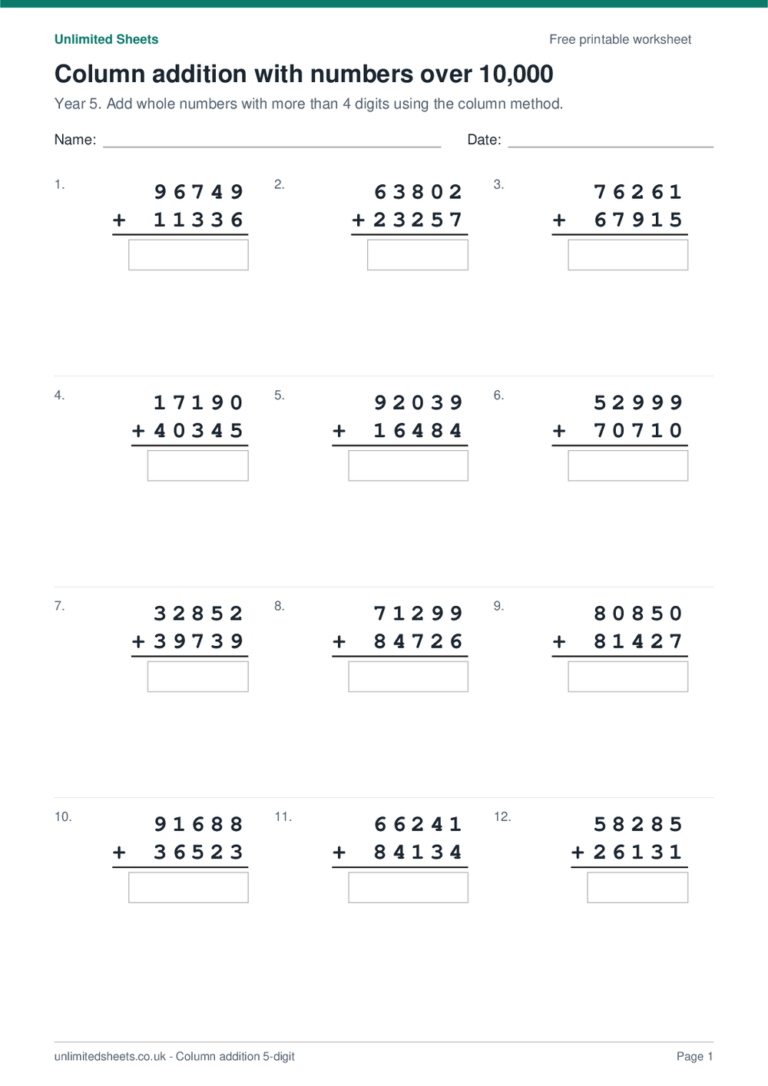
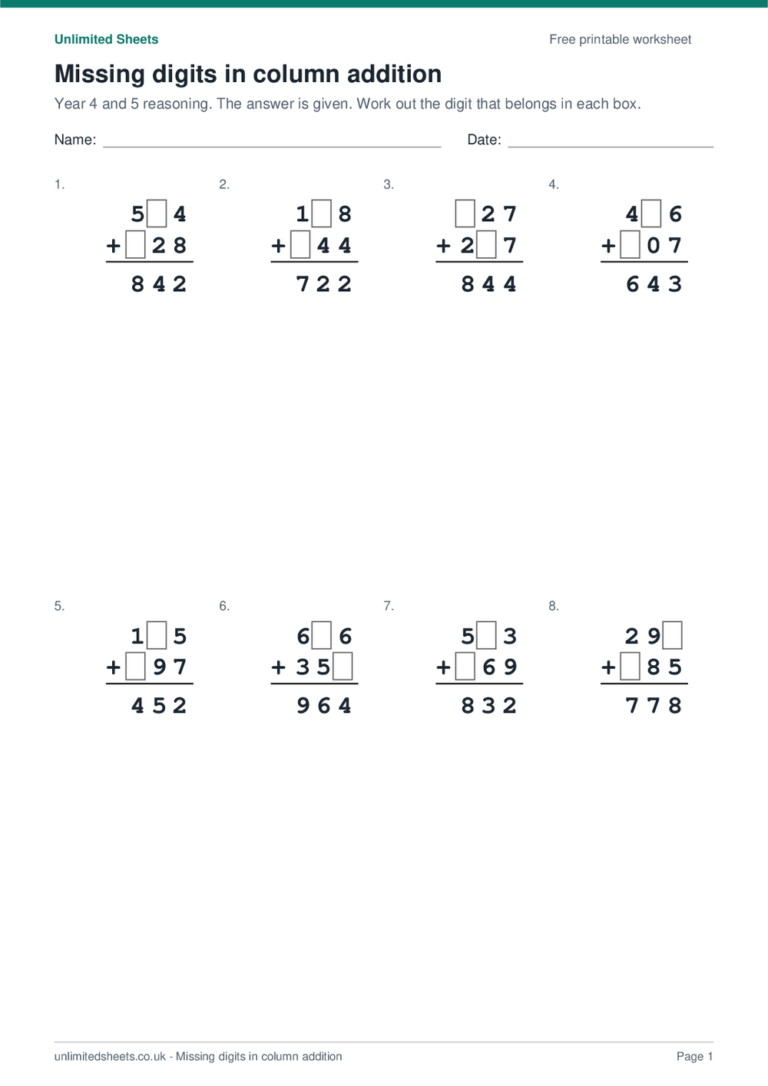
- Column addition: 3-digit with carrying (Year 3). Fifteen questions already set out in columns. Every question needs at least one carry and no answer goes over 999.
- Column addition: 4-digit numbers (Year 4). Twelve four-digit additions where every question carries at least twice, the step where most mistakes happen.
- Column addition with 5-digit numbers (Year 5). Twelve additions with five-digit numbers for the Year 5 objective of adding numbers with more than 4 digits.
- Missing digits in column addition (Year 4–5). Eight reasoning puzzles: the total is given and two digits are hidden. Children have to think about carrying backwards, which builds real understanding of the method.
Column addition questions
What year do children learn column addition?
Children meet it informally in Year 2, and the formal written method of columnar addition is in the Year 3 programme of study for numbers with up to 3 digits. It is extended to 4 digits in Year 4 and to more than 4 digits in Year 5.
Is carrying the same as regrouping or exchanging?
Yes. All three words describe moving ten ones into the tens column (or ten tens into the hundreds). Schools differ in which word they use, but the method is the same.
Where should the carried 1 be written?
Most schools in England teach children to write it small, under the answer line in the next column to the left, so it is added in with that column. Some write it above. Either is fine as long as it is added.
How do I add decimals in columns?
Line up the decimal points first, then add exactly as with whole numbers, starting from the right. Fill any gaps with zeros so every number has the same number of decimal places.
Keep practising
Updated 22 November 2026.