Roman numerals use seven letters: I = 1, V = 5, X = 10, L = 50, C = 100, D = 500 and M = 1,000. Letters are added when they go from largest to smallest (VI = 6, LXX = 70), and a smaller letter in front of a larger one is subtracted (IV = 4, XC = 90). So 2026 is MMXXVI and 1994 is MCMXCIV.
Roman numeral converter
Type a number to see it in Roman numerals, or type a Roman numeral to see its value. The converter splits every number into thousands, hundreds, tens and ones, which is the method children use in school.
Roman numerals 1 to 100
| 1I | 2II | 3III | 4IV | 5V | 6VI | 7VII | 8VIII | 9IX | 10X |
| 11XI | 12XII | 13XIII | 14XIV | 15XV | 16XVI | 17XVII | 18XVIII | 19XIX | 20XX |
| 21XXI | 22XXII | 23XXIII | 24XXIV | 25XXV | 26XXVI | 27XXVII | 28XXVIII | 29XXIX | 30XXX |
| 31XXXI | 32XXXII | 33XXXIII | 34XXXIV | 35XXXV | 36XXXVI | 37XXXVII | 38XXXVIII | 39XXXIX | 40XL |
| 41XLI | 42XLII | 43XLIII | 44XLIV | 45XLV | 46XLVI | 47XLVII | 48XLVIII | 49XLIX | 50L |
| 51LI | 52LII | 53LIII | 54LIV | 55LV | 56LVI | 57LVII | 58LVIII | 59LIX | 60LX |
| 61LXI | 62LXII | 63LXIII | 64LXIV | 65LXV | 66LXVI | 67LXVII | 68LXVIII | 69LXIX | 70LXX |
| 71LXXI | 72LXXII | 73LXXIII | 74LXXIV | 75LXXV | 76LXXVI | 77LXXVII | 78LXXVIII | 79LXXIX | 80LXXX |
| 81LXXXI | 82LXXXII | 83LXXXIII | 84LXXXIV | 85LXXXV | 86LXXXVI | 87LXXXVII | 88LXXXVIII | 89LXXXIX | 90XC |
| 91XCI | 92XCII | 93XCIII | 94XCIV | 95XCV | 96XCVI | 97XCVII | 98XCVIII | 99XCIX | 100C |
Roman numerals practice
Six levels follow the National Curriculum, from reading the numerals on a clock face in Year 3 to reading years in Year 5. The answers mark themselves, and Show how splits each number into its parts.
Next exercise
Year 4 also brings the times tables check: practise all the tables to 12 × 12.
The rules of Roman numerals
- Add when the letters go down in size. CLX = 100 + 50 + 10 = 160.
- Subtract when a smaller letter comes before a larger one, but only in six pairs: IV (4), IX (9), XL (40), XC (90), CD (400) and CM (900).
- Never repeat a letter more than three times. 4 is IV, not IIII, and 40 is XL, not XXXX. (Some clock faces do show IIII for 4, a tradition of clockmakers.)
- V, L and D are never repeated or subtracted. 10 is X, not VV, and 95 is XCV, not VC.
- Work one place value at a time. 1,994 = 1,000 + 900 + 90 + 4 = M + CM + XC + IV = MCMXCIV.
Roman numerals in Years 3, 4 and 5
- Year 3: telling the time from an analogue clock, including clocks with Roman numerals from I to XII.
- Year 4: read Roman numerals to 100 (I to C) and know that, over time, the number system changed to include zero and place value.
- Year 5: read Roman numerals to 1,000 (M) and recognise years written in Roman numerals.
Why the Romans had no zero
Roman numerals have no symbol for zero and no place value: the X in XV and in XC is worth 10 both times. That is why calculating with them was so slow, and why the Hindu-Arabic digits 0 to 9 we use today eventually replaced them. It is a nice way into the Year 4 objective about how the number system changed.
Where you still see Roman numerals
- Clock and watch faces.
- The year a film or television programme was made, in the end credits.
- Monarchs and popes: Elizabeth II, Charles III, Henry VIII.
- Chapter numbers, the pages before a book's introduction, and the dates on old buildings and monuments.
Printable Roman numerals worksheets
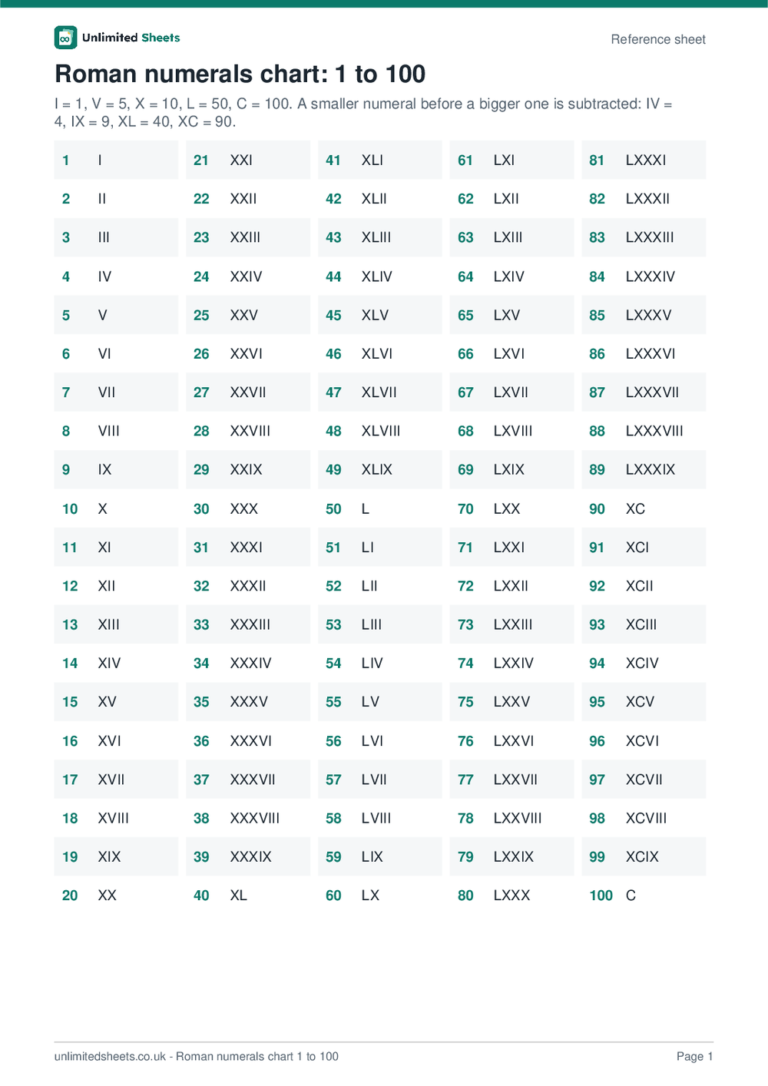
- Roman numerals chart 1 to 100 (Reference). Every number from 1 to 100 beside its Roman numeral, with the subtraction rule explained at the top. One page to keep.
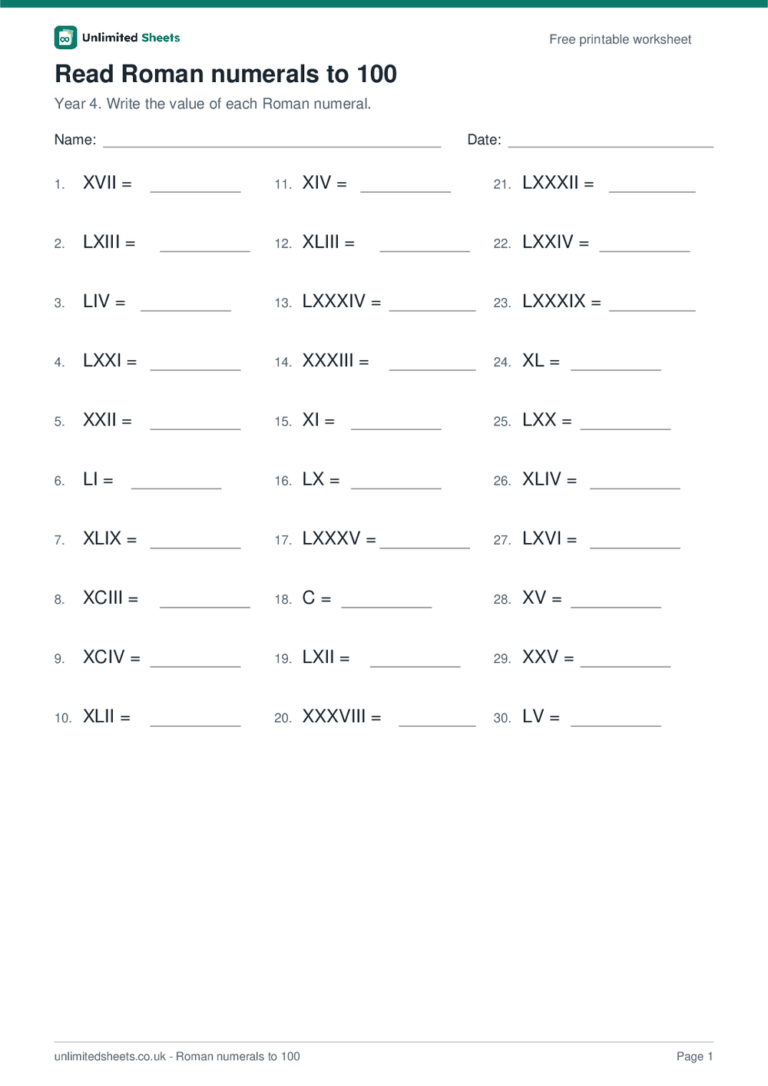
- Read Roman numerals to 100 (Year 4). Thirty numerals from I to C to turn into ordinary numbers, for the Year 4 objective of reading Roman numerals to 100.
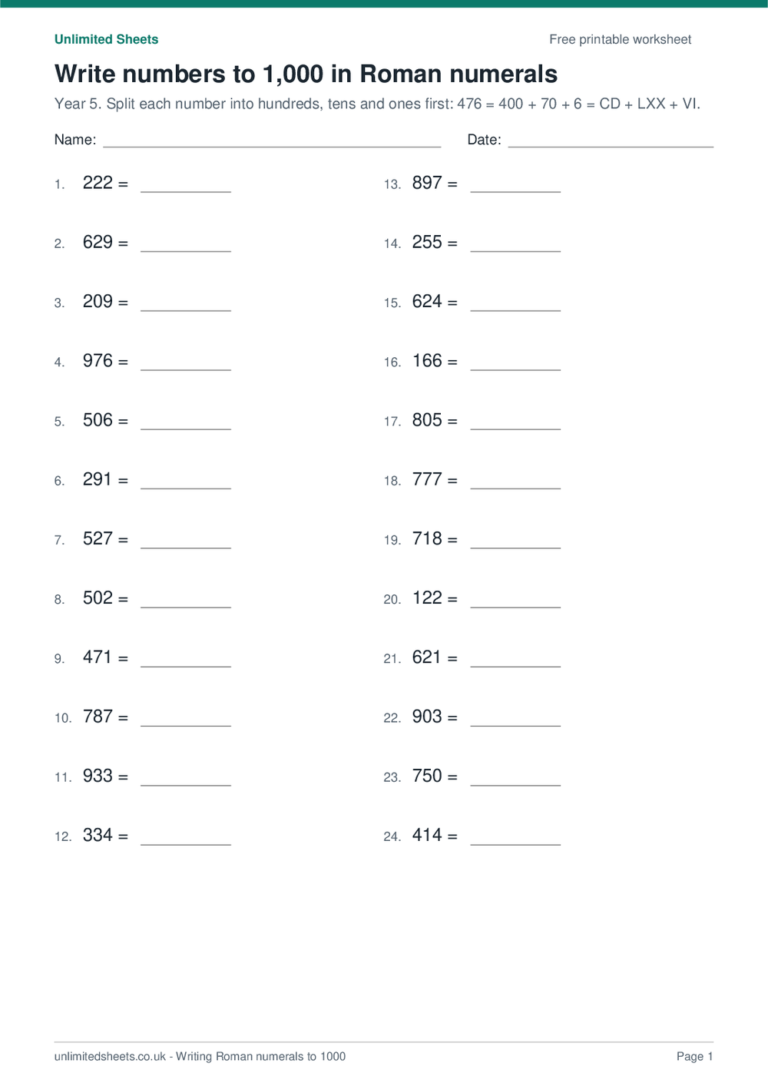
- Write numbers to 1,000 in Roman numerals (Year 5). Twenty-four numbers between 100 and 1,000 to write as Roman numerals, with a hint showing how to split a number up.
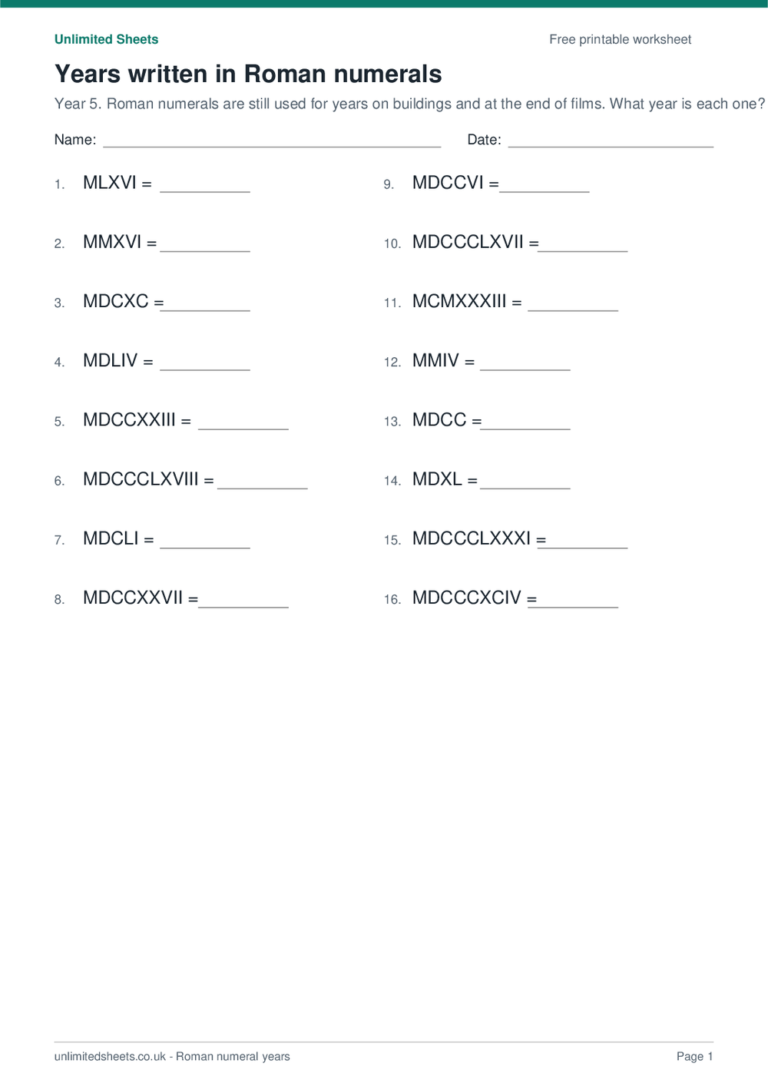
- Years in Roman numerals (Year 5). Sixteen years written in Roman numerals, starting with 1066, for the Year 5 objective of recognising years in Roman numerals.
Roman numerals questions
What is 4 in Roman numerals?
4 is IV: one before five, so 5 − 1. Some clock faces show IIII instead, but IV is the standard form taught in school.
How do you write 2026 in Roman numerals?
2026 = 2,000 + 20 + 6 = MM + XX + VI, so it is MMXXVI.
What is the biggest number in Roman numerals?
With the seven standard letters the largest number is 3,999, written MMMCMXCIX. The Romans used other marks for bigger numbers, but these are not taught in primary school.
Is there a Roman numeral for zero?
No. The Roman system had no zero and no place value, which is one reason the number system we use today replaced it.
Keep practising
Updated 22 November 2026.