Column subtraction is the written method for taking one number away from another, one place value column at a time. Start with the ones. If the top digit is smaller than the bottom digit, exchange one from the next column to the left. For example, 724 − 358 = 366: 4 − 8 cannot be done, so exchange a ten to make 14 − 8 = 6; then 11 − 5 = 6 after exchanging a hundred; then 6 − 3 = 3.
The practice below starts with Year 2 questions that need no exchanging and builds up to Year 5 numbers over 10,000, including the tricky case of exchanging across zeros. The answers are never negative.
How exchanging works
In 724 − 358 there are only 4 ones, not enough to take away 8. So one of the 2 tens is exchanged for 10 ones: the tens digit becomes 1 and the ones become 14. Nothing has been added or lost, 724 is still 7 hundreds, 1 ten and 14 ones. Most schools show this by crossing out the 2 and writing a small 1 above it, with a small 1 in front of the 4.
- Ones: exchange 1 ten. 14 − 8 = 6.
- Tens: now only 1 ten is left, not enough for 5. Exchange 1 hundred: 11 − 5 = 6.
- Hundreds: 6 are left. 6 − 3 = 3.
- Answer: 366. Check by adding: 366 + 358 = 724.
Subtracting from a number with zeros
Questions such as 4,003 − 1,257 cause more mistakes than any other. There are no tens and no hundreds to exchange from, so you have to go all the way to the thousands.
- Exchange 1 thousand for 10 hundreds: 4 thousands become 3, and 0 hundreds become 10.
- Exchange 1 of those hundreds for 10 tens: the hundreds become 9 and the tens become 10.
- Exchange 1 ten for 10 ones: the tens become 9 and the ones become 13.
- Now subtract every column: 13 − 7 = 6, 9 − 5 = 4, 9 − 2 = 7, 3 − 1 = 2. Answer: 2,746.
A shortcut many children like: every 0 between the digit you exchange from and the ones becomes a 9. Level 5 in the practice and one of the worksheets focus only on this.
What each year group learns
- Year 2: subtracting with 2-digit numbers, often in columns but usually without exchanging.
- Year 3: numbers with up to 3 digits using the formal written method of columnar subtraction.
- Year 4: numbers with up to 4 digits, using the columnar method where appropriate.
- Year 5: whole numbers with more than 4 digits.
The four most common subtraction mistakes
- Taking the smaller digit from the bigger one, whichever is on top. 52 − 17 gives 45 instead of 35 because 7 − 2 was done. Always ask: is the top digit big enough?
- Exchanging but not reducing the next digit. If a ten moves to the ones, the tens digit must go down by 1.
- Zeros. Writing 10 in a column that started at 0 but then forgetting it became 9 after the next exchange.
- Not checking. Adding the answer to the number taken away should give the top number. One of the worksheets has a check line under every question.
Addition is the inverse of subtraction, so children who are secure with column addition find the check quick.
Printable column subtraction worksheets
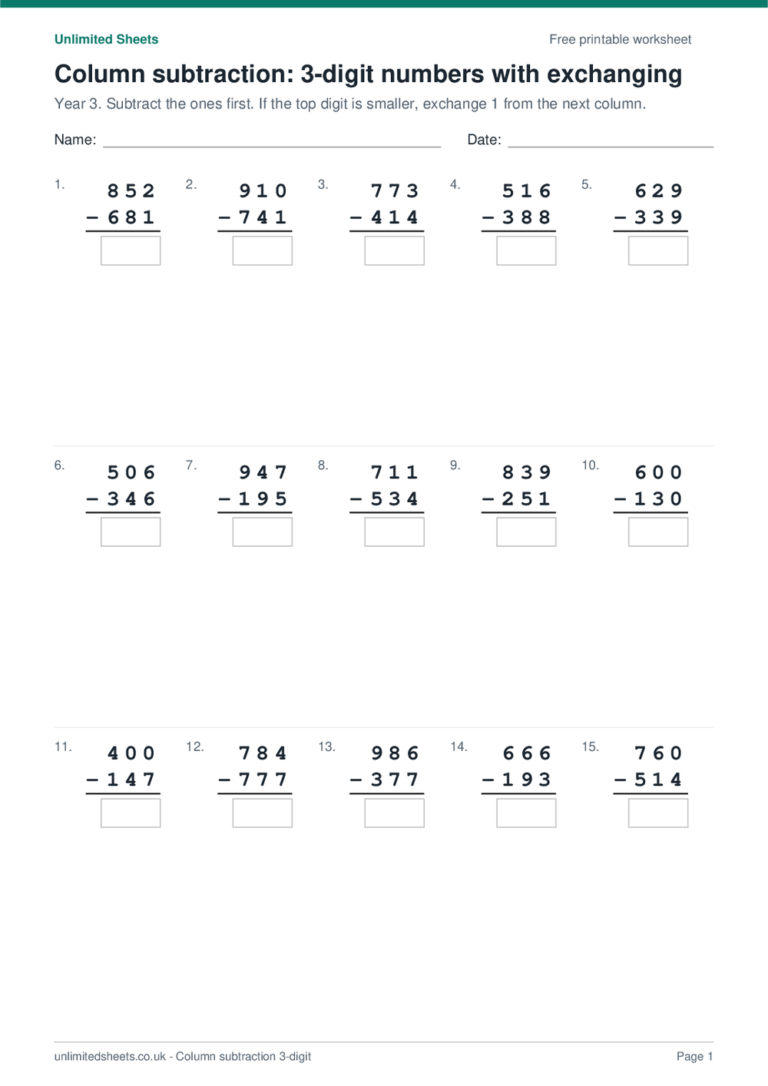
- Column subtraction: 3-digit with exchanging (Year 3). Fifteen three-digit questions. Every one needs at least one exchange and the answer is never negative.
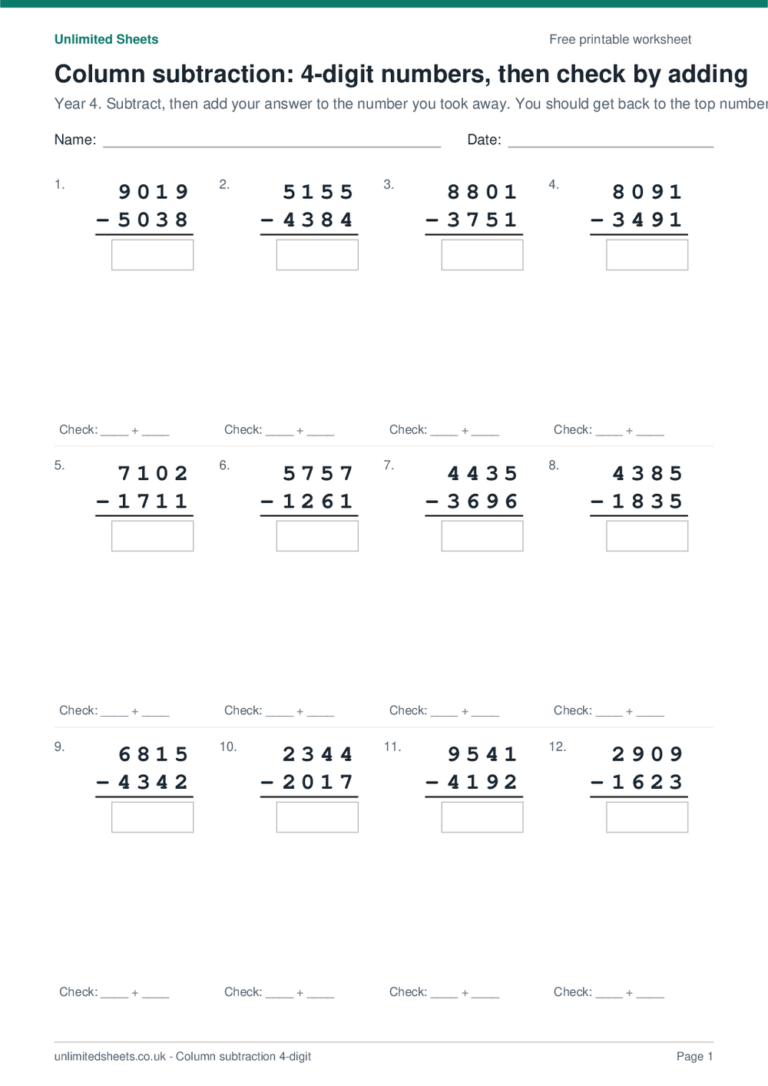
- Column subtraction: 4-digit, check by adding (Year 4). Twelve four-digit subtractions, each with a check line: add the answer to the number taken away to get back to the start.
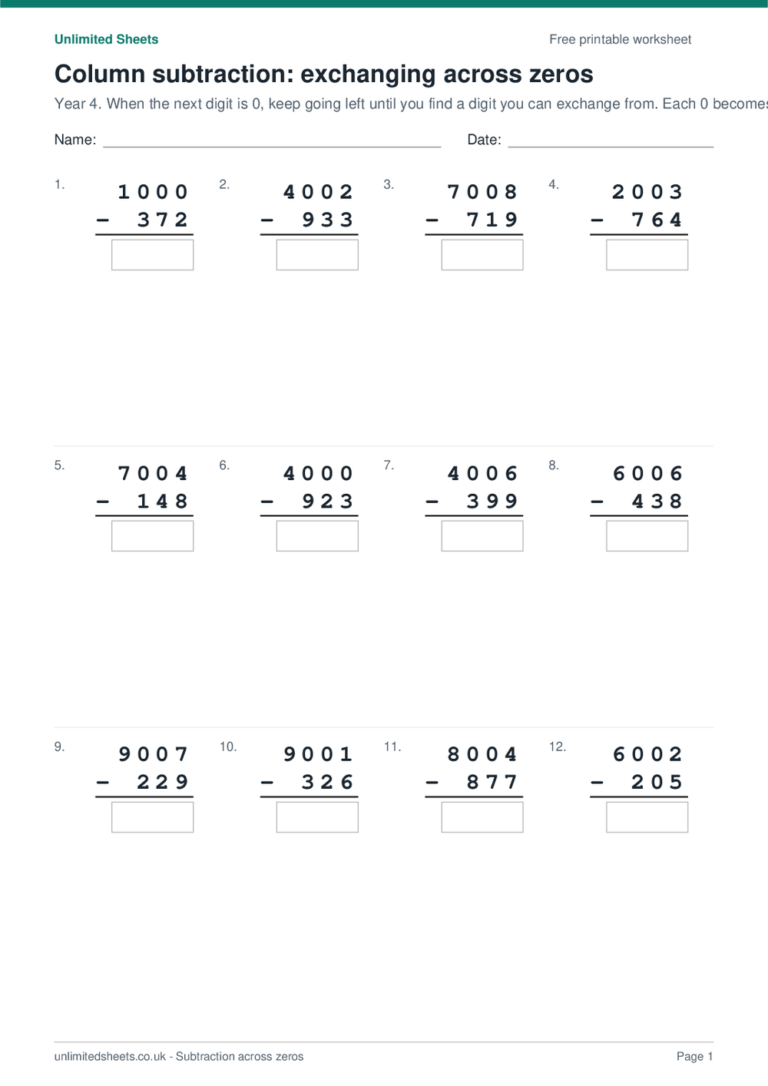
- Subtraction: exchanging across zeros (Year 4). Twelve questions where the top number has zeros in the middle. This is the subtraction children get wrong most often.
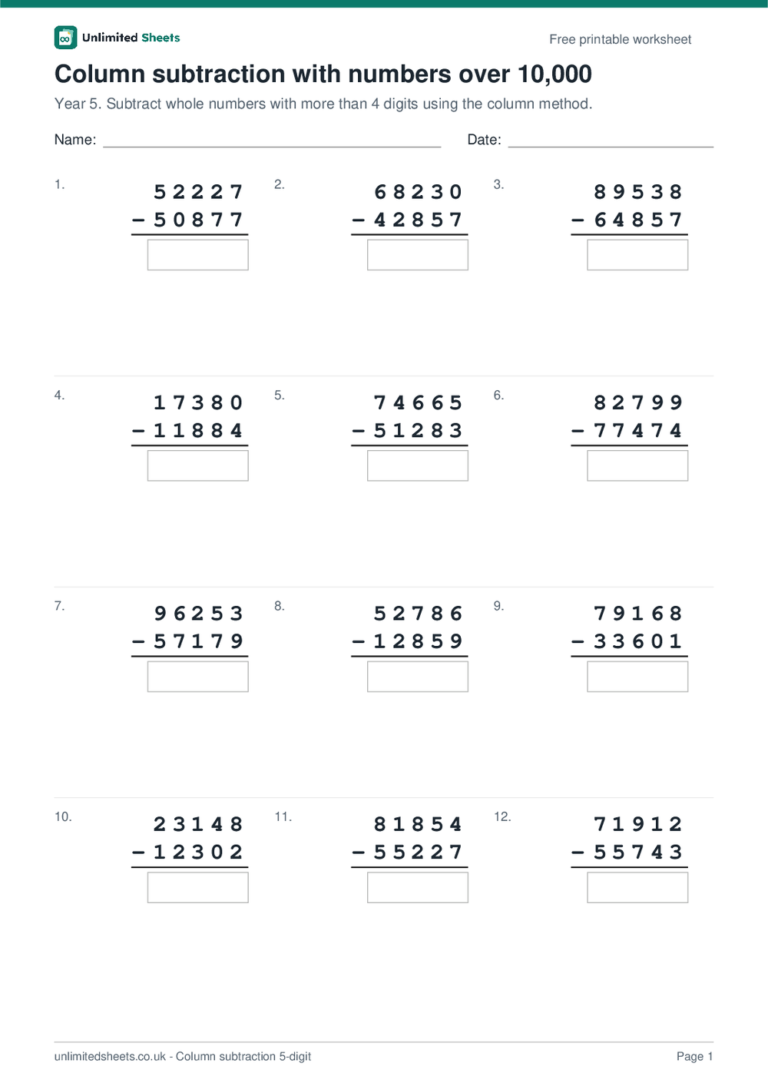
- Column subtraction with 5-digit numbers (Year 5). Twelve five-digit subtractions with exchanging, for the Year 5 objective of subtracting numbers with more than 4 digits.
Column subtraction questions
Is exchanging the same as borrowing?
Yes. Older textbooks say borrowing; schools in England now usually say exchanging, because nothing is given back. One ten is exchanged for ten ones, so the value of the number does not change.
Why does my child get 45 for 52 − 17?
They have taken the smaller digit from the larger one in the ones column (7 − 2) instead of exchanging. Ask them to read each column top to bottom and decide whether the top digit is big enough before subtracting.
How can my child check a subtraction?
Add the answer to the number that was taken away. If 724 − 358 = 366, then 366 + 358 must equal 724. If it does not, look at the columns where an exchange happened.
When is subtracting across zeros taught?
It appears once children subtract 4-digit numbers in Year 4, because numbers such as 2,005 or 6,000 are common there. It needs plenty of practice, so start with one zero before two.
Keep practising
- Column addition
- Times tables
- Long division: uses subtraction at every step
- Long multiplication
Updated 22 November 2026.