BIDMAS is the order for working out a calculation with more than one operation: Brackets, Indices, Division and Multiplication, then Addition and Subtraction. Division and multiplication have equal priority and are worked from left to right, and so are addition and subtraction. So 2 + 1 × 3 = 5, because the multiplication comes first, but (2 + 1) × 3 = 9.
The practice below has four levels with eight new questions each time. When an answer is wrong, Show method lists the steps in the right order.
What each letter in BIDMAS means
| Letter | Stands for | Example |
|---|---|---|
| B | Brackets | (4 + 6) × 3 = 10 × 3 = 30 |
| I | Indices: powers such as squared and cubed | 5 + 3² = 5 + 9 = 14 |
| D and M | Division and multiplication, left to right | 20 ÷ 4 × 2 = 5 × 2 = 10 |
| A and S | Addition and subtraction, left to right | 15 − 6 + 2 = 9 + 2 = 11 |
Some schools say BODMAS, where O stands for orders (another word for indices). It is exactly the same rule.
The left-to-right rule
The most common misunderstanding is thinking that division always comes before multiplication, or addition before subtraction, because of the order of the letters. They do not. 20 ÷ 4 × 2 is 10, not 2.5: work from left to right, 20 ÷ 4 = 5, then 5 × 2 = 10. In the same way, 15 − 6 + 2 = 11, not 7.
Worked examples
- 18 − 3 × 4. Multiply first: 3 × 4 = 12. Then 18 − 12 = 6.
- (18 − 3) × 4. Brackets first: 18 − 3 = 15. Then 15 × 4 = 60.
- 6 × 7 + 24 ÷ 8. Two separate steps of the same priority: 6 × 7 = 42 and 24 ÷ 8 = 3. Then 42 + 3 = 45.
- 3 × (5 + 2 × 4). Inside the brackets the multiplication still comes first: 2 × 4 = 8, then 5 + 8 = 13. Finally 3 × 13 = 39.
Order of operations in Year 6
The National Curriculum for Year 6 says pupils should use their knowledge of the order of operations to carry out calculations involving the four operations. The guidance gives the example used at the top of this page: 2 + 1 × 3 = 5 and (2 + 1) × 3 = 9. Square and cube numbers, written with ² and ³, are introduced in Year 5, which is why our last level includes them.
Mistakes to watch for
- Working strictly left to right from the start: 4 + 5 × 2 becomes 18 instead of 14.
- Always dividing before multiplying (or adding before subtracting) because of the letter order.
- Ignoring the order inside brackets. The rules apply inside the brackets too.
- Treating 3² as 3 × 2. 3² means 3 × 3 = 9.
Calculators that follow the order of operations give the same answers as this page, which is a quick way for a child to check their own work.
Printable BIDMAS worksheets
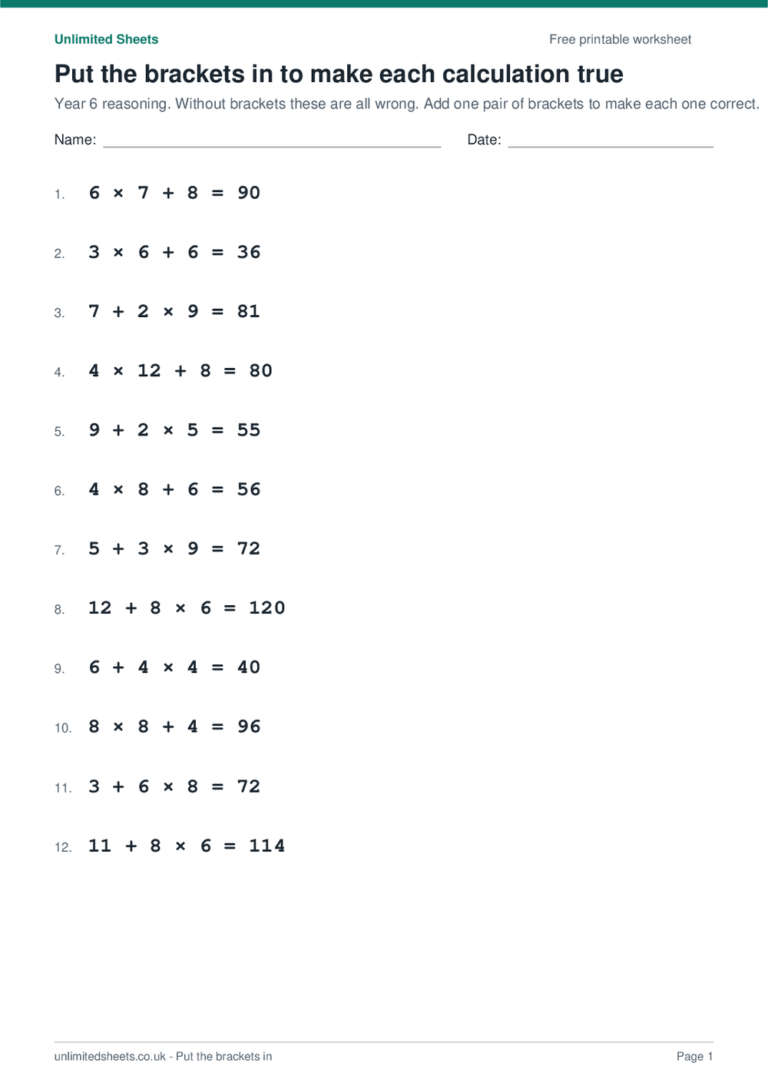
The Put the brackets in sheet asks children to find where brackets must go to make each calculation true. It is a good test of whether the rule is understood rather than memorised.
Order of operations: mixed with squares and cubes
Year 6 · 2 pages: questions + answer key
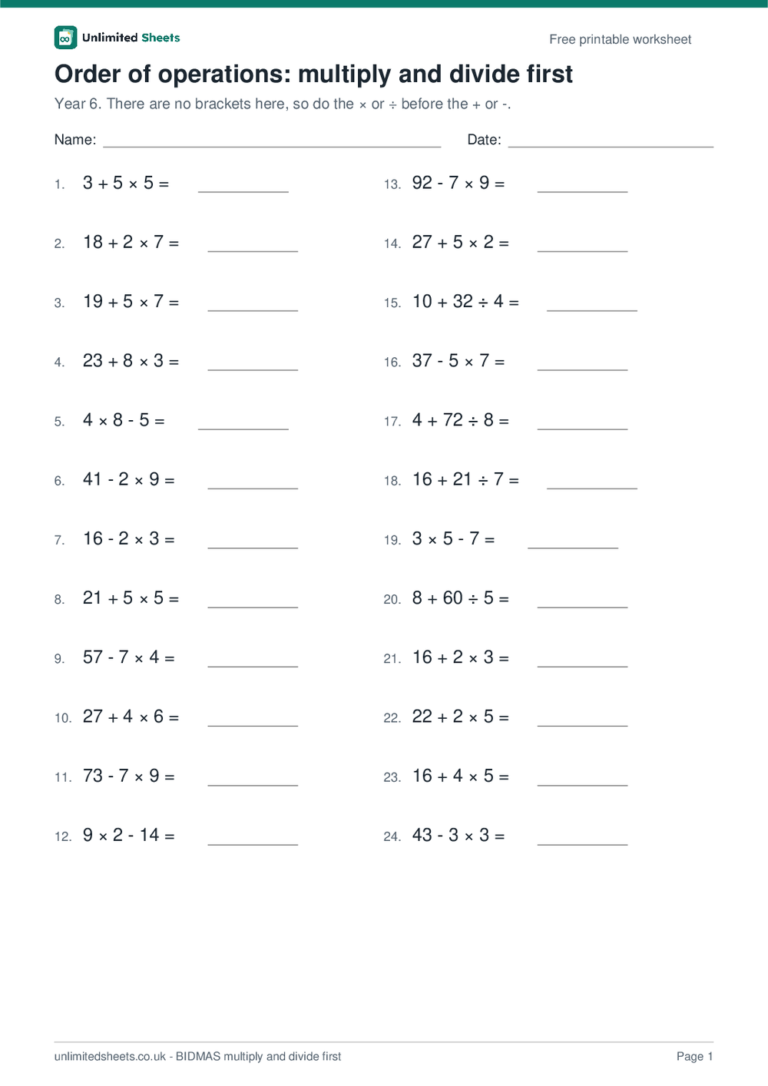
Download PDF- Order of operations: multiply and divide first (Year 6). Twenty-four two-step questions with no brackets, where the multiplication or division must come first.
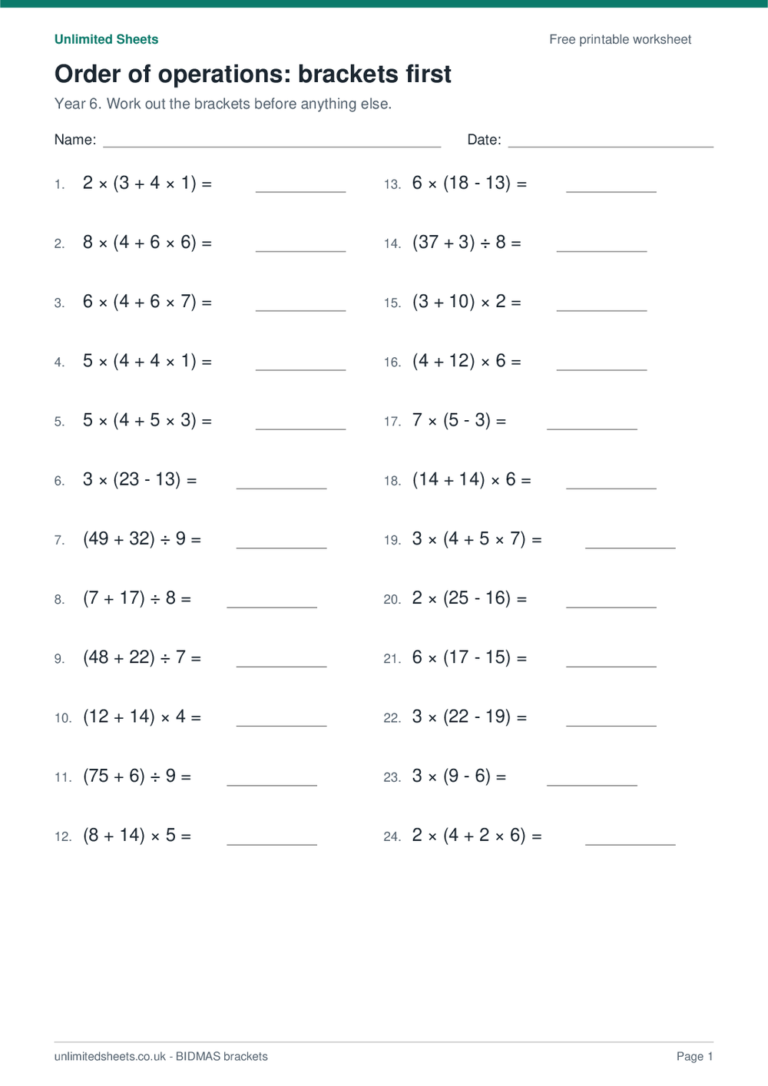
- Order of operations: brackets first (Year 6). Twenty-four questions with brackets, including some where the brackets contain a multiplication as well.
- Put the brackets in (Year 6). Twelve reasoning questions: each calculation is only true if you add brackets in the right place. A favourite for checking real understanding.
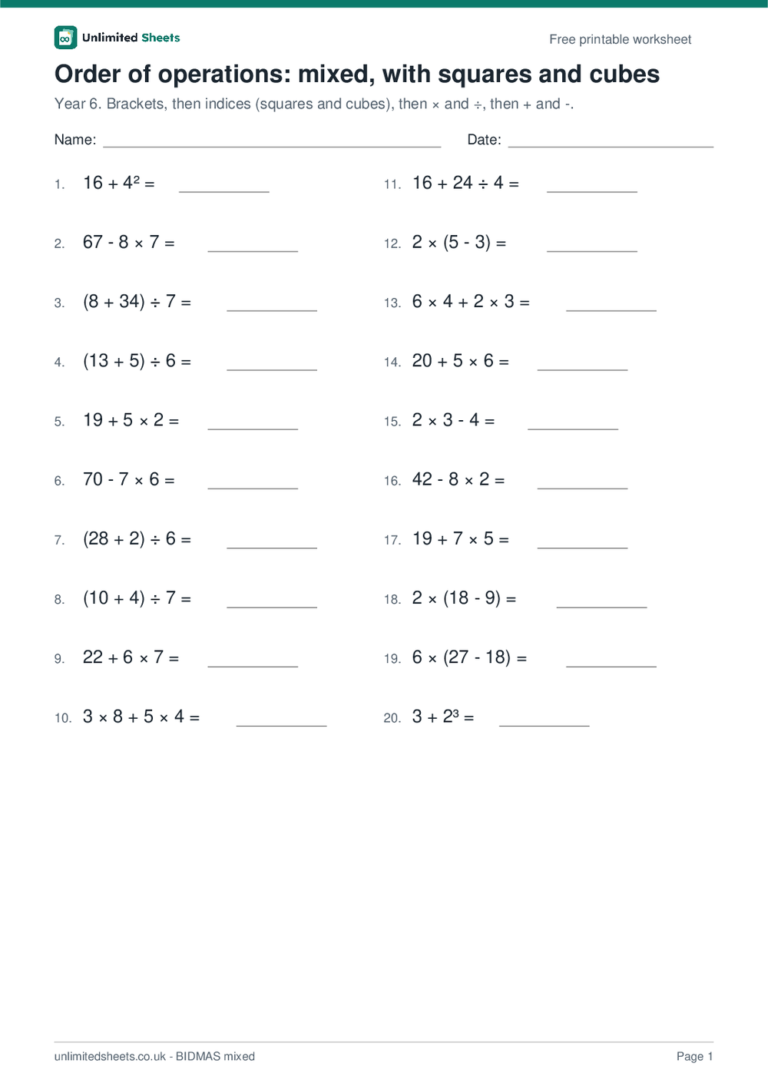
- Order of operations: mixed with squares and cubes (Year 6). Twenty mixed questions that use every part of BIDMAS, including squared and cubed numbers.
BIDMAS questions
Is it BIDMAS or BODMAS?
Both are used in UK schools and they mean the same thing. The I in BIDMAS stands for indices and the O in BODMAS stands for orders; both are powers such as squared and cubed.
Does division come before multiplication?
No. Division and multiplication have the same priority, so you work them from left to right in the order they appear. The same goes for addition and subtraction.
What year is the order of operations taught?
It is in the Year 6 programme of study in England, and it continues in secondary school, where indices and more complex brackets are added.
What is 8 ÷ 2 × 4?
Work from left to right: 8 ÷ 2 = 4, then 4 × 4 = 16. The answer is 16, not 1.
Keep practising
Updated 22 November 2026.