To add or subtract fractions with the same denominator, add or subtract the numerators and keep the denominator. For example, 57 + 17 = 67. If the denominators are different, first rewrite both fractions with a common denominator: 13 + 14 = 412 + 312 = 712.
The practice follows the order taught in school: same denominators in Years 3 and 4, related denominators in Year 5, then any denominators and mixed numbers in Year 6. From Year 5 the answer must be in its simplest form; you can type improper fractions (7/5) or mixed numbers (1 2/5).
Next exercise
Another Year 6 topic: brackets, indices, then multiply and divide before you add.
Same denominator (Years 3 and 4)
When the denominators match, the parts are already the same size, so only the number of parts changes. 57 + 17 = 67 is the example in the Year 3 curriculum. In Year 3 answers stay within one whole; in Year 4 they can go over, so 25 + 45 = 65, which children later write as 115.
Never add the denominators. 12 + 12 is one whole, not 24.
When one denominator is a multiple of the other (Year 5)
In 12 + 16, 6 is a multiple of 2, so only one fraction needs changing. Multiply the top and bottom of 12 by 3 to make 36. Then 36 + 16 = 46, which simplifies to 23.
Different denominators (Year 6)
- Find a common denominator. The lowest common multiple of the denominators is easiest. For 34 and 56, multiples of 4 are 4, 8, 12... and multiples of 6 are 6, 12..., so use 12.
- Rewrite both fractions. 34 = 912 and 56 = 1012.
- Add or subtract the numerators. 912 + 1012 = 1912, and 1012 − 912 = 112.
- Simplify and convert. 1912 = 1712.
Multiplying the two denominators together (4 × 6 = 24) always gives a common denominator too. It works, but the numbers are bigger and the answer usually needs more simplifying.
Adding and subtracting mixed numbers
There are two good methods. For 234 + 123:
- Wholes and parts separately: 2 + 1 = 3, and 34 + 23 = 912 + 812 = 1712 = 1512. Total: 4512.
- Improper fractions: 234 = 114 and 123 = 53. 3312 + 2012 = 5312 = 4512.
For subtraction, the improper fraction method avoids the tricky case where the second fraction part is bigger than the first.
Common mistakes
- Adding the denominators: 12 + 13 = 25 is wrong; it is 56.
- Changing the denominator but not the numerator when making equivalent fractions.
- Not simplifying: 46 is correct but not finished; the simplest form is 23.
- Losing the whole numbers when working with mixed numbers.
Printable adding and subtracting fractions worksheets
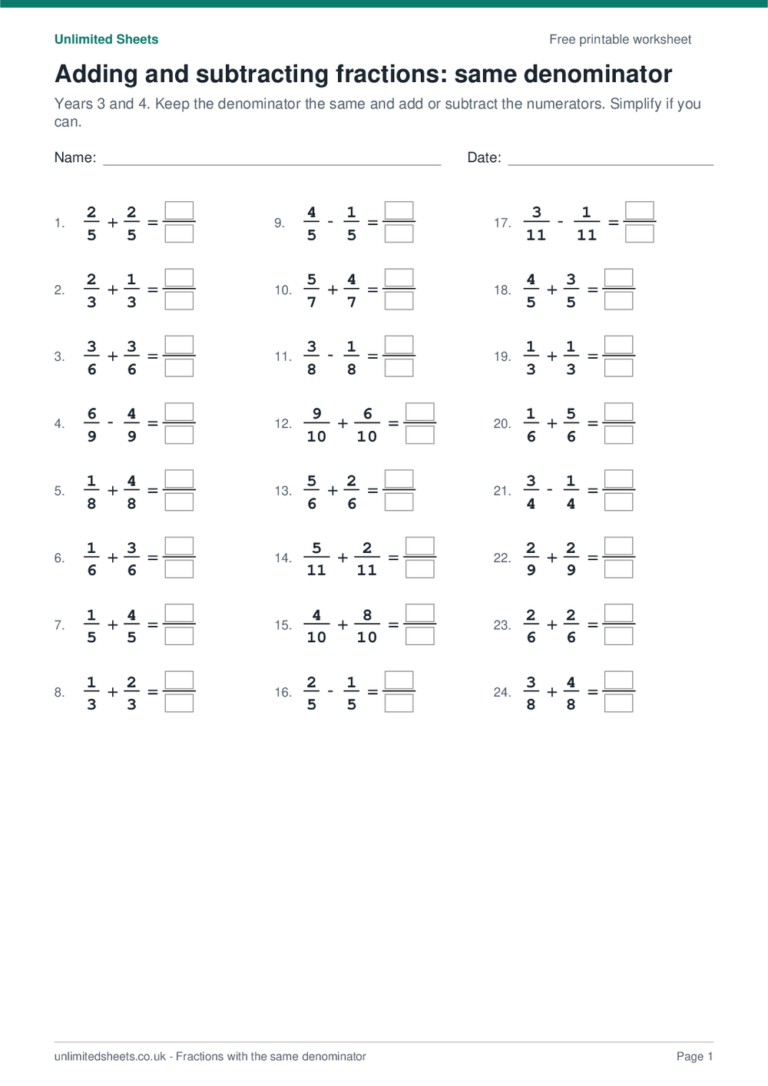
Adding and subtracting fractions: same denominator
Year 3–4 · 2 pages: questions + answer key
Download PDF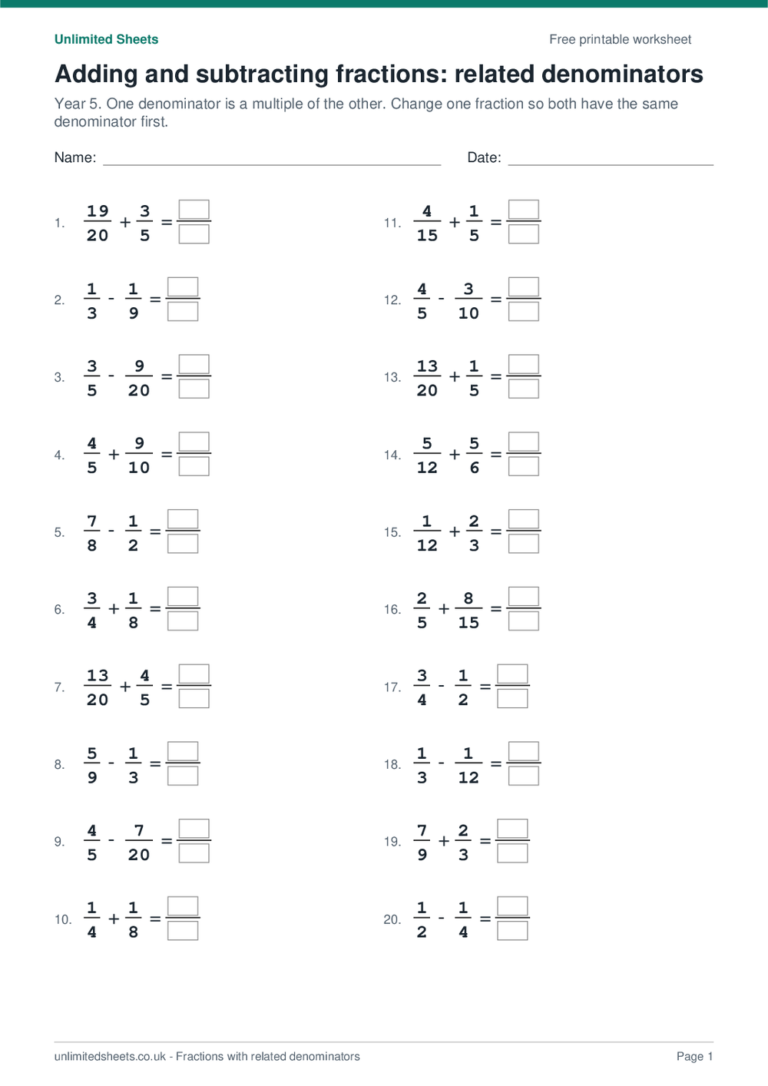
Adding and subtracting fractions: related denominators
Year 5 · 2 pages: questions + answer key
Download PDF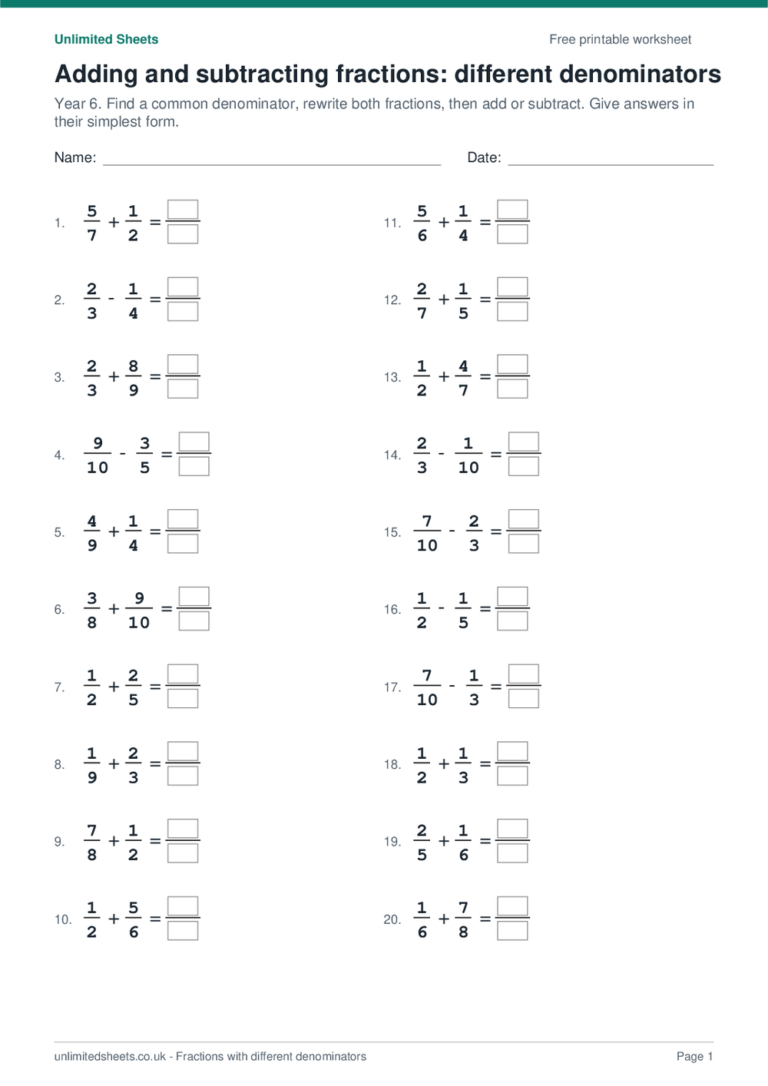
Adding and subtracting fractions: different denominators
Year 6 · 2 pages: questions + answer key
Download PDF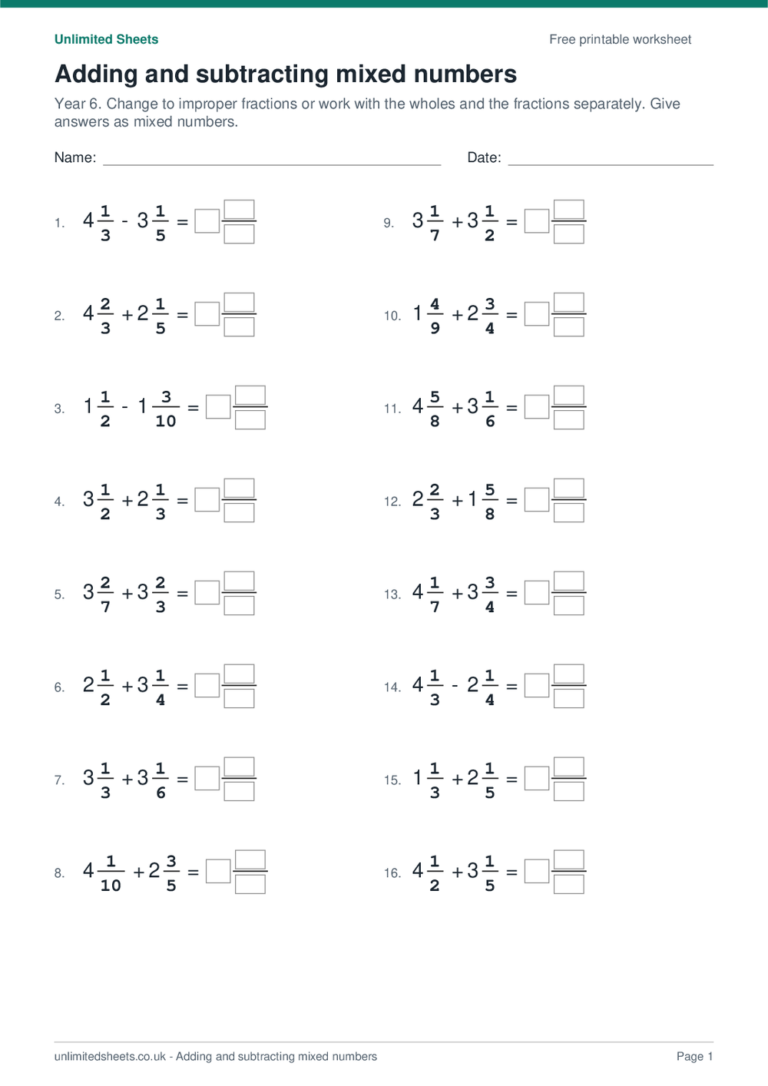
- Adding and subtracting fractions: same denominator (Year 3–4). Twenty-four questions where the denominators match. Answers in the key are simplified, and those over 1 are shown as mixed numbers.
- Adding and subtracting fractions: related denominators (Year 5). Twenty questions with pairs like halves and sixths or thirds and twelfths, for the Year 5 objective on denominators that are multiples of the same number.
- Adding and subtracting fractions: different denominators (Year 6). Twenty questions with unrelated denominators, such as thirds and quarters, where a common denominator has to be found first.
- Adding and subtracting mixed numbers (Year 6). Sixteen questions with mixed numbers and different denominators. Answers are never negative.
Adding and subtracting fractions questions
Do you add the denominators when adding fractions?
No. The denominator tells you the size of the parts, and adding fractions does not change the size of the parts. Only the numerators are added, once the denominators are the same.
How do you find a common denominator?
Look for the lowest number that both denominators divide into, their lowest common multiple. For quarters and sixths that is 12. Multiplying the two denominators together also works but gives bigger numbers.
What year do children add fractions with different denominators?
In Year 6. Year 5 covers denominators where one is a multiple of the other, such as halves and sixths, and Years 3 and 4 cover fractions with the same denominator.
Should the answer be a mixed number or an improper fraction?
Both are correct if they are simplified. Schools often ask for a mixed number when the answer is greater than 1, so check the question.
Keep practising
Updated 22 November 2026.