Long division is a written method for dividing by a number with two or more digits. You work through the number from left to right: divide, multiply, subtract, bring down, and write each digit of the answer above the line. For example, 1115 ÷ 18 = 61 r 17, because 61 × 18 = 1098 and 1115 − 1098 = 17.
Use the step-by-step calculator below to see the full working for any division, or practise five levels of questions that mark themselves. There are five printable worksheets with answer keys further down the page.
Next exercise
Also in Year 6: brackets, indices, then multiply and divide before you add.
How to do long division: divide, multiply, subtract, bring down
Here is 1115 ÷ 18 worked through, the way it is taught in Year 6. The number being divided (1115) is the dividend, the number you divide by (18) is the divisor, and the answer is the quotient.
- Find where to start. 18 does not go into 1 or into 11, so look at the first three digits: 111.
- Divide. How many 18s are in 111? 6 × 18 = 108 and 7 × 18 = 126, which is too big, so the answer is 6. Write 6 above the last 1 of 111.
- Multiply and subtract. Write 108 under 111 and subtract: 111 − 108 = 3.
- Bring down the next digit, 5, to make 35.
- Repeat. 18 goes into 35 once. Write 1 above the 5. 35 − 18 = 17.
- Finish. There are no more digits to bring down, so 17 is the remainder. 1115 ÷ 18 = 61 r 17.
Always check the answer by multiplying back: 61 × 18 + 17 = 1098 + 17 = 1115.
Write the multiples first
Dividing by a two-digit number is much easier with a list of its multiples beside the question: 18, 36, 54, 72, 90, 108, 126, 144, 162. Many schools teach children to jot this list down before they start, and the calculator above shows it for every two-digit divisor.
Long division and short division (the bus stop method)
Both methods use the same “bus stop” layout and give the same answer. The difference is how much is written down.
- Short division is taught in Year 5 for dividing by a one-digit number. Each remainder is written as a small digit in front of the next digit instead of being subtracted underneath. For 752 ÷ 3: 3 goes into 7 twice, remainder 1; the 1 turns the 5 into 15; 3 goes into 15 five times; 3 goes into 2 zero times, remainder 2. Answer: 250 r 2.
- Long division is taught in Year 6 for dividing by a two-digit number. Every multiplication and subtraction is written out, because the numbers are too big to work out in your head.
The National Curriculum also allows Year 6 pupils to use short division by a two-digit number “where appropriate”, for example dividing by 11 or 12 when the times tables are known well.
When a zero goes in the answer
The most common long division mistake is leaving out a zero. If the divisor does not go into the number you have made, write 0 above that digit and bring down the next one.
- 618 ÷ 3: 3 goes into 6 twice. Bring down 1: 3 does not go into 1, so write 0. Bring down 8 to make 18: 3 goes in 6 times. Answer: 206, not 26.
- 3602 ÷ 18: 18 goes into 36 twice, leaving 0. 18 does not go into 0 or into 2, so two zeros go in the answer. Answer: 200 r 2.
Three ways to write the remainder
In Year 6, pupils learn to write a remainder in the way that fits the question. The curriculum guidance gives the example 98 ÷ 4 = 24 r 2 = 24½ = 24.5 ≈ 25.
| Question | Calculation | What to do with the remainder | Answer |
|---|---|---|---|
| 98 sweets shared between 4 children. How many each, and how many left? | 98 ÷ 4 = 24 r 2 | Keep it as a remainder | 24 each, 2 left over |
| 98 cm of string cut into 4 equal pieces. How long is each piece? | 98 ÷ 4 = 24 r 2 | Write it as a fraction or decimal | 24½ cm or 24.5 cm |
| A taxi takes 4 people. How many taxis for 98 people? | 98 ÷ 4 = 24 r 2 | Round up | 25 taxis |
| Books are packed 4 to a box. How many full boxes from 98 books? | 98 ÷ 4 = 24 r 2 | Round down | 24 full boxes |
Long division with decimal answers
Instead of stopping with a remainder, you can keep dividing. Put a decimal point after the dividend and in the answer directly above it, add a zero and bring it down.
For 7 ÷ 4: 4 goes into 7 once, remainder 3. Add a decimal point and a zero: 30 ÷ 4 = 7 remainder 2. Add another zero: 20 ÷ 4 = 5 exactly. So 7 ÷ 4 = 1.75. Year 6 pupils use this for answers with up to two decimal places, which is why money questions work so well.
Some divisions never finish. 2 ÷ 3 gives 0.666… because the remainder 2 keeps coming back. In secondary school this is written as a recurring decimal with a dot over the 6: 0.6̇. The calculator detects recurring digits and marks them in the same way.
Common mistakes and how to fix them
- Digits in the wrong column. Each digit of the answer must sit exactly above the last digit of the number it came from. Squared paper, one digit per square, fixes most layout errors.
- A remainder bigger than the divisor. If you subtract and get a number equal to or bigger than the divisor, the digit you chose was too small. Go back and try one more.
- A subtraction that will not work. If the multiple is bigger than the number above it, the digit you chose was too big. Try one less.
- Forgetting to bring down. Every digit of the dividend must be brought down once. Tick each digit as you use it.
- Weak times tables. Long division is mostly multiplication. Children who know their tables to 12 × 12, the Year 4 target, find it far easier.
What the National Curriculum in England expects
- Year 5: divide numbers up to 4 digits by a one-digit number using the formal written method of short division, and interpret remainders appropriately for the context.
- Year 6: divide numbers up to 4 digits by a two-digit whole number using the formal written method of long division, and interpret remainders as whole number remainders, fractions, or by rounding. Pupils also use written division where the answer has up to 2 decimal places.
Source: Mathematics programmes of study, Department for Education (GOV.UK).
Printable long division worksheets (PDF with answers)
Each A4 worksheet is two pages: the questions on page 1 and the answer key on page 2. The questions and answers are generated by the same code that powers the calculator above, so every answer has been checked.
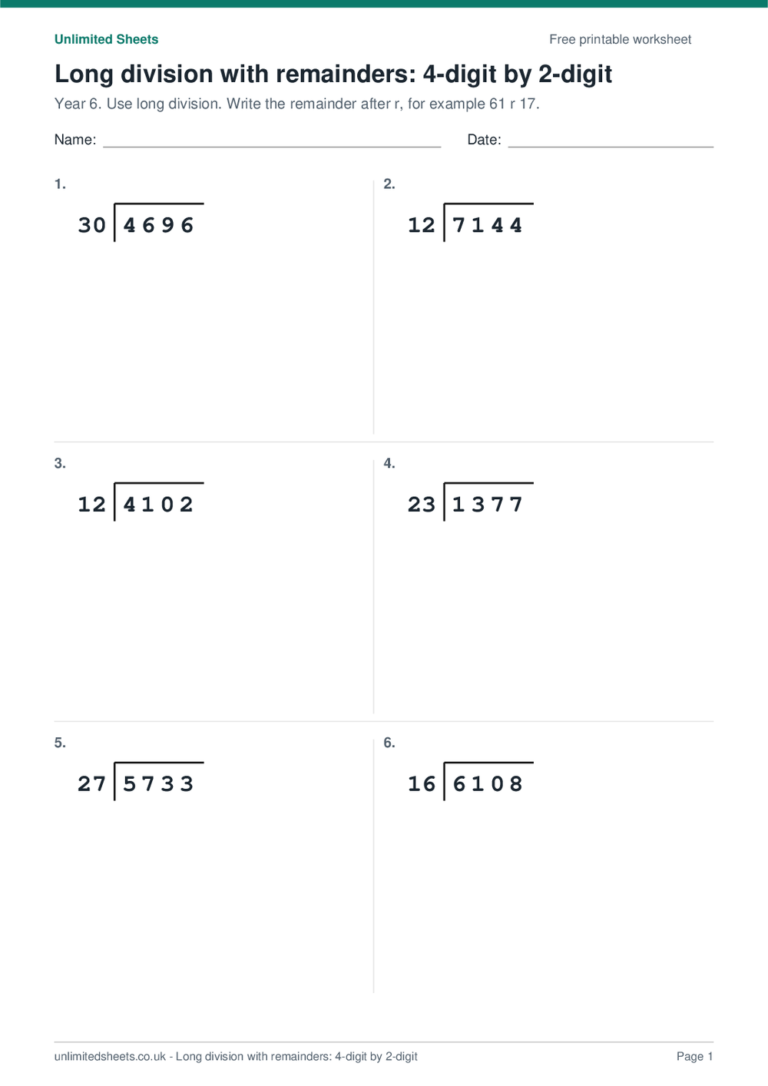
Long division with remainders: 4-digit by 2-digit
Year 6 · 2 pages: questions + answer key
Download PDF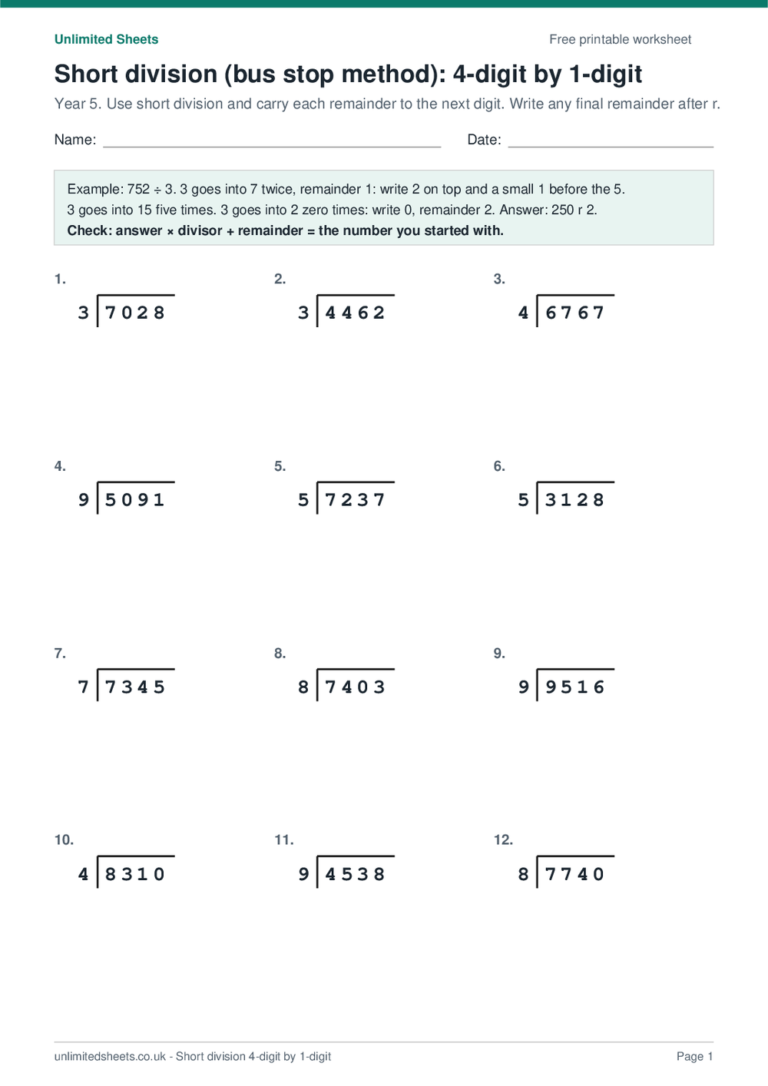
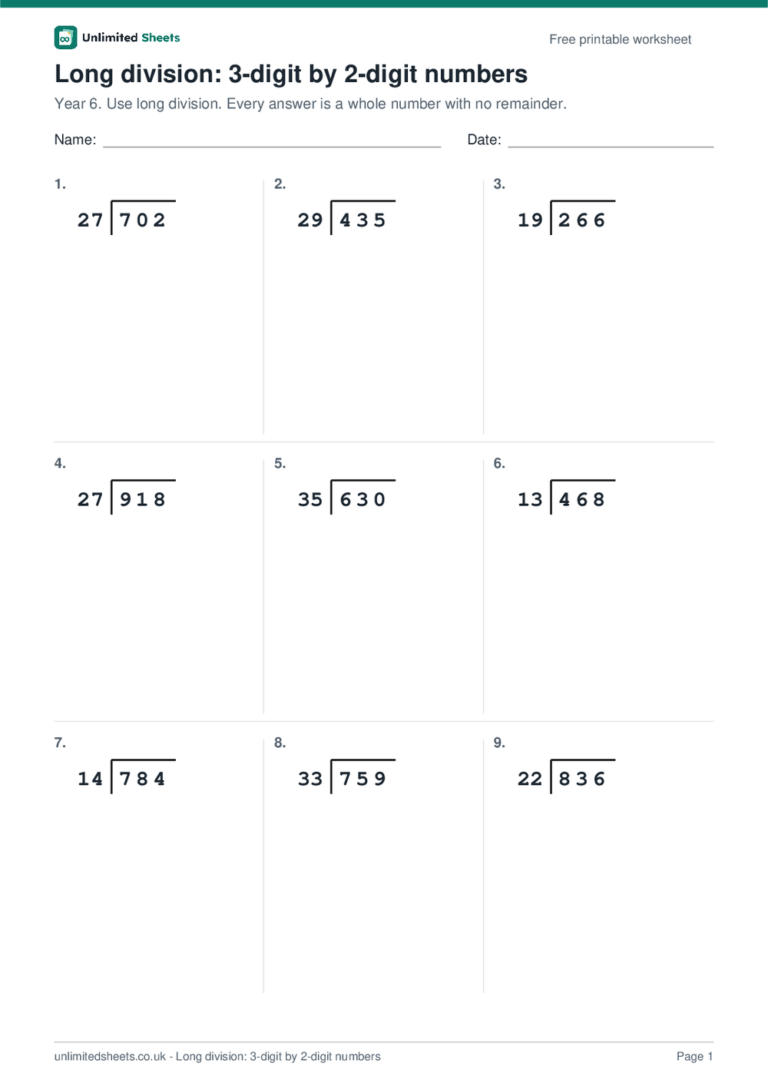
- Long division: 3-digit by 2-digit (Year 6). Nine questions set out in bus-stop frames, such as 702 ÷ 27. Every answer is a whole number, which makes it a good first sheet for long division. The answer key shows each worked layout.
- Long division with remainders: 4-digit by 2-digit (Year 6). Six bigger questions, such as 4696 ÷ 30, with plenty of room for working. Every answer has a remainder written after r. The answer key gives the full working with the remainder marked.
- Short division (bus stop): 4-digit by 1-digit (Year 5). Twelve questions such as 7028 ÷ 3 with a worked example at the top. The answer key is a table with each answer and the multiplication check.
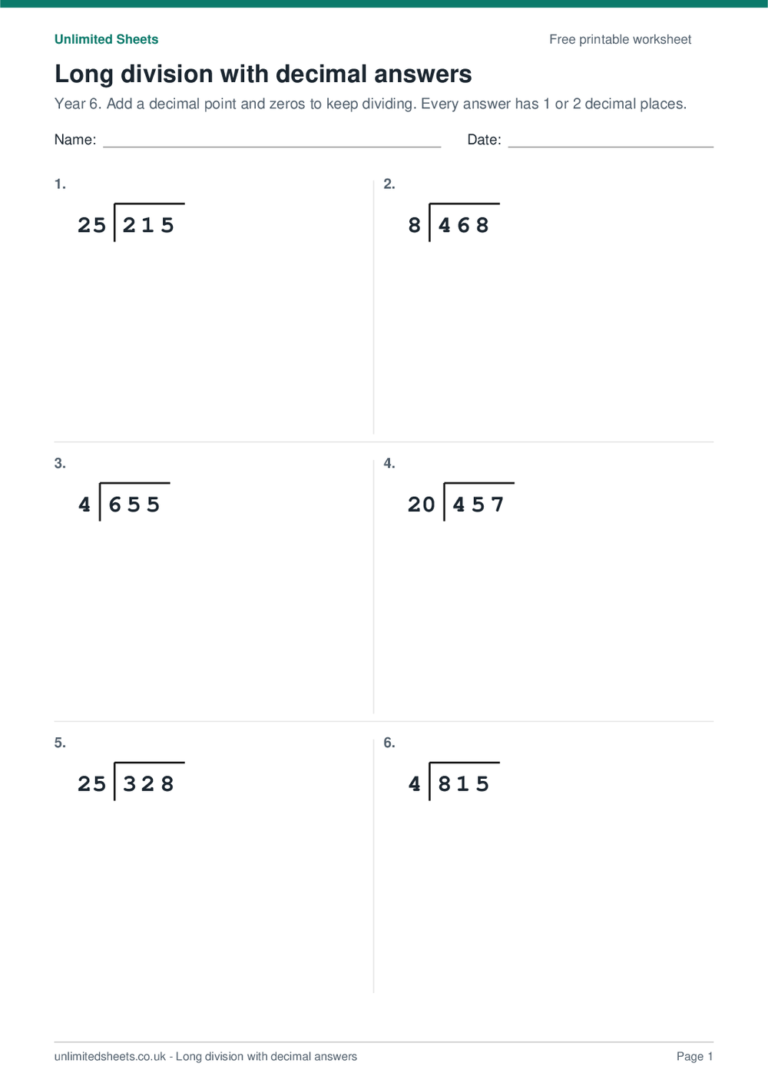
- Long division with decimal answers (Year 6). Six questions such as 655 ÷ 4 where pupils add a decimal point and zeros and keep dividing. Each answer has one or two decimal places, and the key shows where the point goes.
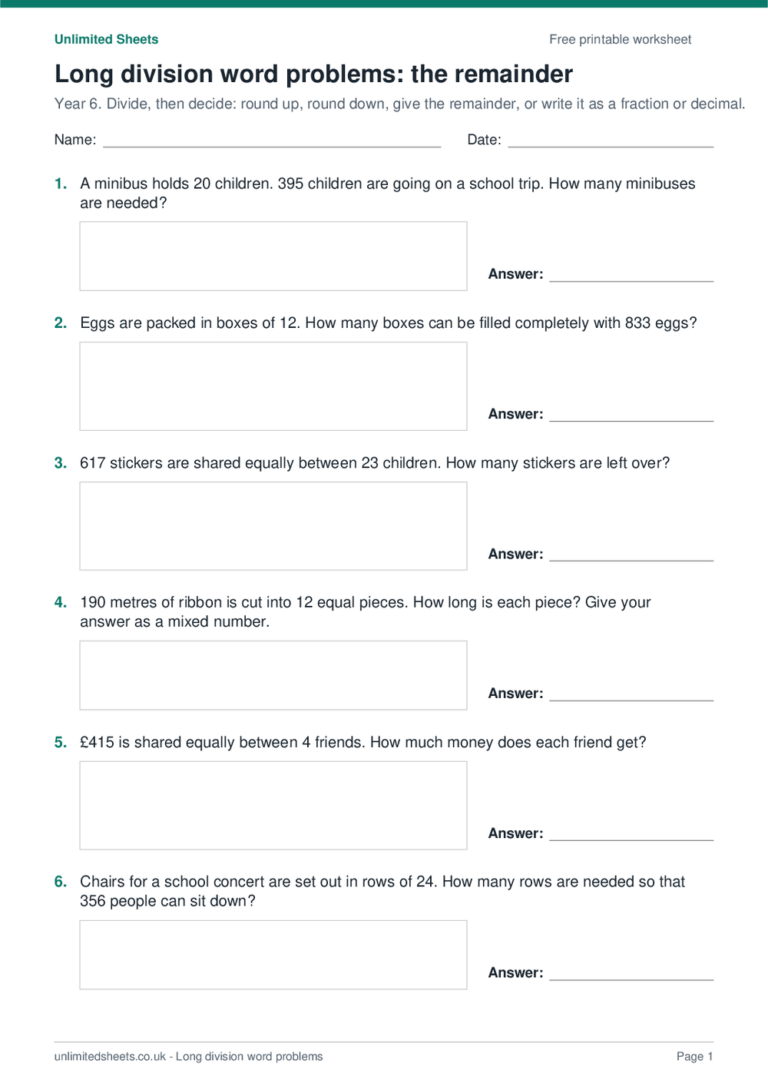
- Word problems: what to do with the remainder (Year 6). Six problems about minibuses, egg boxes, stickers, ribbon, money and rows of chairs. Pupils decide whether to round up, round down, give the remainder or write it as a fraction or decimal.
Long division questions from parents
What year do children learn long division?
Long division by a two-digit number is in the Year 6 programme of study. Children prepare for it in Year 5 with short division by a one-digit number, and they need their times tables to 12 × 12, which are expected by the end of Year 4.
Is long division in the Year 6 SATs?
The Key Stage 2 arithmetic paper usually includes divisions by a two-digit number, and children may use long or short division. Neat formal working makes slips easier to spot and correct, so it is worth practising the layout as well as the answer.
What does r mean in a division answer?
r stands for remainder: the amount left over when a number cannot be divided exactly. 1115 ÷ 18 = 61 r 17 means 18 fits into 1115 sixty-one times, with 17 left over.
Why does my child's school call it the bus stop method?
The line over the dividend and the bracket beside it look like a bus shelter, with the divisor waiting outside. Schools use the name for short division, and often for long division too, because the layout is the same.
Keep practising
- Long multiplication
- Times tables: division facts
- Column subtraction
- BIDMAS
Updated 22 November 2026.