Times tables are the multiplication facts from 1 × 1 to 12 × 12. In England, children learn the 2, 5 and 10 times tables in Year 2, the 3, 4 and 8 times tables in Year 3, and all the tables up to 12 × 12 by the end of Year 4, when they take the multiplication tables check.
The full multiplication table is below. Tap any square to see its fact, or hide the answers and use it as a quiz. Underneath there is self-marking practice for each year group, a tool to practise any tables you choose, and four printable worksheets.
| × | 1 | 2 | 3 | 4 | 5 | 6 | 7 | 8 | 9 | 10 | 11 | 12 |
|---|---|---|---|---|---|---|---|---|---|---|---|---|
| 1 | 1 | 2 | 3 | 4 | 5 | 6 | 7 | 8 | 9 | 10 | 11 | 12 |
| 2 | 2 | 4 | 6 | 8 | 10 | 12 | 14 | 16 | 18 | 20 | 22 | 24 |
| 3 | 3 | 6 | 9 | 12 | 15 | 18 | 21 | 24 | 27 | 30 | 33 | 36 |
| 4 | 4 | 8 | 12 | 16 | 20 | 24 | 28 | 32 | 36 | 40 | 44 | 48 |
| 5 | 5 | 10 | 15 | 20 | 25 | 30 | 35 | 40 | 45 | 50 | 55 | 60 |
| 6 | 6 | 12 | 18 | 24 | 30 | 36 | 42 | 48 | 54 | 60 | 66 | 72 |
| 7 | 7 | 14 | 21 | 28 | 35 | 42 | 49 | 56 | 63 | 70 | 77 | 84 |
| 8 | 8 | 16 | 24 | 32 | 40 | 48 | 56 | 64 | 72 | 80 | 88 | 96 |
| 9 | 9 | 18 | 27 | 36 | 45 | 54 | 63 | 72 | 81 | 90 | 99 | 108 |
| 10 | 10 | 20 | 30 | 40 | 50 | 60 | 70 | 80 | 90 | 100 | 110 | 120 |
| 11 | 11 | 22 | 33 | 44 | 55 | 66 | 77 | 88 | 99 | 110 | 121 | 132 |
| 12 | 12 | 24 | 36 | 48 | 60 | 72 | 84 | 96 | 108 | 120 | 132 | 144 |
Times tables practice that marks itself
Pick a level, type the answers and press Check answers. The 25-question check level is timed, like the Year 4 check, so you can see progress from week to week. To focus on just one or two tables, tick them in the box and press Practise these tables.
Next exercise
Put the tables to work: multiply 2-, 3- and 4-digit numbers step by step.
Which times tables are learned in each year
| Year group | Times tables | What the National Curriculum says |
|---|---|---|
| Year 2 | 2, 5 and 10 | Recall and use multiplication and division facts for the 2, 5 and 10 multiplication tables, including recognising odd and even numbers. |
| Year 3 | 3, 4 and 8 | Recall and use multiplication and division facts for the 3, 4 and 8 multiplication tables. |
| Year 4 | All tables to 12 × 12 (adding 6, 7, 9, 11 and 12) | Recall multiplication and division facts for multiplication tables up to 12 × 12. |
| Years 5 and 6 | All, used in written methods | The tables are used every day in long multiplication, short and long division, fractions and factors. |
The tables are not learned in number order. Each new table builds on one already known: the 4s are double the 2s, the 8s are double the 4s, and the 6s are double the 3s.
The Year 4 multiplication tables check
The multiplication tables check (MTC) is statutory for Year 4 pupils at state-funded schools in England. It is an on-screen check of 25 timed questions on the tables up to 12, taken during a two-week window in June, and schools receive their pupils' results later in June. It checks quick recall rather than working out, so the best preparation is short, frequent practice of the facts a child finds hardest.
The 25-question check level above gives the same number of questions with a stopwatch. Use it once or twice a week; on the other days practise only the tables that were slow or wrong.
Tricks that make each table easier
- ×2, ×4 and ×8: double, double again, double a third time. 7 × 8 is 7 doubled three times: 14, 28, 56.
- ×5: half of ×10. 8 × 5 is half of 80, which is 40.
- ×9: ×10 then take one lot away: 7 × 9 = 70 − 7 = 63. The digits of every answer up to 9 × 9 add up to 9.
- ×11: up to 9 × 11 the digit repeats (6 × 11 = 66). Learn 10 × 11 = 110, 11 × 11 = 121 and 12 × 11 = 132 on their own.
- ×12: ×10 plus ×2. 7 × 12 = 70 + 14 = 84.
- ×6: double the ×3 fact. 6 × 7 = double 21 = 42.
- ×7: the hardest table, but most of it is already known from the others. Only 7 × 7 = 49 is new once the rest are learned.
Turn it round
Every fact works both ways: 3 × 7 = 7 × 3. A child who knows the 3 times table already knows a third of the 7 times table. On the multiplication square, the bottom-left half is a mirror image of the top-right half, which roughly halves the facts to learn.
Common mistakes and how to fix them
- Mixing up neighbouring facts. 6 × 8 = 48 and 7 × 8 = 56 are often confused, as are 7 × 7 = 49 and 6 × 9 = 54. Practise each pair side by side.
- Counting on from the start. Saying the table from 1 × 7 every time is slow. Practise facts out of order, which is what the Missing numbers and custom levels do.
- Knowing multiplication but not division. 56 ÷ 7 needs the same fact as 7 × 8. Long division depends on it, so use the Division facts level too.
Printable times tables worksheets
All four are A4 and print well in black and white. The practice sheets have the answer key on page 2.
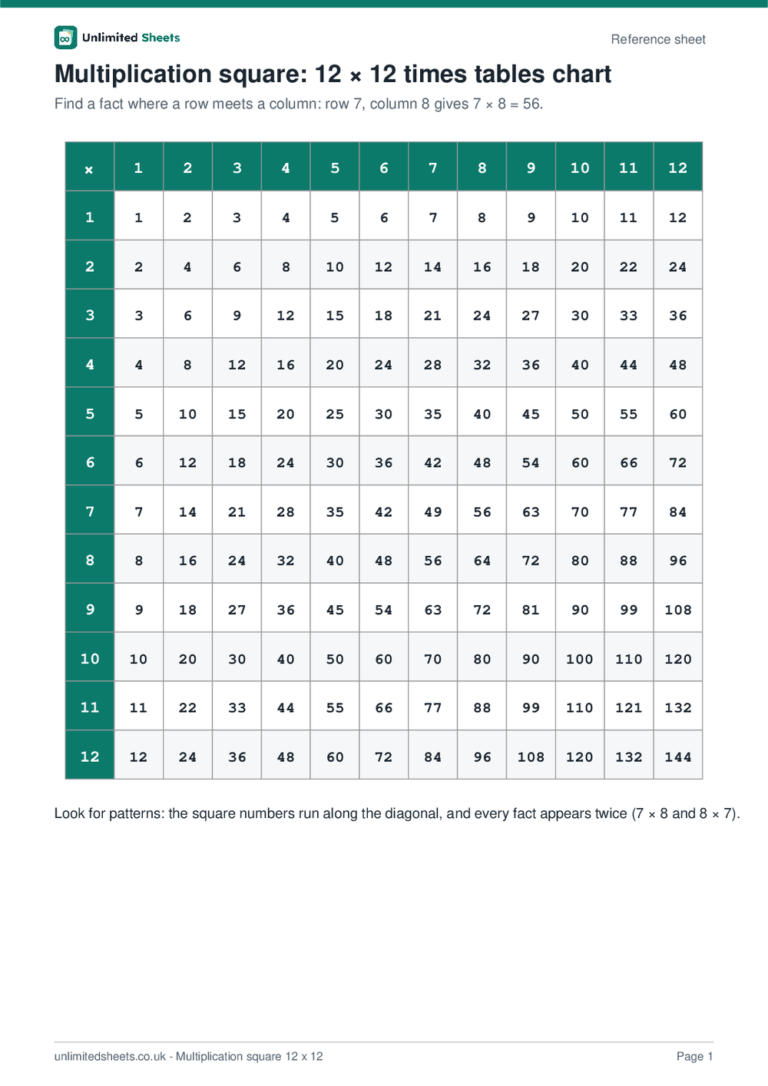
- Multiplication square: 12 × 12 times tables chart (Reference). One page to print and keep: every fact from 1 × 1 to 12 × 12, with the square numbers on the diagonal. No answer key needed.
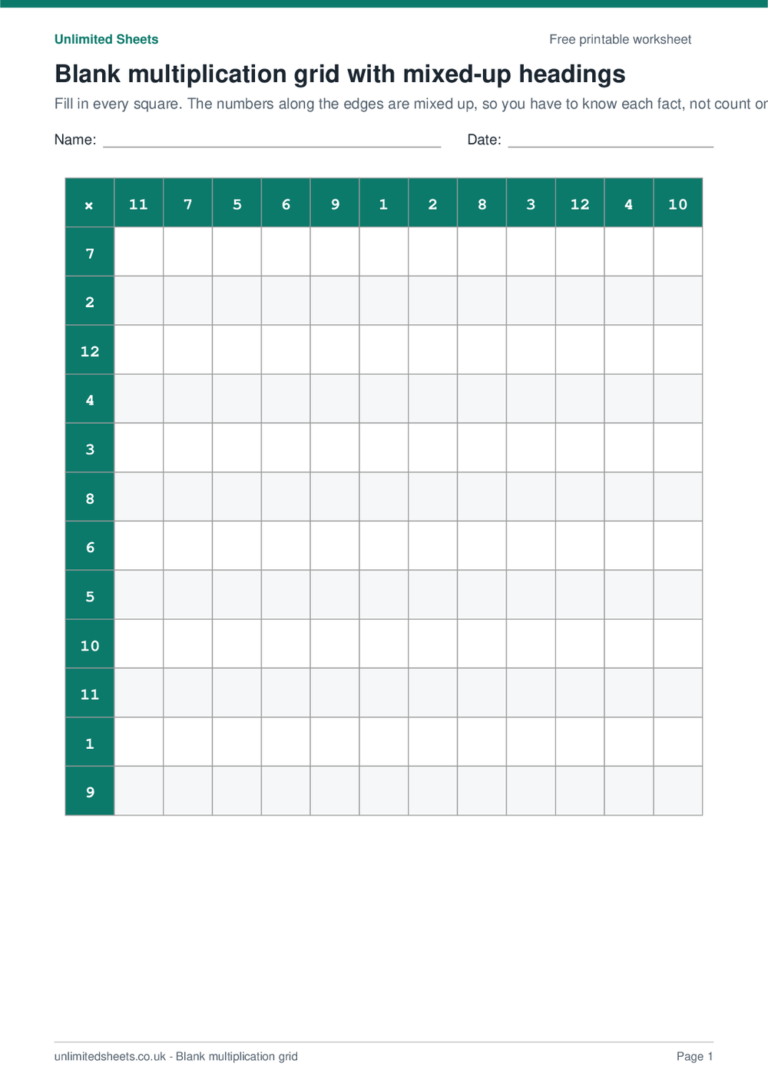
- Blank multiplication grid (mixed order) (Year 4). An empty 12 × 12 grid with the headings shuffled, so children cannot just count on along a row. Page 2 is the completed grid.
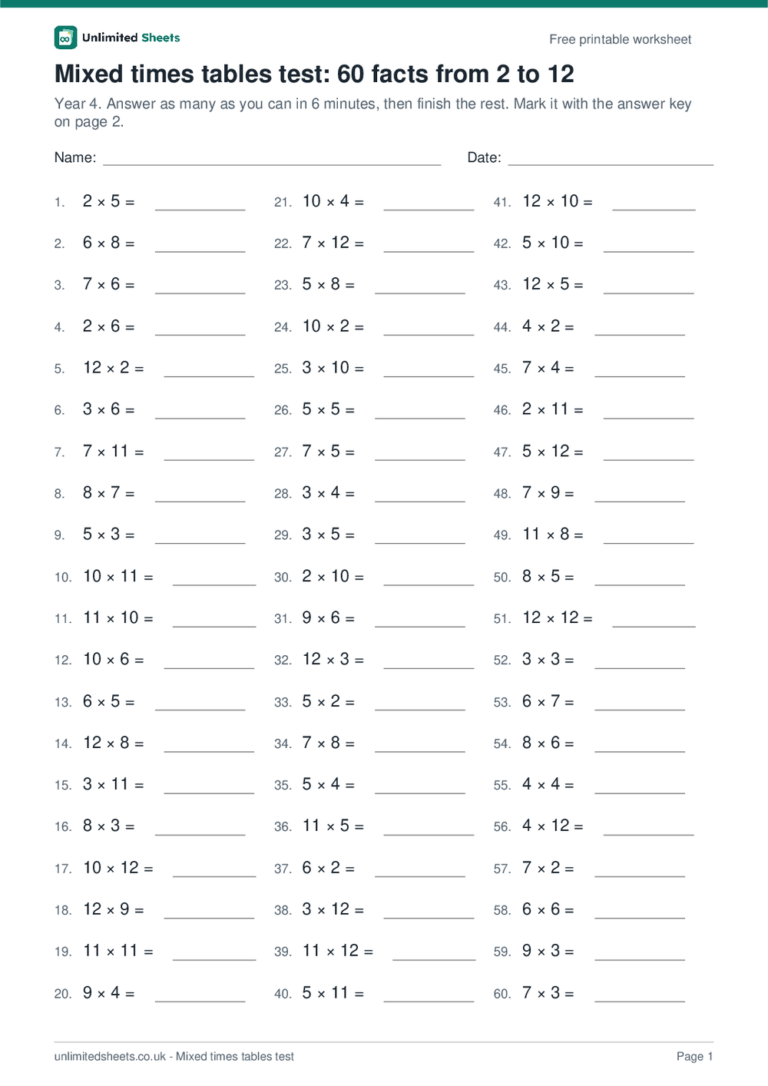
- Mixed times tables test: 60 facts (Year 4). Sixty different facts from the 2 to 12 times tables, never the same one twice, in three columns. Good for timing progress week by week.
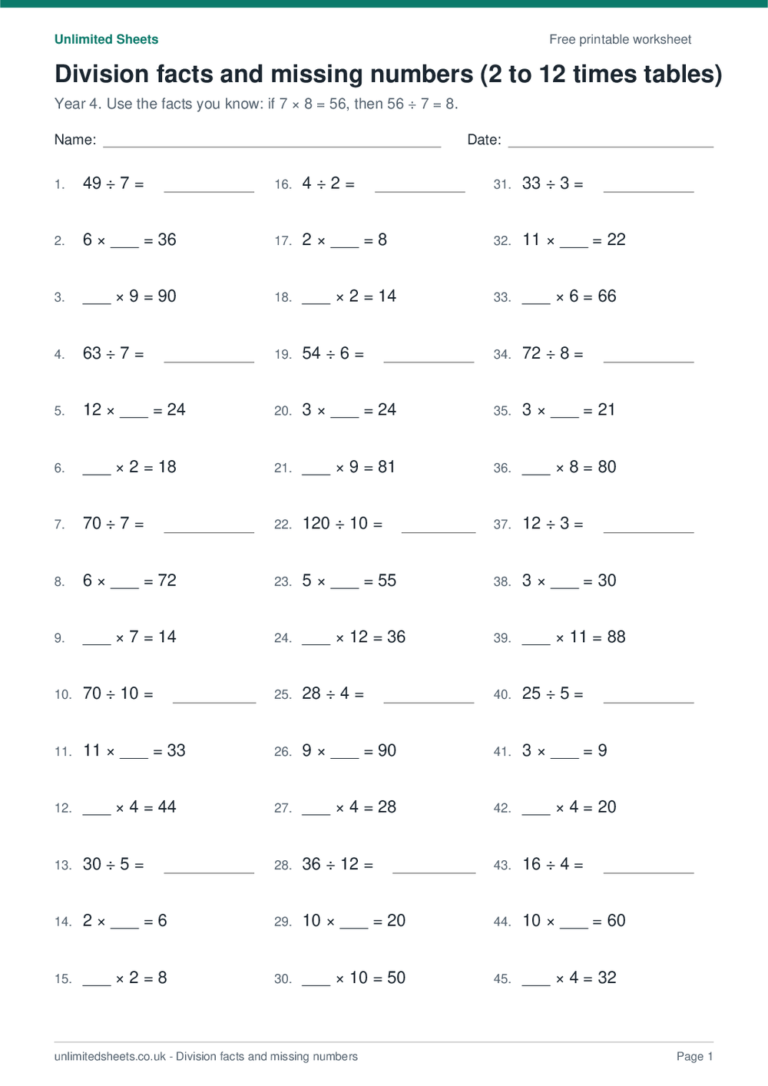
- Division facts and missing numbers (Year 4). Forty-five questions that turn the tables round: division facts and multiplications with a missing number, which is how the facts are used in long division.
Times tables questions from parents
In what order should children learn their times tables?
Follow the order used in school: 2, 5 and 10 first (Year 2), then 3, 4 and 8 (Year 3), then 6, 7, 9, 11 and 12 (Year 4). Each new table can be worked out from one already known, for example the 6s are double the 3s.
When is the multiplication tables check?
It is taken by Year 4 pupils in state-funded schools in England during a two-week window in June. It has 25 timed questions on the tables up to 12, and schools receive the results later in June.
How long should my child practise each day?
Short and often works best: a few minutes a day on the facts that are still slow is more useful than a long session once a week. Re-test the same weak facts the next day.
Which times tables are the hardest?
For most children the 6, 7, 8 and 12 times tables are the slowest, especially 6 × 8, 7 × 8, 6 × 7 and 8 × 12. Use the custom practice to drill only those.
Keep practising
- Long multiplication: Years 3 to 6
- Long division calculator: division facts in action
- Column addition
- BIDMAS order of operations: Year 6
Updated 22 November 2026.