Long multiplication is the written method for multiplying by a number with two or more digits. Multiply by the ones digit, then by the tens digit with a zero as a place holder, and add the two rows. For example, 47 × 36: 47 × 6 = 282, 47 × 30 = 1,410, and 282 + 1,410 = 1,692.
The practice starts with short multiplication by a single digit (Years 3 and 4) and builds to Year 6 questions such as a 4-digit number times a 2-digit number. Open Show method to see both rows of working and how they are added.
Short multiplication: multiplying by one digit
Before long multiplication, children learn the formal written layout for multiplying by a single digit. For 347 × 6:
- Ones: 7 × 6 = 42. Write 2 and carry 4 into the tens.
- Tens: 4 × 6 = 24, plus the 4 carried makes 28. Write 8 and carry 2.
- Hundreds: 3 × 6 = 18, plus 2 makes 20. Write 20.
- Answer: 347 × 6 = 2,082.
The carried digit is added after multiplying, never multiplied itself. That one rule prevents most short multiplication errors.
Long multiplication step by step
Here is 368 × 35, a typical Year 5 question.
- Estimate first: about 400 × 35 = 14,000, so the answer should be a little under that.
- Multiply by the ones digit, 5: 368 × 5 = 1,840. Write this as the first row.
- Multiply by the tens digit, 3, which is really 30. Write a 0 in the ones column first as a place holder, then multiply 368 by 3 = 1,104 to get 11,040 in the second row.
- Add the two rows: 1,840 + 11,040 = 12,880.
- Compare with the estimate: 12,880 is a little under 14,000, so it is sensible.
Why the place-holder zero matters
The 3 in 35 means 3 tens. Multiplying by 3 and forgetting the zero gives 1,104 instead of 11,040, an answer ten times too small. If the final answer is much smaller than the estimate, look for a missing zero.
Multiplication in the National Curriculum
- Year 3: two-digit numbers times one-digit numbers, using mental and progressing to formal written methods.
- Year 4: multiply two-digit and three-digit numbers by a one-digit number using formal written layout.
- Year 5: multiply numbers up to 4 digits by a one- or two-digit number using a formal written method, including long multiplication for two-digit numbers.
- Year 6: long multiplication of numbers with up to 4 digits by a two-digit number, written in the formal layout.
All of it depends on quick recall of the times tables up to 12 × 12, which children are expected to know by the end of Year 4.
Grid method or long multiplication?
Many schools teach the grid method first: 47 × 36 is split into 40 × 30, 40 × 6, 7 × 30 and 7 × 6, and the four parts are added. It shows clearly why multiplication works, but it is slow with bigger numbers. Long multiplication does the same thing in two rows, and it is the method named in the Year 5 and Year 6 curriculum.
Common mistakes
- Forgetting the place-holder zero in the second row.
- Multiplying the carried digit instead of adding it.
- Carries from the first row getting mixed up with the second. Cross out or rub out the first row's carries before starting the second row.
- Errors in the final addition, especially with carries into a new column.
Division is the inverse: check 47 × 36 = 1,692 by working out 1,692 ÷ 36 with our long division calculator.
Printable multiplication worksheets
Four A4 worksheets with answer keys. The long multiplication keys show both rows of working, not just the answer.
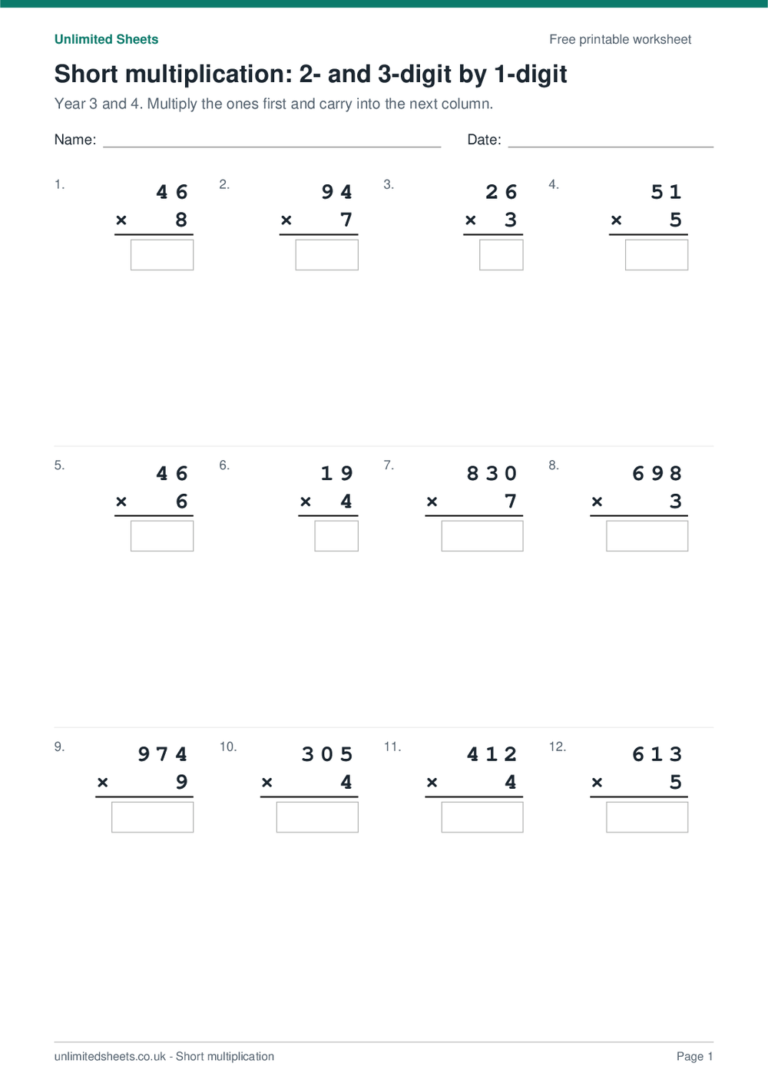
- Short multiplication by a 1-digit number (Year 3–4). Six 2-digit and six 3-digit numbers multiplied by a single digit in the formal written layout.
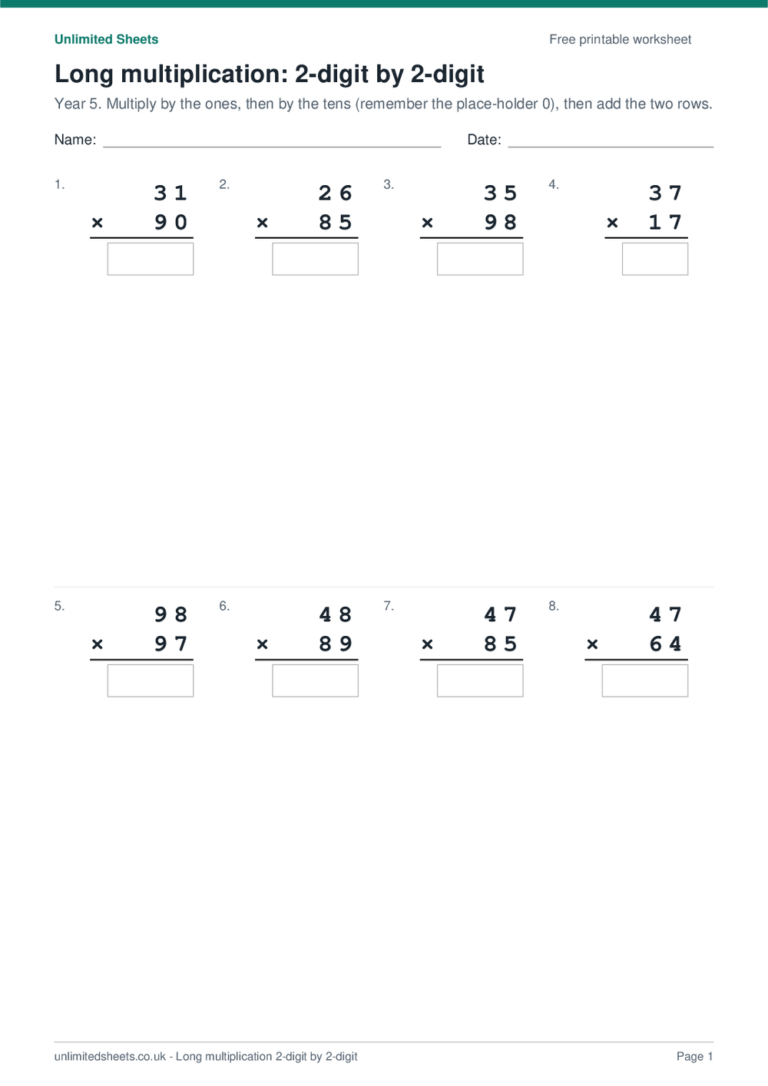
- Long multiplication: 2-digit by 2-digit (Year 5). Eight 2-digit by 2-digit questions, the first step into long multiplication. The answer key shows both rows of working.
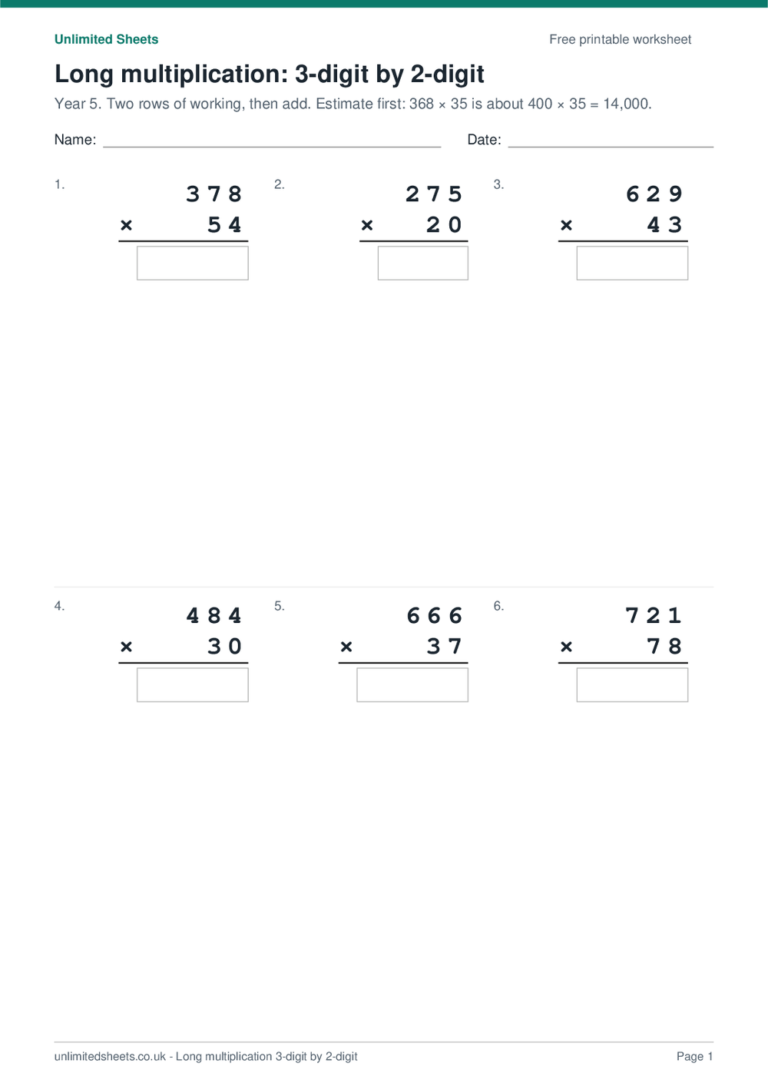
- Long multiplication: 3-digit by 2-digit (Year 5). Six bigger questions with lots of room for working, with an estimating tip at the top.
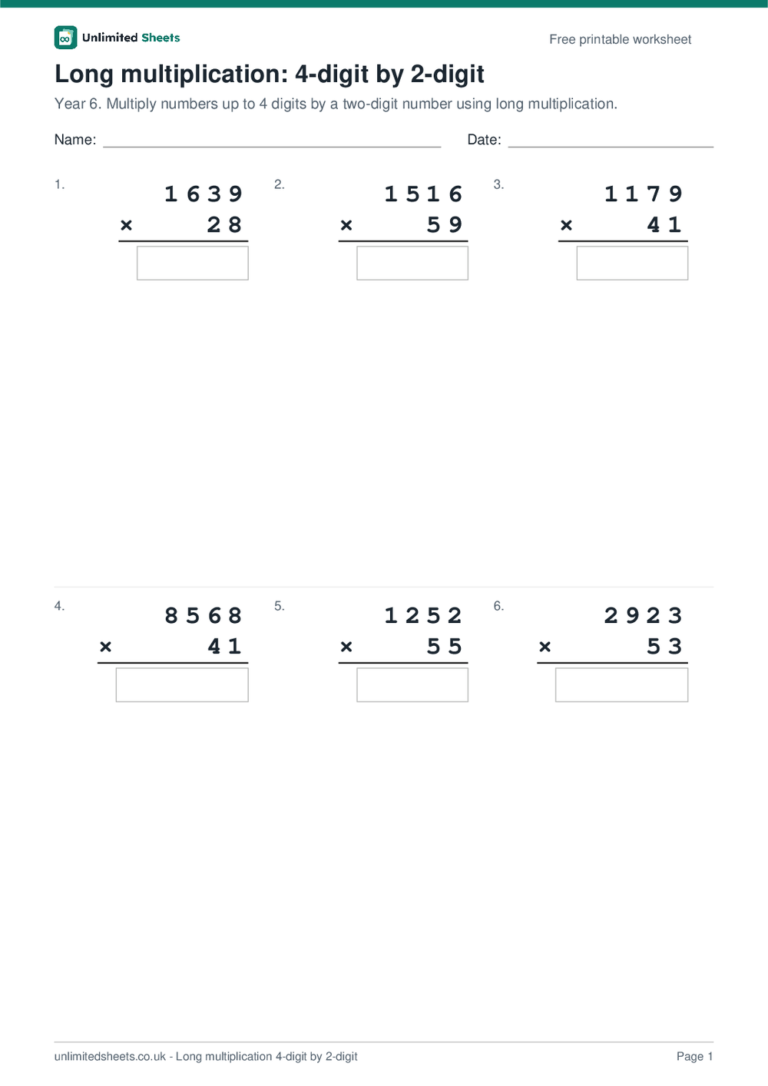
- Long multiplication: 4-digit by 2-digit (Year 6). Six Year 6 questions with answers up to six digits, set out for long multiplication with full working in the key.
Long multiplication questions
What year is long multiplication taught?
Long multiplication by a two-digit number is in the Year 5 programme of study, and Year 6 extends it to numbers with up to 4 digits multiplied by a two-digit number. Short multiplication by one digit comes first, in Years 3 and 4.
Why do you put a zero in the second row?
Because you are multiplying by the tens digit, which is worth ten times its face value. Writing the zero first moves every digit one place to the left, which is the same as multiplying by 10.
What is the difference between short and long multiplication?
Short multiplication multiplies by a single digit and has one row of working. Long multiplication multiplies by a number with two or more digits, so it has one row for each digit plus a final addition.
My child prefers the grid method. Is that wrong?
No. The grid method gives the same answer and shows the place value clearly. It is worth learning long multiplication as well, because it is faster with bigger numbers and is the formal method named for Years 5 and 6.
Keep practising
- Times tables
- Long division calculator
- Column addition: for adding the two rows
- BIDMAS
Updated 22 November 2026.