A fraction describes equal parts of a whole. The bottom number, the denominator, says how many equal parts the whole is split into; the top number, the numerator, says how many of those parts you have. So 34 means 3 of 4 equal parts. Children in England meet halves and quarters in Year 1 and finish primary school able to compare, simplify, add and subtract fractions with different denominators.
The practice below has eight levels, from shading halves and quarters to simplifying fractions in Year 6. Type fractions with a slash, such as 3/4, and mixed numbers with a space, such as 2 1/4.
Next exercise
Use fractions to share numbers: divide by the denominator, multiply by the numerator.
Fractions from Year 1 to Year 6
| Year | What children learn about fractions |
|---|---|
| Year 1 | Find and name a half as 1 of 2 equal parts and a quarter as 1 of 4 equal parts of a shape, object or quantity. |
| Year 2 | Write 13, 14, 24 and 34; know that 24 is the same as 12; find simple fractions such as 12 of 6 = 3. |
| Year 3 | Unit and non-unit fractions with small denominators; tenths; equivalent fractions shown with diagrams; adding and subtracting with the same denominator within one whole; comparing unit fractions and fractions with the same denominator. |
| Year 4 | Families of common equivalent fractions; fractions of quantities; adding and subtracting with the same denominator; decimal equivalents of 14, 12 and 34. |
| Year 5 | Comparing and ordering fractions whose denominators are multiples of the same number; mixed numbers and improper fractions; adding and subtracting with related denominators. |
| Year 6 | Simplifying with common factors; comparing and ordering fractions greater than 1; adding and subtracting with different denominators and mixed numbers; multiplying and dividing simple fractions. |
Based on the National Curriculum mathematics programmes of study (GOV.UK).
Equivalent fractions
Fractions are equivalent when they are the same size, even though the numbers are different: 12 = 24 = 48. Cut a pizza in half, then cut each half in two: you now have 2 quarters instead of 1 half, but the same amount of pizza.
To make an equivalent fraction, multiply (or divide) the numerator and the denominator by the same number. 34: multiply both by 2 to get 68. You can never add the same number to the top and bottom; 12 and 23 are not equivalent.
Comparing and ordering fractions
- Same denominator: compare the numerators. 58 > 38.
- Same numerator: the larger denominator means smaller pieces. 16 < 13, which surprises many children because 6 is bigger than 3.
- Different denominators: rewrite both fractions with a common denominator. To compare 34 and 23, use twelfths: 912 > 812, so 34 is bigger.
Mixed numbers and improper fractions
An improper fraction has a numerator bigger than its denominator, such as 114. It is more than one whole. A mixed number writes the same amount as wholes plus a fraction: 114 = 234, because 11 ÷ 4 = 2 remainder 3. The Year 5 curriculum gives the example 25 + 45 = 65 = 115.
To go back from a mixed number, multiply the whole number by the denominator and add the numerator: 234 = (2 × 4 + 3) quarters = 114.
Simplifying fractions
A fraction is in its simplest form when no number other than 1 divides both the numerator and the denominator. To simplify, divide both by their highest common factor. For 1218, the highest common factor of 12 and 18 is 6, so 1218 = 23. Dividing by a smaller common factor first is fine too; just keep going until nothing else divides both.
Common mistakes with fractions
- Unequal parts. A shape split into 4 pieces of different sizes does not show quarters. The parts must be equal.
- Thinking a bigger denominator means a bigger fraction. 110 is smaller than 12.
- Changing only one number. Multiplying the denominator but not the numerator changes the size of the fraction.
- Stopping too early when simplifying. 1218 = 69 is right but not simplest; divide by 3 again to get 23.
Printable fractions worksheets
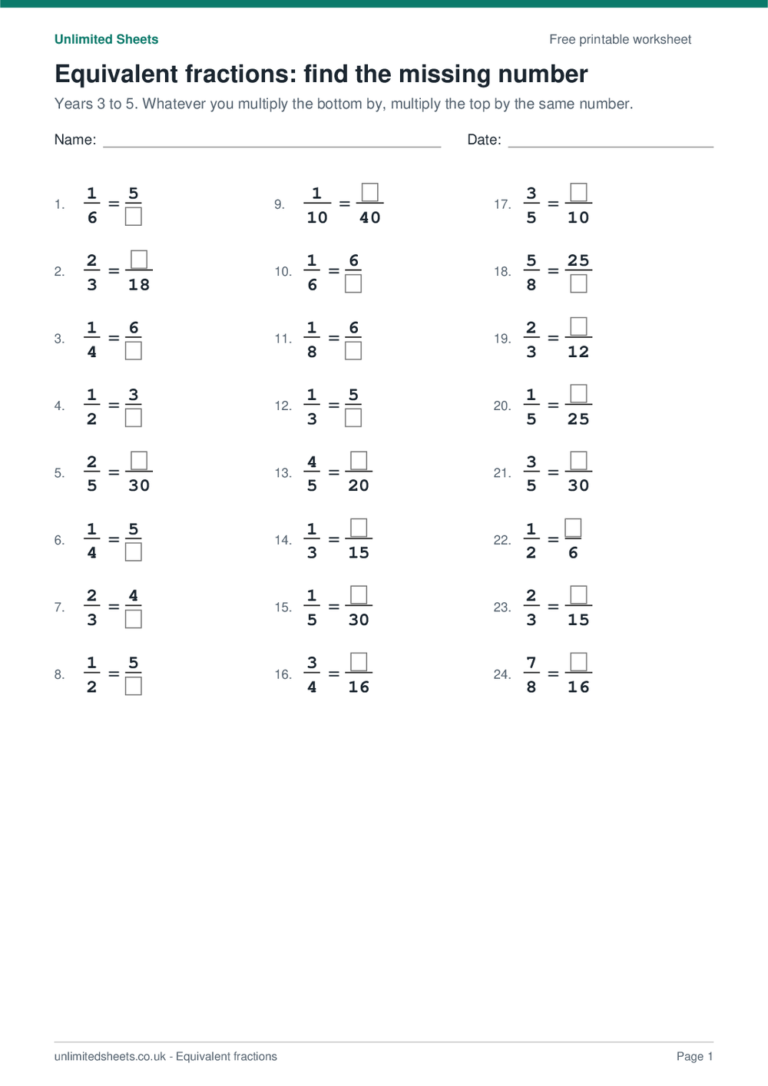
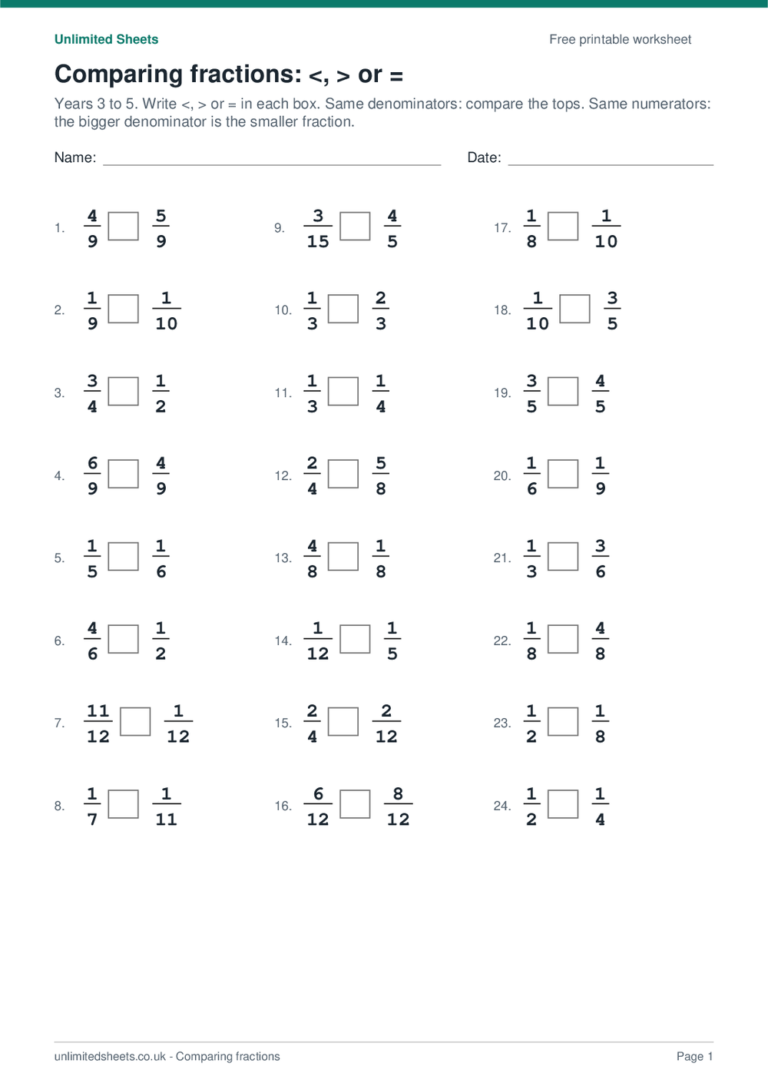
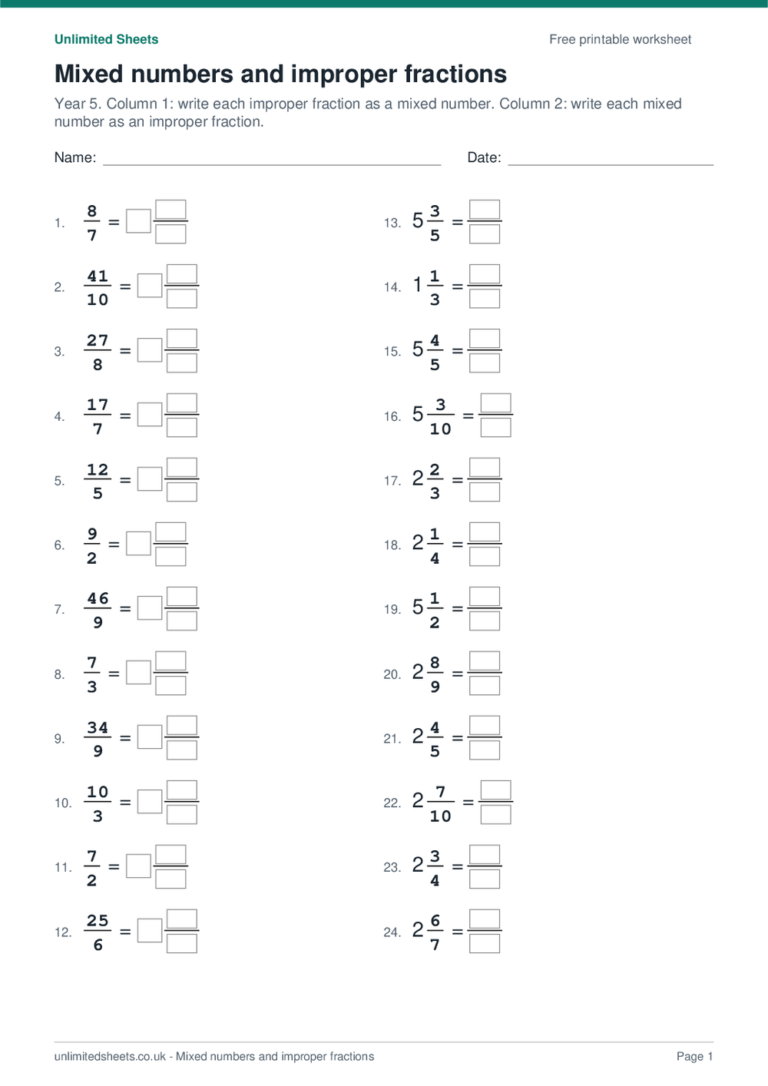
Four A4 worksheets with answer keys. The shape sheet uses bars, circles and rectangles so children learn that a fraction is about equal parts, not about one particular shape.
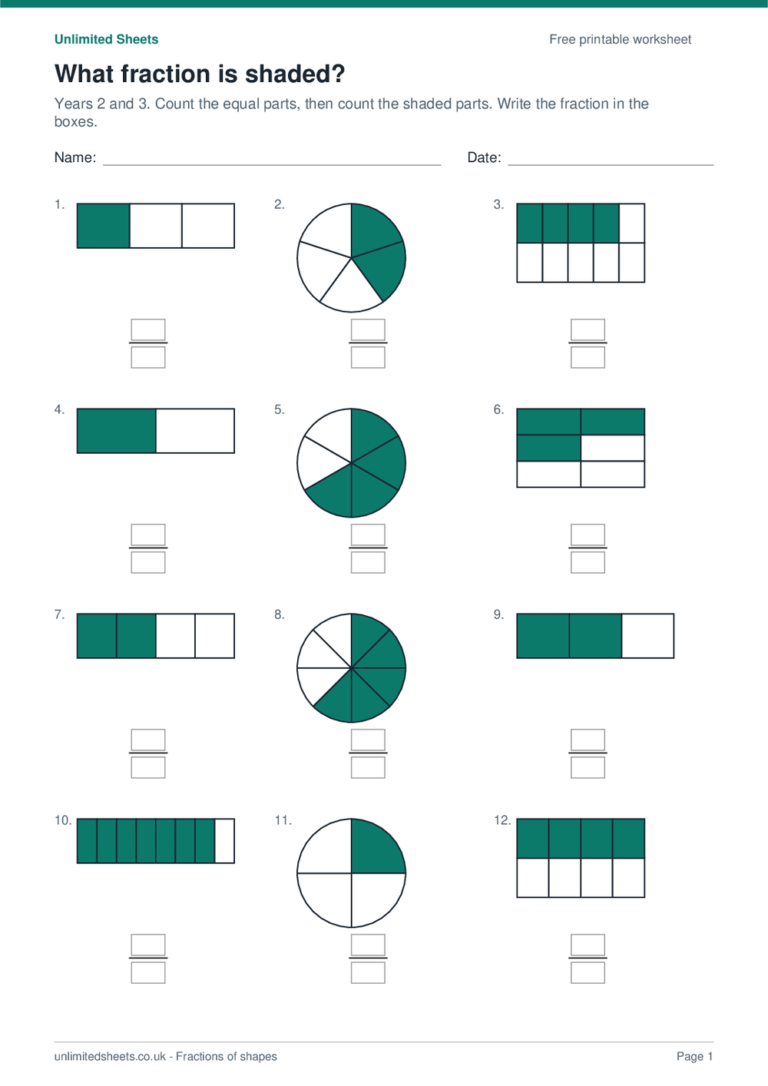
- What fraction is shaded? (Year 2–3). Twelve shapes split into halves, thirds, quarters, fifths, sixths, eighths and tenths. Children count the parts and write the fraction.
- Equivalent fractions (Year 3–5). Twenty-four equivalent fraction pairs with one number missing, using denominators from 2 to 60.
- Comparing fractions (Year 3–5). Twenty-four pairs: same denominators, unit fractions, and related denominators such as thirds and ninths. Some pairs are equal.
- Mixed numbers and improper fractions (Year 5). Twelve improper fractions to write as mixed numbers and twelve mixed numbers to write as improper fractions, with answer boxes laid out for each form.
Fractions questions from parents
What is the difference between the numerator and the denominator?
The denominator (bottom number) tells you how many equal parts the whole is divided into. The numerator (top number) tells you how many of those parts you are talking about.
When do children learn to add fractions?
Adding and subtracting fractions with the same denominator starts in Year 3, within one whole. Year 5 adds denominators that are multiples of the same number, and Year 6 covers any denominators and mixed numbers.
Is a half the same as two quarters?
Yes. 1/2 and 2/4 are equivalent fractions: they are the same amount, written with different numbers. Recognising this is part of the Year 2 curriculum.
How do I know if a fraction is in its simplest form?
Check whether any number other than 1 divides both the numerator and the denominator. If one does, divide both by it and check again.
Keep practising
- Fractions of amounts
- Adding and subtracting fractions
- Times tables: for equivalent fractions
- All maths topics
Updated 22 November 2026.