To tell the time on an analogue clock, read the short hand for the hour and the long hand for the minutes. When the long hand points to 12 it is o’clock, to 6 it is half past, to 3 it is quarter past and to 9 it is quarter to the next hour. Each number on the clock face is 5 minutes for the long hand, so when it points to 4 it is 20 minutes past.
Practise eight levels below, from o’clock and half past in Year 1 to reading the time to the minute, Roman numeral clocks, the 24-hour clock and working out how long something takes.
Next exercise
Many clocks use Roman numerals I to XII: learn to read them, then go up to 1,000.
Telling the time from Year 1 to Year 4
- Year 1: tell the time to the hour and half past the hour, and draw the hands on a clock face; use the days of the week, months and years.
- Year 2: tell and write the time to five minutes, including quarter past and quarter to; know that there are 60 minutes in an hour and 24 hours in a day.
- Year 3: read analogue clocks, including clocks with Roman numerals from I to XII, and 12-hour and 24-hour clocks; read the time to the nearest minute; use am, pm, noon and midnight; know there are 60 seconds in a minute and how many days are in each month and in a leap year.
- Year 4: convert between analogue and digital 12-hour and 24-hour clocks, and solve problems converting hours to minutes, minutes to seconds, years to months and weeks to days.
In Years 5 and 6, time becomes part of measurement problems: converting between units and working out durations. Source: National Curriculum mathematics (GOV.UK).
Past and to
In the UK, times in the first half of the hour are said as past the hour (twenty past four) and times in the second half are said as to the next hour (twenty to five). On the clock face, the right-hand side is “past” and the left-hand side is “to”. The tricky part is the hour: at twenty to five the short hand is nearly on 5, not on 4, which is why 4:40 is twenty to five.
Why the hour hand matters
The hour hand moves slowly all the time. At half past three it sits halfway between 3 and 4. Children who draw it pointing straight at 3 for half past three are only half right, and the drawing worksheet below checks exactly this. When reading a clock, if the hour hand is between two numbers, the hour is the smaller number (except between 12 and 1, where it is 12).
The 24-hour clock
The 24-hour clock counts the hours from 00 at midnight to 23 in the evening, so there is no need for am and pm. For pm times, add 12 to the hour; to go back, subtract 12 from any hour from 13 to 23. It is used on bus and train timetables, phones and digital clocks, which is why the Year 4 curriculum asks children to convert both ways.
| 12-hour clock | 24-hour clock |
|---|---|
| 12:05 am (just after midnight) | 00:05 |
| 7:30 am | 07:30 |
| 12 noon | 12:00 |
| 3:45 pm | 15:45 |
| 9:10 pm | 21:10 |
| 11:59 pm | 23:59 |
Working out how long something takes
Count on to the next o’clock, then on in hours, then add the minutes left over. From 2:45 to 4:10: 2:45 to 3:00 is 15 minutes, 3:00 to 4:00 is 60 minutes, and 4:00 to 4:10 is 10 minutes, so 85 minutes, or 1 hour 25 minutes. Subtracting the times like ordinary numbers does not work, because there are 60 minutes in an hour, not 100.
Units of time
| Unit | Equals |
|---|---|
| 1 minute | 60 seconds |
| 1 hour | 60 minutes |
| 1 day | 24 hours |
| 1 week | 7 days |
| 1 year | 12 months, 52 weeks and 1 day, or 365 days (366 in a leap year) |
Printable telling the time worksheets
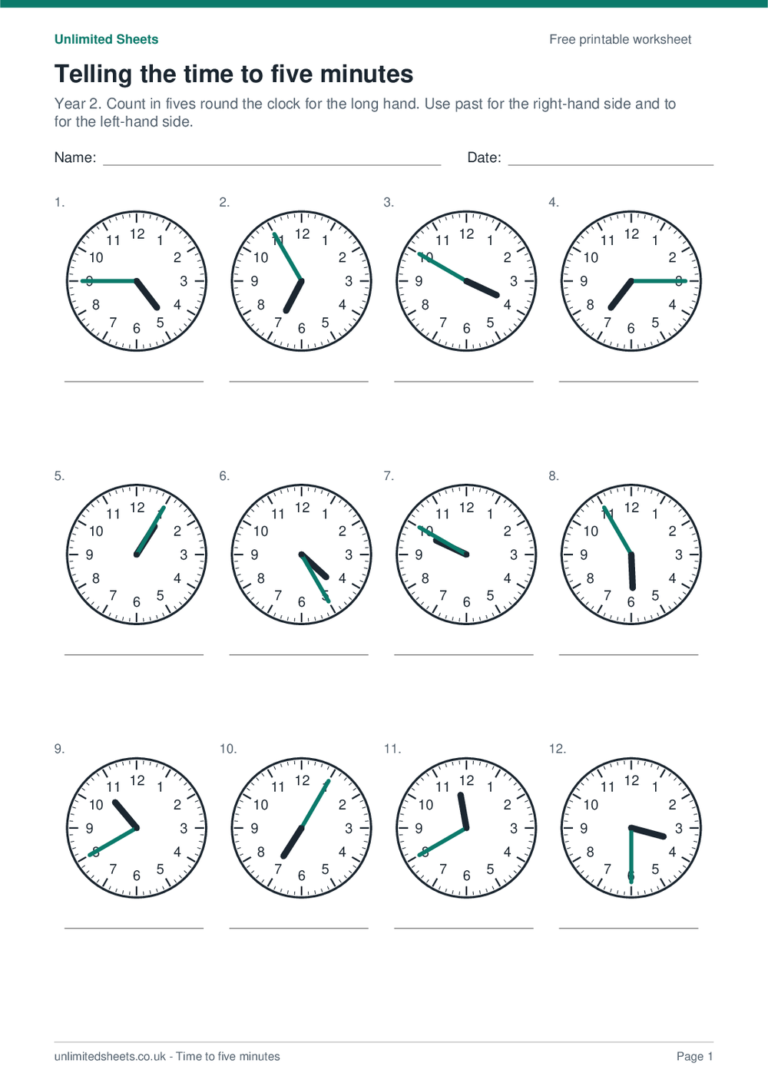
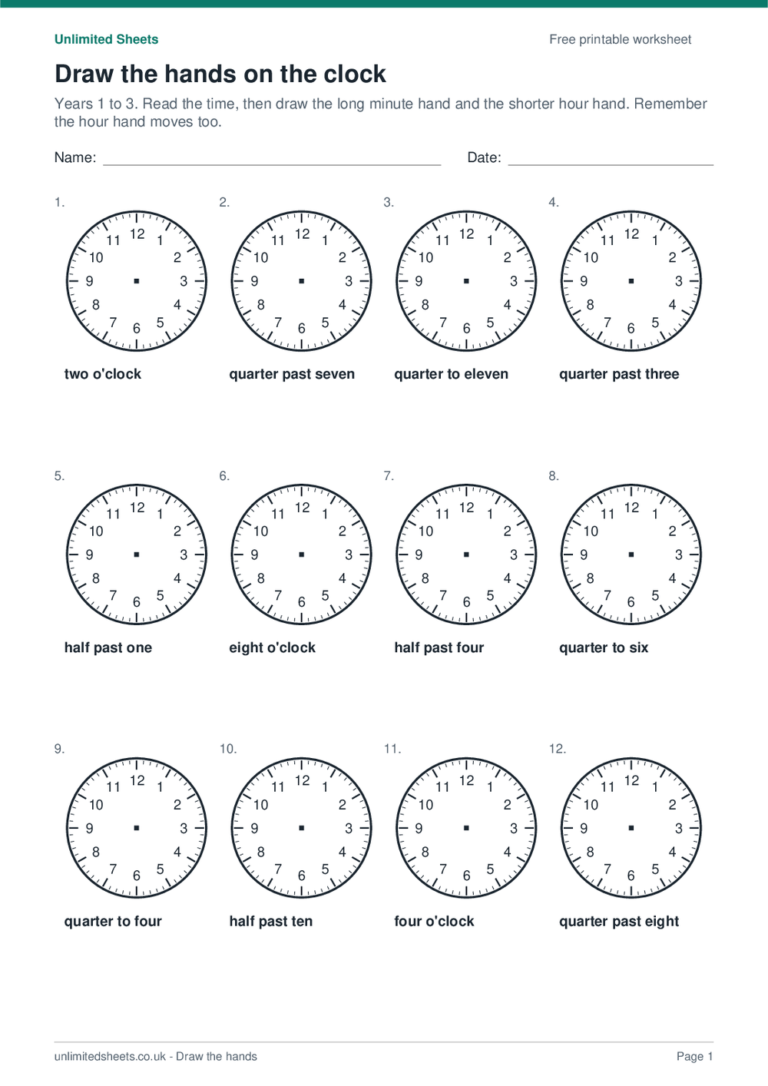
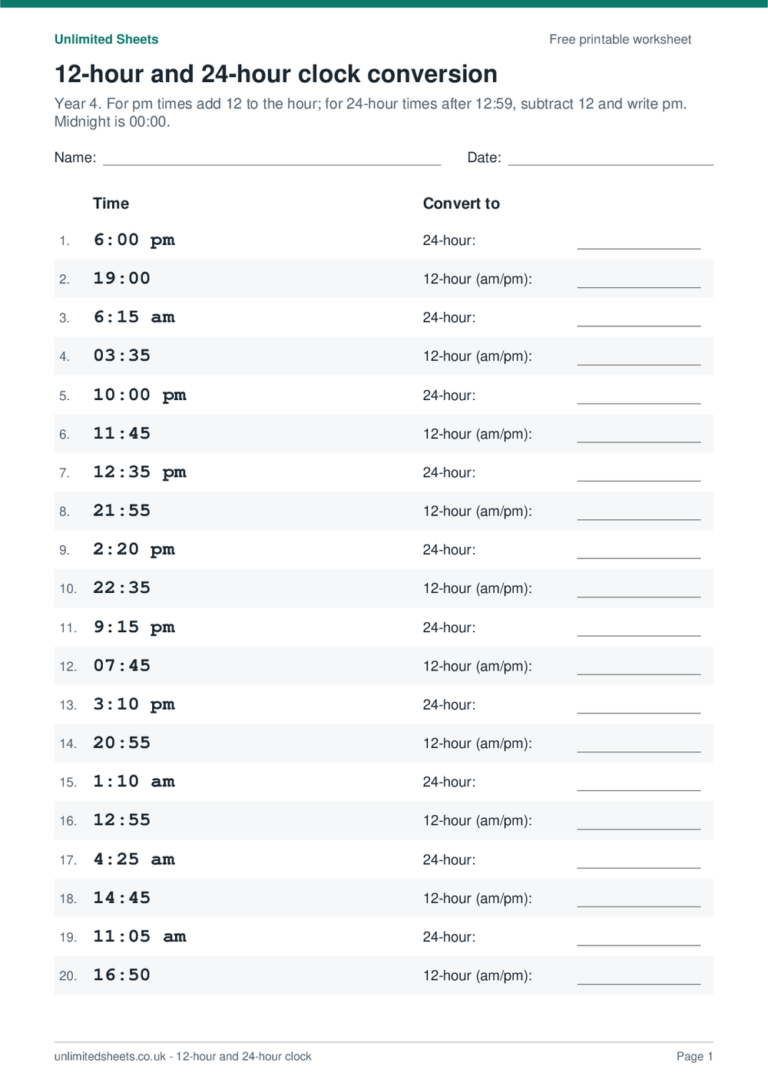
Five A4 worksheets, from Year 1 clocks to a Year 4 to 6 bus timetable. The clock faces are drawn accurately, so the hour hand sits in the right place between the numbers.
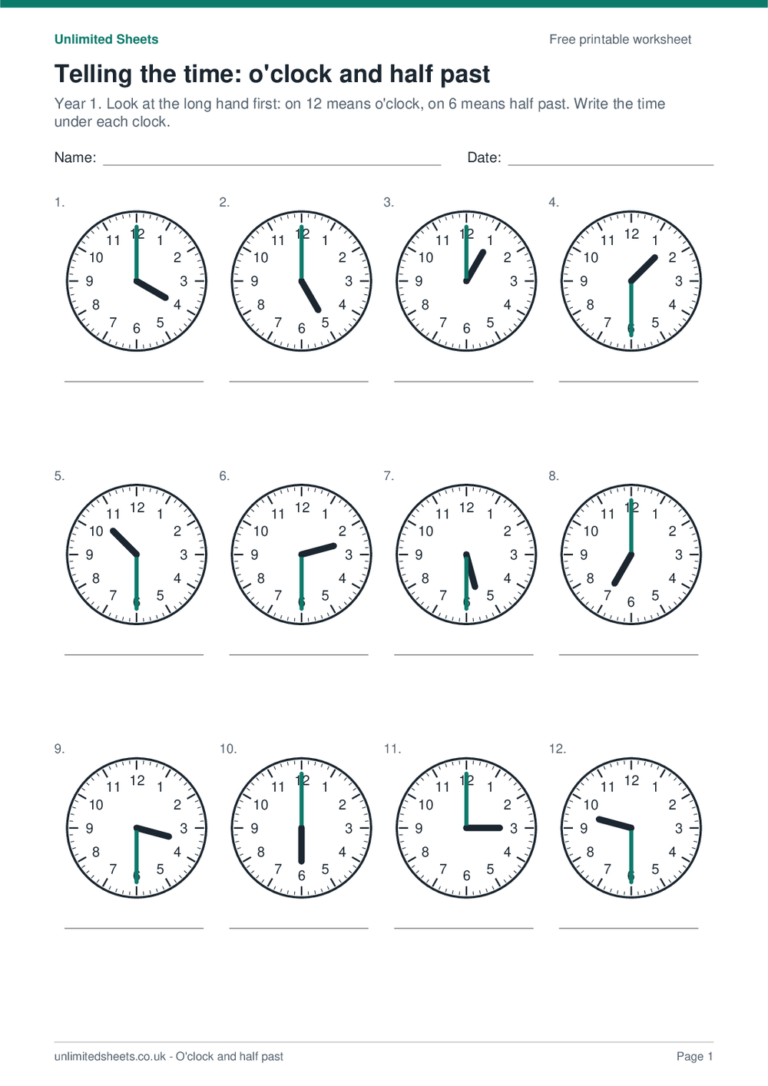
- Telling the time: o'clock and half past (Year 1). Twelve clocks showing o'clock and half past times for Year 1. The answer key gives each time in words and digits.
- Telling the time to five minutes (Year 2). Twelve clocks to the nearest five minutes, including quarter past and quarter to, as in the Year 2 curriculum.
- Draw the hands on the clock (Year 1–3). Twelve blank clocks with a time written underneath. Drawing the hands is part of the Year 1 and Year 2 objectives, and the key shows where the hour hand should sit.
- 12-hour and 24-hour clock conversion (Year 4). Twenty conversions in both directions, including times just after midnight and noon, which are the ones most often wrong.
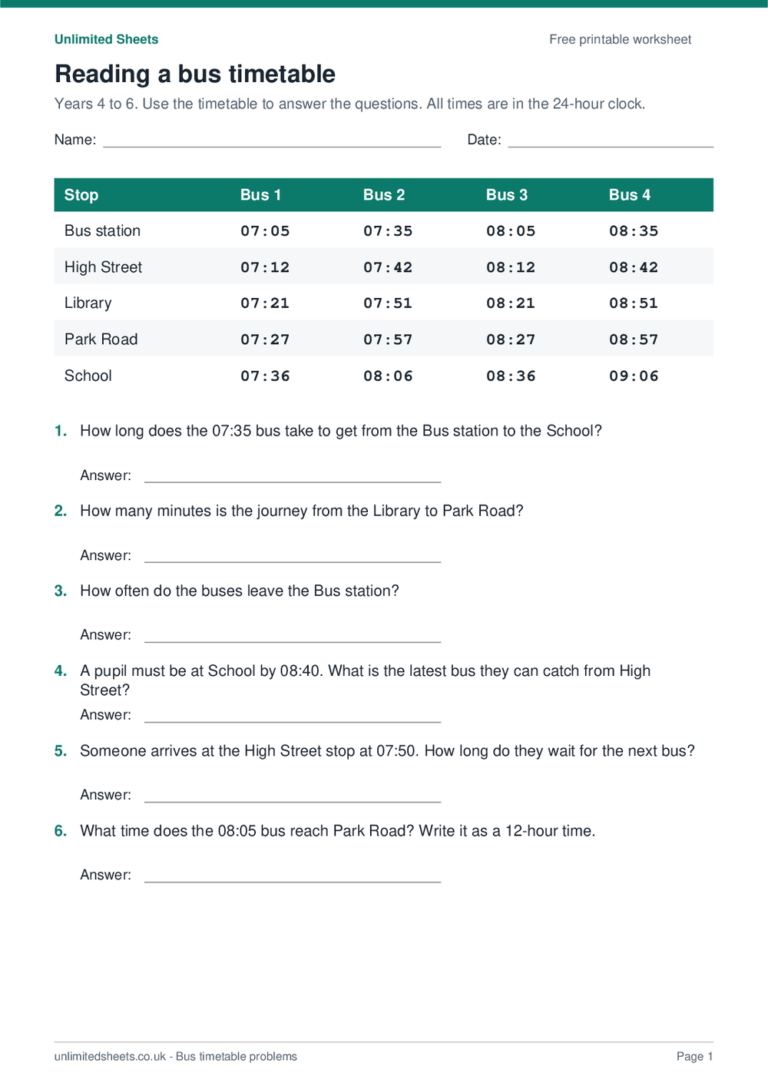
- Reading a bus timetable (Year 4–6). A real-looking timetable with four buses and five stops, plus six questions about journey lengths, waiting times and which bus to catch.
Telling the time questions
What age do children learn to tell the time?
In England, children start in Year 1 (age 5 to 6) with o’clock and half past. By the end of Year 2 they tell the time to five minutes, and in Year 3 to the nearest minute.
Is 12:00 am midnight or noon?
12:00 am is midnight and 12:00 pm is noon. Because this is easy to mix up, timetables use the 24-hour clock instead, where midnight is 00:00 and noon is 12:00.
How do you change pm times to the 24-hour clock?
Add 12 to the hour and keep the minutes. 3:45 pm becomes 15:45. Times from midnight to noon keep the same hour, written with two digits, so 7:30 am is 07:30.
Why is 4:40 called twenty to five?
Because there are 20 minutes left until five o’clock. Times after half past are counted towards the next hour, so the hour in the name is one more than the hour shown on a digital clock.
Keep practising
- Roman numerals
- Fractions: quarter past and half past are fractions of an hour
- Times tables: the 5 times table for minutes
- All maths topics
Updated 22 November 2026.