Place value means that a digit is worth a different amount depending on its position in a number. In 4,732 the 4 is worth 4,000, the 7 is worth 700, the 3 is worth 30 and the 2 is worth 2. Each column is worth ten times the column to its right, which is why the same ten digits can write any number.
The practice below covers place value and rounding from Year 2 to Year 6: the value of a digit, comparing numbers, partitioning, 10, 100 or 1,000 more or less, rounding whole numbers and decimals, and reading numbers written in words.
Next exercise
Place value in action: line up the columns and carry tens into the next column.
Place value columns
Writing a number in a place value chart makes the value of every digit clear. Here is 3,406,275:
| Millions | Hundred thousands | Ten thousands | Thousands | Hundreds | Tens | Ones |
|---|---|---|---|---|---|---|
| 3 | 4 | 0 | 6 | 2 | 7 | 5 |
The 3 is worth 3 million, the 4 is worth 400,000 and the 0 shows that there are no ten thousands. Zeros matter: without the 0, the number would be 346,275, which is about a tenth of the size. In the UK, large numbers are grouped in threes with commas: 3,406,275.
Place value from Year 1 to Year 6
| Year | Numbers up to | Key skills |
|---|---|---|
| Year 1 | 100 | Count, read and write numbers to 100; 1 more and 1 less; numbers to 20 in words |
| Year 2 | 100 | Tens and ones in a 2-digit number; compare with <, > and = |
| Year 3 | 1,000 | Hundreds, tens and ones; 10 or 100 more or less |
| Year 4 | beyond 1,000 | 4-digit place value; 1,000 more or less; round to the nearest 10, 100 or 1,000; round decimals with 1 decimal place to a whole number |
| Year 5 | 1,000,000 | Value of each digit; round to the nearest 10, 100, 1,000, 10,000 and 100,000; round decimals with 2 decimal places |
| Year 6 | 10,000,000 | Read, write, order and compare; round any whole number to a required degree of accuracy |
Source: National Curriculum mathematics programmes of study (GOV.UK).
Partitioning, and why 14 tens is allowed
Partitioning means splitting a number into parts. The standard way follows the columns: 467 = 400 + 60 + 7. But 467 is also 3 hundreds, 16 tens and 7 ones, because one hundred can be exchanged for ten tens. This non-standard partitioning is exactly what happens when children exchange in column subtraction, so practising it makes written methods much easier.
How to round numbers
- Find the column you are rounding to. To round 4,738 to the nearest 100, look at the hundreds digit, 7.
- Look at the digit immediately to its right, the tens digit, 3.
- If it is 5 or more, round up; if it is 4 or less, round down. 3 is less than 5, so 4,738 rounds down to 4,700.
- Replace the digits to the right with zeros. To the nearest 10, the same number is 4,740; to the nearest 1,000 it is 5,000.
A number line helps when the rule feels like magic: 4,738 is between 4,700 and 4,800, and it is nearer to 4,700. Numbers exactly halfway, such as 4,750, are rounded up by convention.
Rounding decimals
The method is the same. 6.4 rounds to 6 because the tenths digit is less than 5, and 6.5 rounds up to 7. In Year 5, 3.47 rounded to 1 decimal place is 3.5, because the hundredths digit, 7, is 5 or more.
Common mistakes
- Reading the digit, not its value: saying the 7 in 4,732 is worth 7.
- Comparing by the first digit only: 989 is less than 1,002 even though 9 is bigger than 1. Count the digits first.
- Rounding the wrong digit, for example looking at the hundreds when rounding to the nearest 100 instead of the digit to its right.
- Leaving out zeros when writing numbers from words: four thousand and six is 4,006, not 46.
Printable place value and rounding worksheets
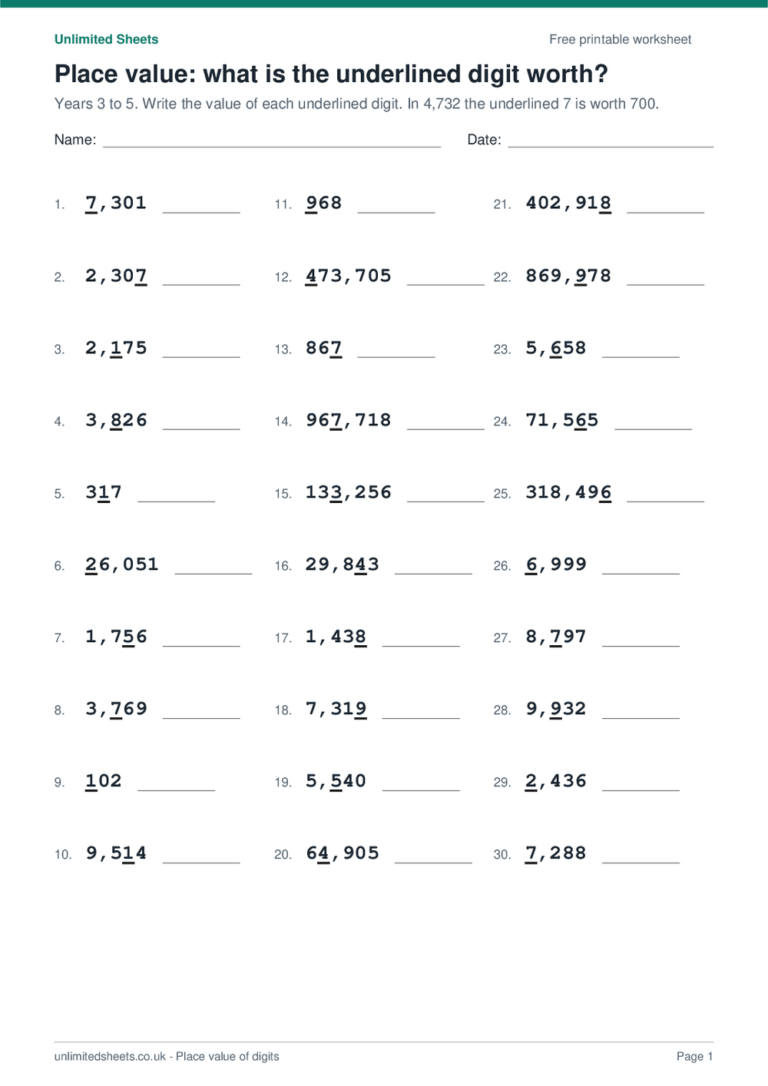
- Place value: value of the underlined digit (Year 3–5). Thirty numbers from hundreds to hundreds of thousands. Children write the value of one underlined digit in each, which is the core place value skill from Year 3 to Year 5.
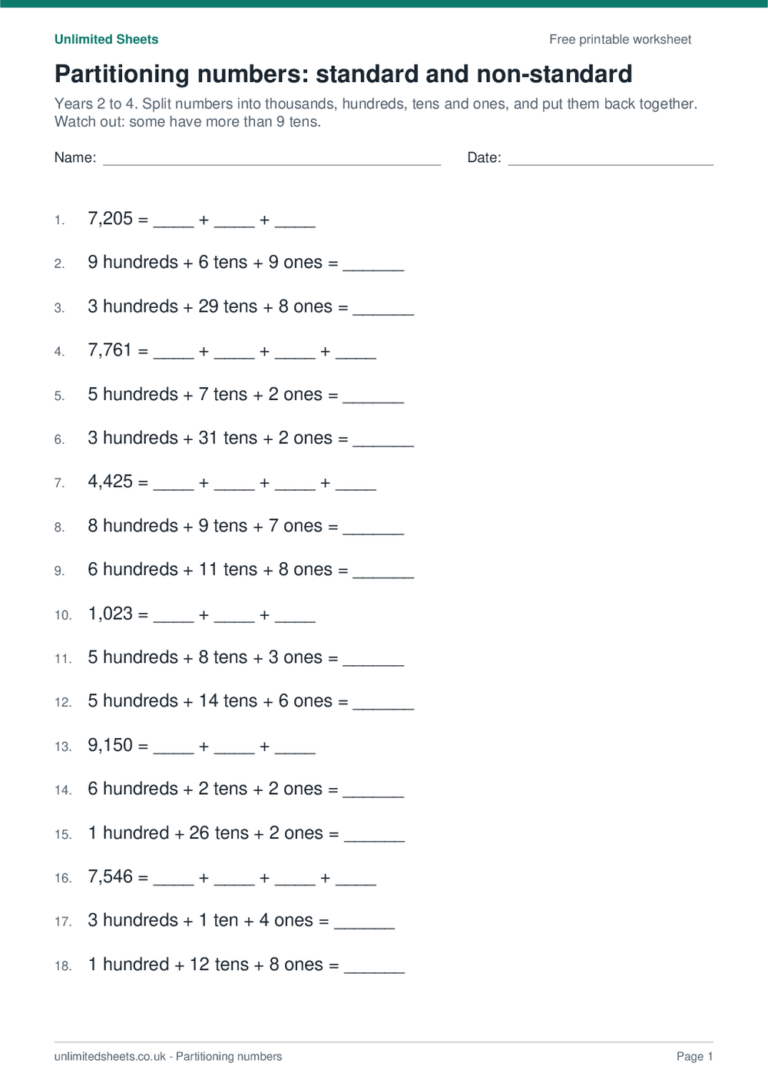
- Partitioning numbers (Year 2–4). Eighteen questions: split four-digit numbers into their parts, rebuild three-digit numbers, and solve non-standard partitions such as 3 hundreds + 14 tens + 6 ones.
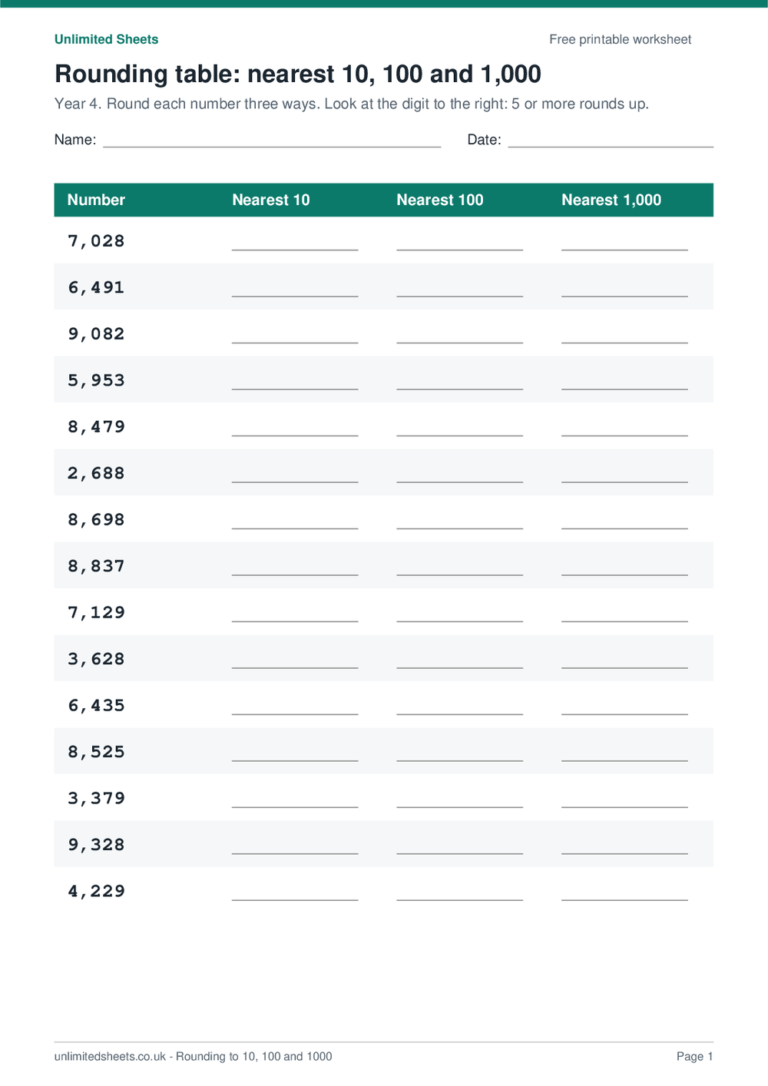
- Rounding table: nearest 10, 100 and 1,000 (Year 4). Fifteen four-digit numbers to round three ways in a table, so children see how the same number rounds differently to 10, 100 and 1,000.
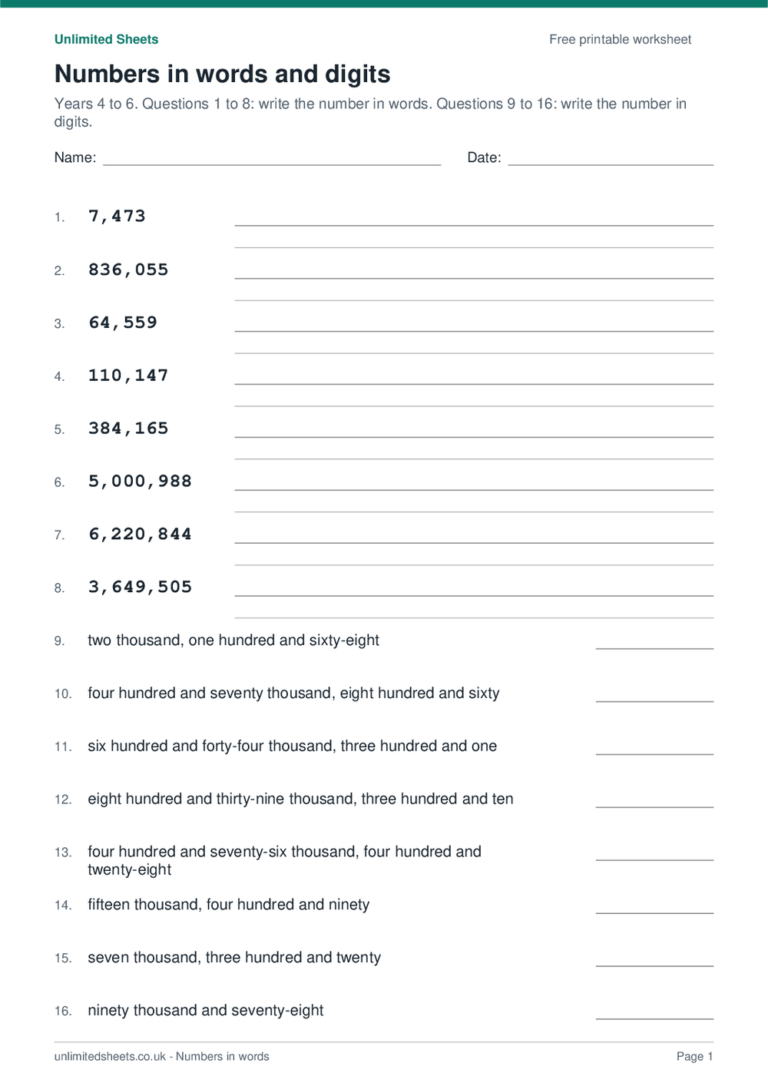
- Numbers in words and digits (Year 4–6). Eight numbers to write in words and eight to write in digits, up to the millions, including numbers with zeros in the middle such as five thousand and six.
Place value questions
What is place value in maths?
Place value is the value a digit has because of its position in a number. In 352 the 3 is worth 300 because it is in the hundreds column, while in 532 the 3 is worth 30.
How do you round to the nearest 100?
Look at the tens digit. If it is 5 or more, round the hundreds up; if it is 4 or less, keep the hundreds digit the same. Then change the tens and ones to zero: 4,738 rounds to 4,700 and 4,762 rounds to 4,800.
What year do children learn to round numbers?
Rounding to the nearest 10, 100 or 1,000 is in Year 4, along with rounding decimals with one decimal place to the nearest whole number. Year 5 extends it to 100,000 and to decimals with two decimal places.
How big are the numbers in each year?
Children work with numbers to 100 in Years 1 and 2, to 1,000 in Year 3, beyond 1,000 in Year 4, to 1,000,000 in Year 5 and to 10,000,000 in Year 6.
Keep practising
- Column addition
- Column subtraction: exchanging uses non-standard partitioning
- Roman numerals: a number system without place value
- All maths topics
Updated 22 November 2026.