To find a fraction of an amount, divide by the denominator, then multiply by the numerator. For 34 of 28: 28 ÷ 4 = 7, so one quarter is 7, and three quarters are 7 × 3 = 21. For a unit fraction such as 15 of 35, only the first step is needed: 35 ÷ 5 = 7.
Practise five levels, from Year 2 questions such as 12 of 6 to Year 5 and 6 amounts in the hundreds. Every answer is a whole number, and Show how gives both steps.
Next exercise
Adding and subtracting fractions →
Same denominators first, then related and different denominators.
Unit fractions: just divide
A unit fraction has 1 as its numerator: 12, 13, 14, 110. Finding 14 of an amount means sharing it into 4 equal groups and counting one group, which is the same as dividing by 4. This is why quick division facts from the times tables make fractions so much easier.
Non-unit fractions: divide, then multiply
For 38 of 48, first find one eighth: 48 ÷ 8 = 6. Three eighths is three of those: 6 × 3 = 18. Year 3 pupils work with non-unit fractions of small sets, and Year 4 pupils solve problems where the answer is a whole number, as in every question on this page.
Seeing it with a bar model
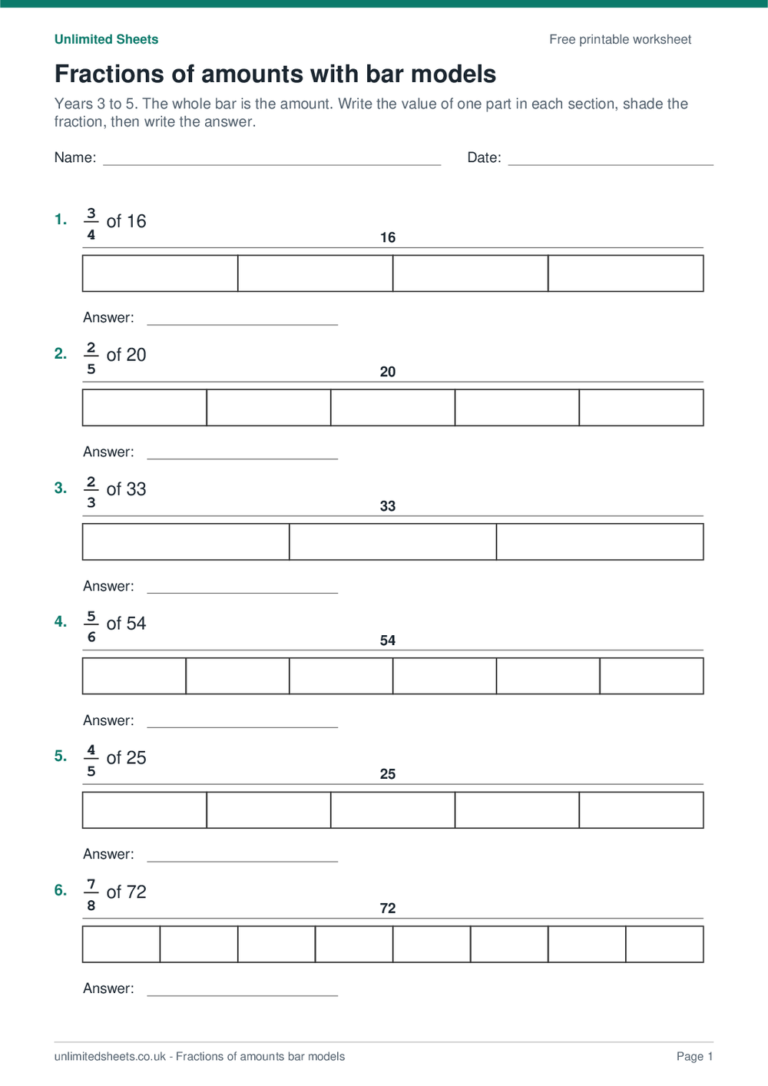
Many schools draw a bar model. The whole bar is the amount; it is split into as many equal parts as the denominator, and the numerator says how many parts to shade. Here is 25 of 40: each fifth is worth 8, so two fifths are 16.
The bar model worksheet below has six of these to complete, and it is a good bridge to harder problems.
Fractions of money and measures
The method does not change with units. 34 of £20 is £15, 23 of 90 minutes is 60 minutes, and 15 of 1 kg is 200 g once the kilogram is written as 1,000 g. Converting to a smaller unit first often turns a hard question into an easy one.
Finding what is left
Read problems carefully. If 34 of 28 children have packed lunches, then 21 do, but the question might ask how many do not: 28 − 21 = 7, which is the remaining 14. Two of the word problems on our worksheet are like this.
Common mistakes
- Dividing by the numerator. For 34 of 28, dividing by 3 gives the wrong answer. Always divide by the denominator, the number of equal parts.
- Forgetting the second step. 28 ÷ 4 = 7 is only one quarter. For three quarters, multiply by 3.
- Answering the wrong question in word problems, giving the part when the question asks for what is left.
Printable fractions of amounts worksheets
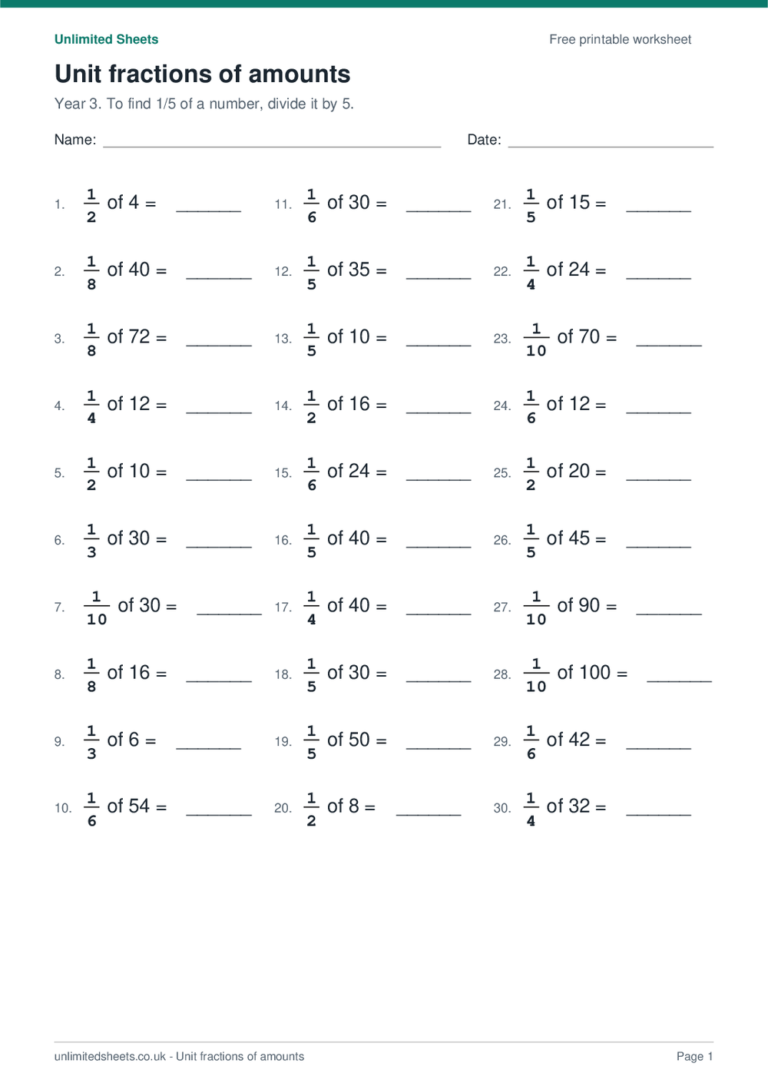
- Unit fractions of amounts (Year 3). Thirty questions finding a unit fraction (1/2, 1/3, 1/4, 1/5, 1/6, 1/8 or 1/10) of a whole number. Every answer is a whole number.
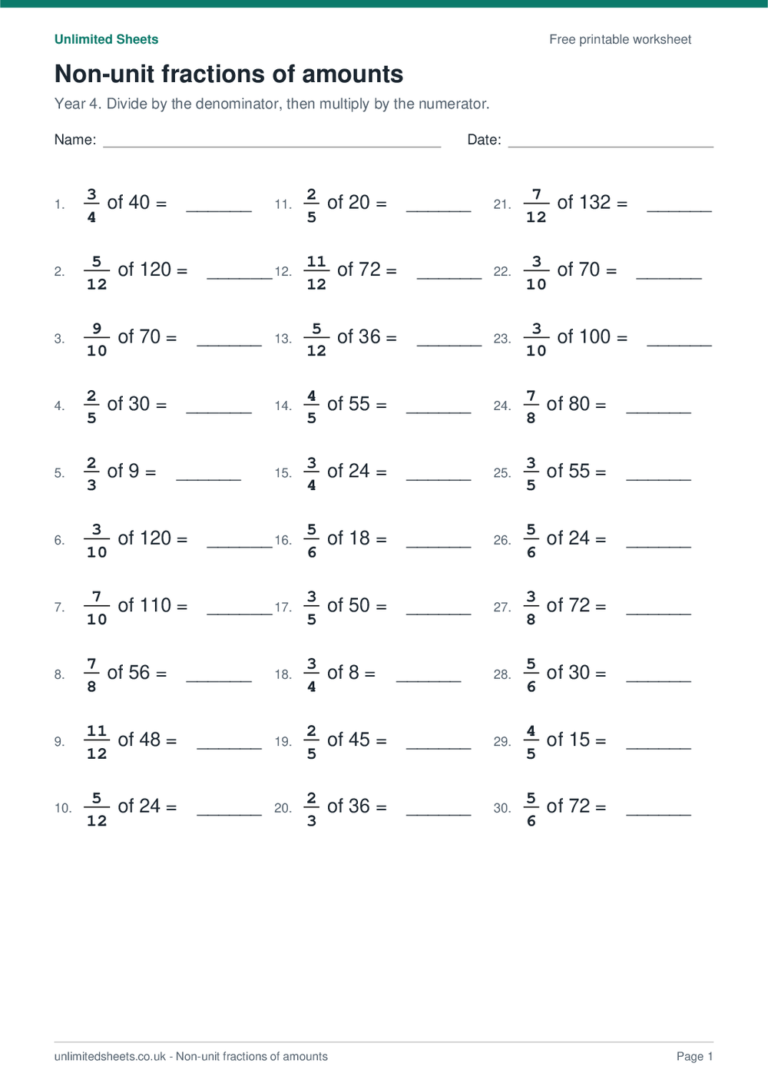
- Non-unit fractions of amounts (Year 4). Thirty questions such as finding three quarters or five eighths of a number: divide by the denominator, then multiply by the numerator.
- Fractions of amounts with bar models (Year 3–5). Six bar models to complete: write the value of one part in each section, shade the fraction and find the answer. The key shows every bar filled in.
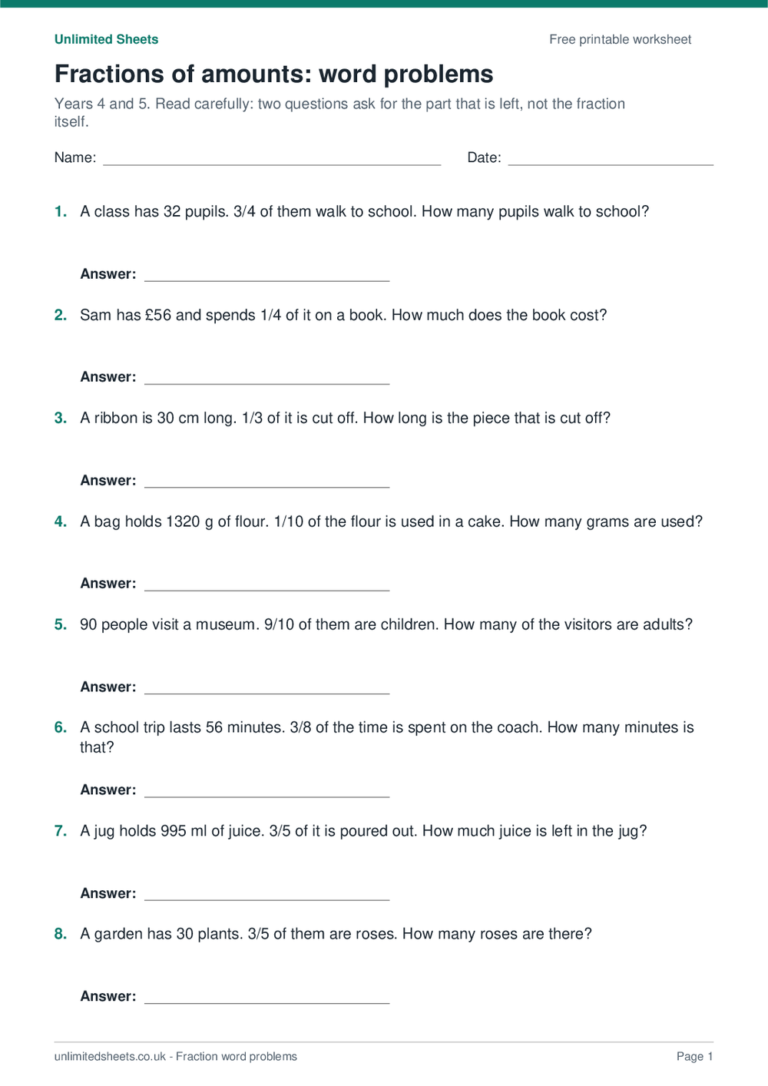
- Fraction word problems (Year 4–5). Eight problems in real contexts: money, length, mass, capacity and time. Two of them ask for the part that is left, which needs one extra step.
Fractions of amounts questions
How do you find 3/4 of a number?
Divide the number by 4 to find one quarter, then multiply by 3. For example, 3/4 of 28: 28 ÷ 4 = 7 and 7 × 3 = 21.
What year do children find fractions of amounts?
They start in Year 2 with halves, quarters and thirds of small numbers, such as 1/2 of 6 = 3. Year 3 covers unit and non-unit fractions of sets, and Year 4 extends this to harder fractions of quantities.
Why does dividing by the denominator work?
The denominator tells you how many equal parts the amount is split into, and dividing by it gives the size of one part. The numerator then says how many of those parts you need.
Can the answer be a fraction?
Yes, in general. All the questions on this page are chosen so the answer is a whole number, which matches what the Year 4 curriculum asks for.
Keep practising
- Fractions practice: shapes, equivalent fractions and more
- Adding and subtracting fractions
- Times tables: division facts
- Long division
Updated 22 November 2026.