
Equivalent fractions are fractions that look different but are worth the same amount. ½, 2/4 and 3/6 are equivalent: half a pizza is the same amount whether you cut it into 2, 4 or 6 equal slices. Children meet their first equivalent fractions in Year 2 and simplify fractions by Year 6.
Equivalent fractions chart
| Fraction | Equivalent fractions |
|---|---|
| 1/2 | 2/4 = 3/6 = 4/8 = 5/10 |
| 1/3 | 2/6 = 3/9 = 4/12 = 5/15 |
| 2/3 | 4/6 = 6/9 = 8/12 = 10/15 |
| 1/4 | 2/8 = 3/12 = 4/16 = 5/20 |
| 3/4 | 6/8 = 9/12 = 12/16 = 15/20 |
| 1/5 | 2/10 = 3/15 = 4/20 = 5/25 |
| 2/5 | 4/10 = 6/15 = 8/20 = 10/25 |
| 1/10 | 2/20 = 3/30 = 4/40 = 5/50 |
How to find an equivalent fraction
Multiply the numerator (top) and the denominator (bottom) by the same number. To find fractions equal to ⅔: multiply both by 2 to get 4/6, by 3 to get 6/9, by 4 to get 8/12. It works because multiplying top and bottom by 3 is the same as multiplying by 3/3, which is 1 whole, and multiplying by 1 does not change a number.
To go the other way, divide both by the same number. 6/8 ÷ 2/2 = 3/4. Dividing until no number except 1 goes into both is called simplifying, or writing the fraction in its lowest terms.
Seeing it on a fraction wall
A fraction wall stacks strips of the same length cut into halves, thirds, quarters and so on. Lining them up shows at a glance that two quarters cover exactly the same length as one half, and that three sixths do too. Folding paper strips at home makes the same point.
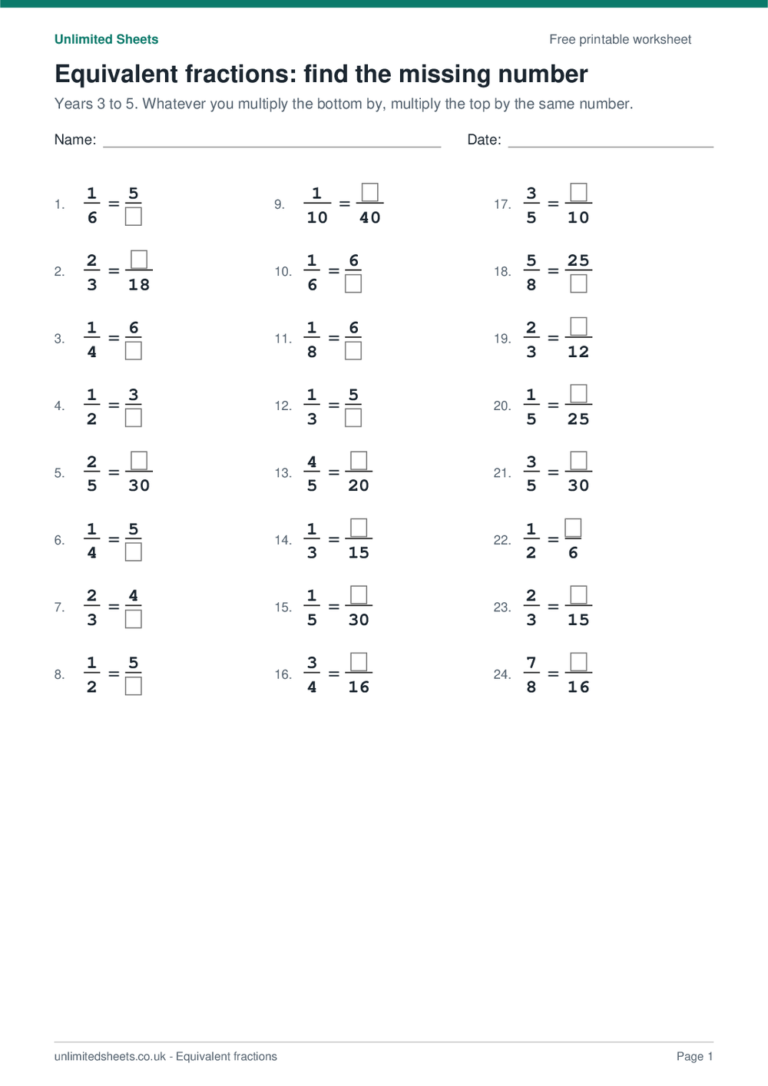
Missing number questions
In 3/5 = ?/20, ask what 5 was multiplied by to make 20. The answer is 4, so multiply the numerator by 4 too: 3/5 = 12/20.
Common mistakes
- Adding instead of multiplying: adding 1 to top and bottom of ½ gives 2/3, which is not equivalent.
- Changing only one number: both the numerator and denominator must be multiplied or divided by the same number.
- Stopping too early when simplifying: 12/18 ÷ 2/2 = 6/9, but it simplifies further to 2/3.
Equivalent fractions year by year
- Year 2: recognise that 2/4 and ½ are equivalent.
- Year 3: recognise and show, using diagrams, equivalent fractions with small denominators.
- Year 4: recognise and show families of common equivalent fractions.
- Year 5: identify, name and write equivalent fractions of a given fraction, including tenths and hundredths.
- Year 6: use common factors to simplify fractions and common multiples to give fractions the same denominator.
Printable equivalent fractions worksheet
Related pages
Fractions, adding and subtracting fractions, Year 3 fractions, Year 4 fractions and Year 6 fractions.
Sources
National curriculum in England: mathematics programmes of study, Department for Education, GOV.UK.
Updated 23 November 2026.