
Year 6 decimals: what children learn in Year 6 and practice that marks itself. In Year 6, the national curriculum expects children to associate a fraction with division and calculate decimal fraction equivalents (for example, 0.375) for a simple fraction (for example, 3/8).
What Year 6 children learn about decimals
From the statutory Year 6 programme of study for mathematics:
- Associate a fraction with division and calculate decimal fraction equivalents (for example, 0.375) for a simple fraction (for example, 3/8)
- Identify the value of each digit in numbers given to three decimal places and multiply and divide numbers by 10, 100 and 1000 giving answers up to three decimal places
- Multiply one-digit numbers with up to two decimal places by whole numbers
- Use written division methods in cases where the answer has up to two decimal places
- Recall and use equivalences between simple fractions, decimals and percentages, including in different contexts
Worked examples
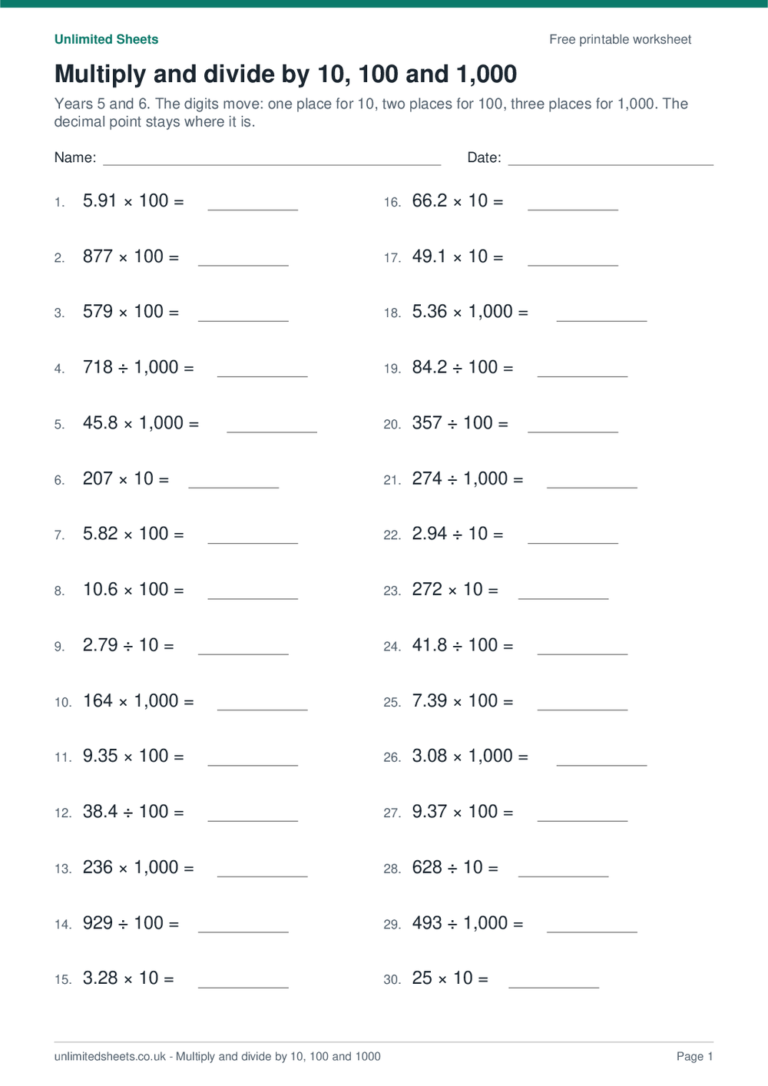
Years 5 and 6: multiply and divide by 10, 100 and 1,000
2.84 × 10
- Multiplying by 10 moves every digit 1 place to the left, so the number gets bigger.
- 2.84 × 10 = 28.4.
Answer: 28.4
Years 4 to 6: fraction and decimal equivalents
Write 0.5 as a fraction in its simplest form
- 0.5 = 50/100.
- Simplify by dividing the top and bottom by 50: 1/2.
Answer: 1/2
Year 6 decimals worksheets
Printable A4 PDFs. Practice sheets have the answers on the last page.
More decimals
Other years: Year 4 decimals, Year 5 decimals. See how decimals builds up across the primary years on the decimals overview page.
More Year 6 maths: place value, multiplication, division, fractions, percentages, measurement, area and perimeter, angles, coordinates, statistics, BIDMAS. Back to all Year 6 maths.