
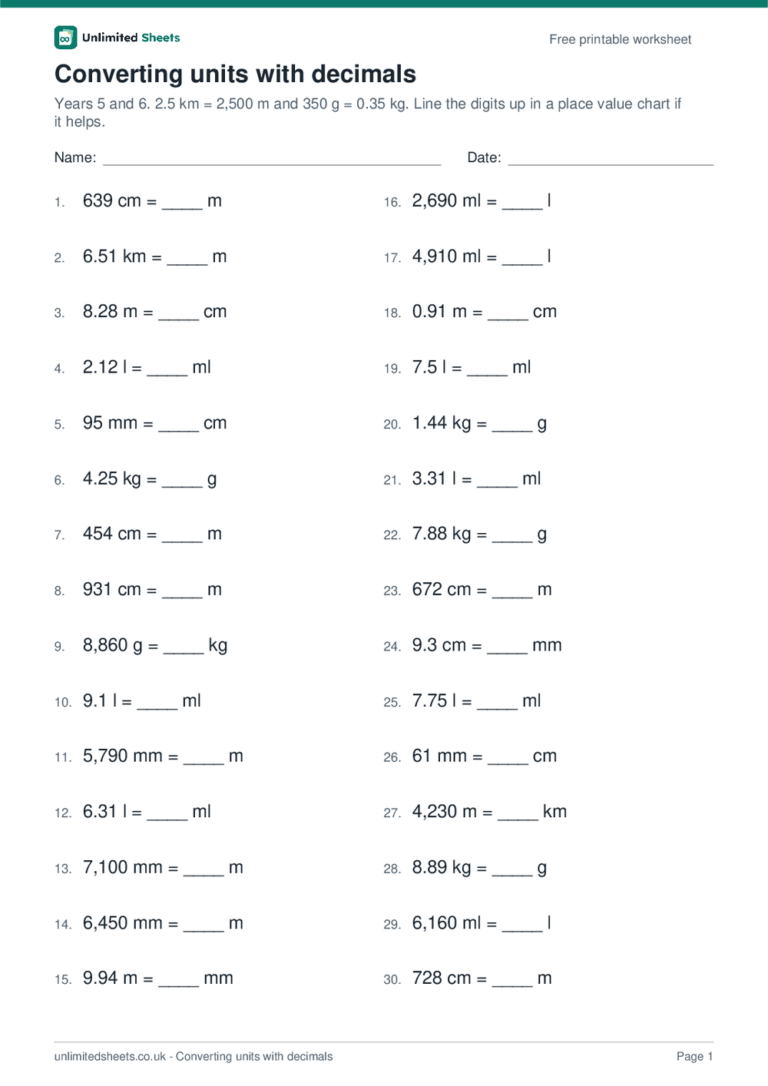
Year 5 measurement: what children learn in Year 5 and practice that marks itself. In Year 5, the national curriculum expects children to convert between different units of metric measure (for example, kilometre and metre; centimetre and metre; centimetre and millimetre; gram and kilogram; litre and millilitre).
What Year 5 children learn about measurement
From the statutory Year 5 programme of study for mathematics:
- Convert between different units of metric measure (for example, kilometre and metre; centimetre and metre; centimetre and millimetre; gram and kilogram; litre and millilitre)
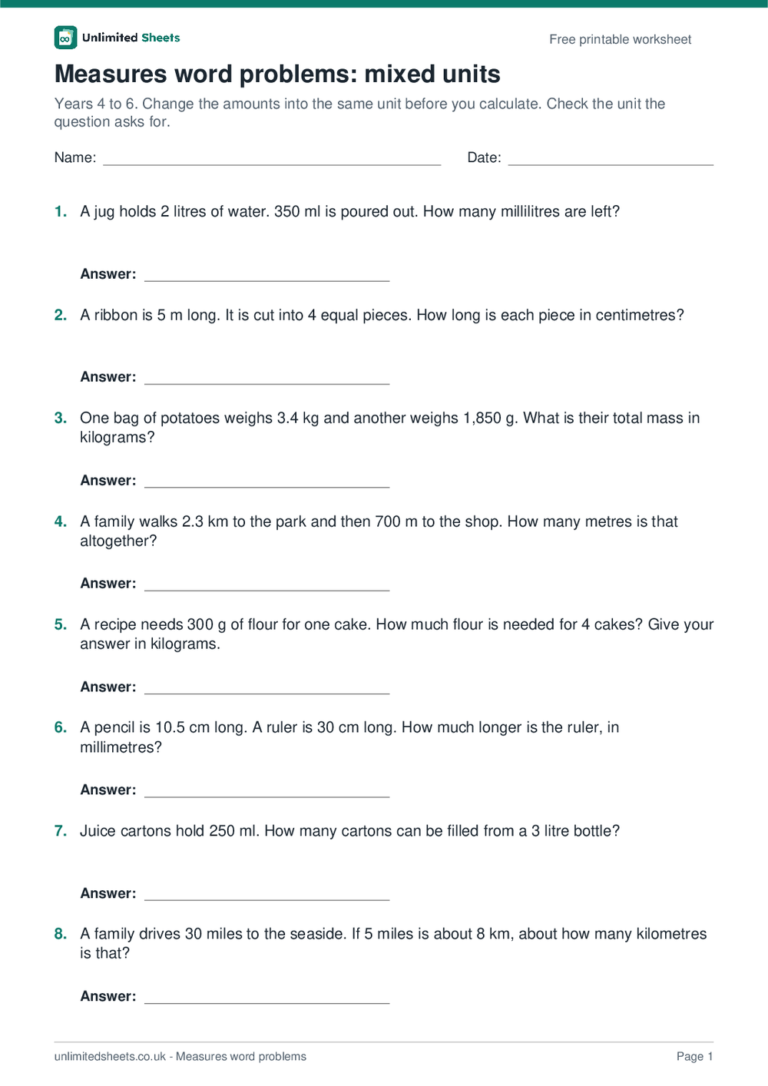
- Understand and use approximate equivalences between metric units and common imperial units such as inches, pounds and pints
- Calculate and compare the area of rectangles (including squares), and including using standard units, square centimetres (cm²) and square metres (m²), and estimate the area of irregular shapes
- Estimate volume (for example, using 1 cm blocks to build cuboids (including cubes)) and capacity (for example, using water)
- Solve problems involving converting between units of time
- Use all four operations to solve problems involving measure (for example, length, mass, volume, money) using decimal notation, including scaling
Worked examples
Year 5: metric conversions with decimals, such as 2.5 km = 2,500 m
1,260 m = ? km
- 1 kilometre = 1,000 metres.
- To change metres to kilometres, divide by 1,000: 1,260 ÷ 1,000 = 1.26.
Answer: 1.26
Year 5: approximate equivalences between metric and imperial units
1 inch is about ? cm (250 / 2.5 / 0.25 / 25)
- 1 inch is about 2.5 cm.
- These are approximate. They are close enough to check whether an answer is sensible.
Answer: 2.5
Year 5 measurement worksheets
Printable A4 PDFs. Practice sheets have the answers on the last page.
More measurement
Other years: Year 3 measurement, Year 4 measurement, Year 6 measurement. See how measurement builds up across the primary years on the measurement overview page.
More Year 5 maths: place value, addition, subtraction, multiplication, division, fractions, decimals, percentages, time, area and perimeter, angles, statistics, roman numerals. Back to all Year 5 maths.