
Subitising means seeing how many objects there are at a glance, without counting them. When you look at a dice and just know it shows 5, you are subitising. It is one of the early learning goals for Reception: by the end of the year children are expected to subitise up to 5.
Two kinds of subitising
- Perceptual subitising is instantly seeing a small amount, usually up to about 4 or 5, such as 3 dots in any arrangement.
- Conceptual subitising is seeing a bigger amount as smaller parts: 8 on a ten frame is a full row of 5 and 3 more, and 6 on a dice is two rows of 3.
Conceptual subitising is the start of number bonds and adding. A child who sees 7 as 5 and 2 is already using the bond 5 + 2 = 7.
Why subitising matters
Counting one by one is slow and easy to get wrong. Children who can see small groups quickly can count on from a group, compare amounts and spot number bonds. That is why the EYFS framework lists subitising as part of the Number goal, alongside understanding numbers to 10 and recalling bonds to 5.
Dice patterns and ten frames
| Pattern | What to notice |
|---|---|
| Dice 4 | Two rows of 2, one in each corner |
| Dice 5 | The 4 pattern with one more in the middle |
| Dice 6 | Two rows of 3 |
| Ten frame 5 | The top row is full |
| Ten frame 7 | A full row of 5 and 2 more |
| Ten frame 9 | Only 1 space is empty, so 9 and 1 make 10 |
Subitising activities
- Quick look: show a dot card for two seconds, hide it and ask how many. Then ask how they saw it.
- Dice snap: roll two dice and shout “snap” when they show the same number.
- Hidden objects: put up to 5 toys under a tea towel, lift it for a moment and drop it again.
- Fingers: show numbers on your fingers without counting, such as 5 and 1 for 6.
- Ten-frame egg box: cut an egg box to ten holes and fill it with pasta or pom-poms.
Printable subitising dot cards
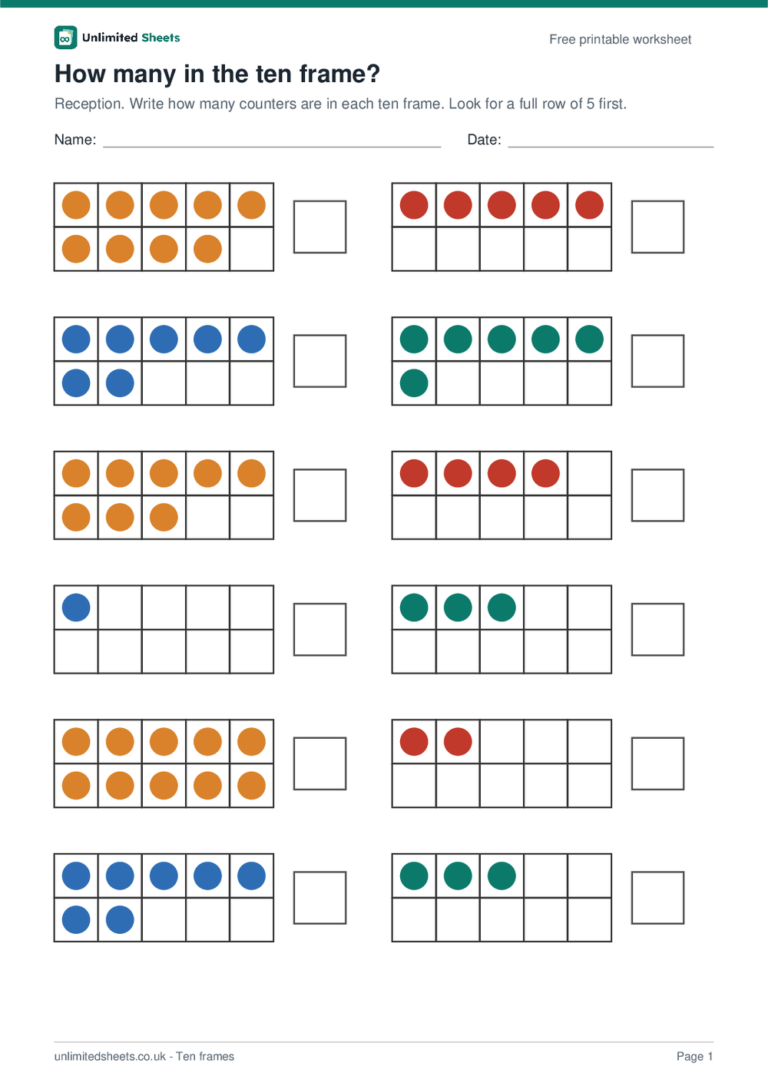
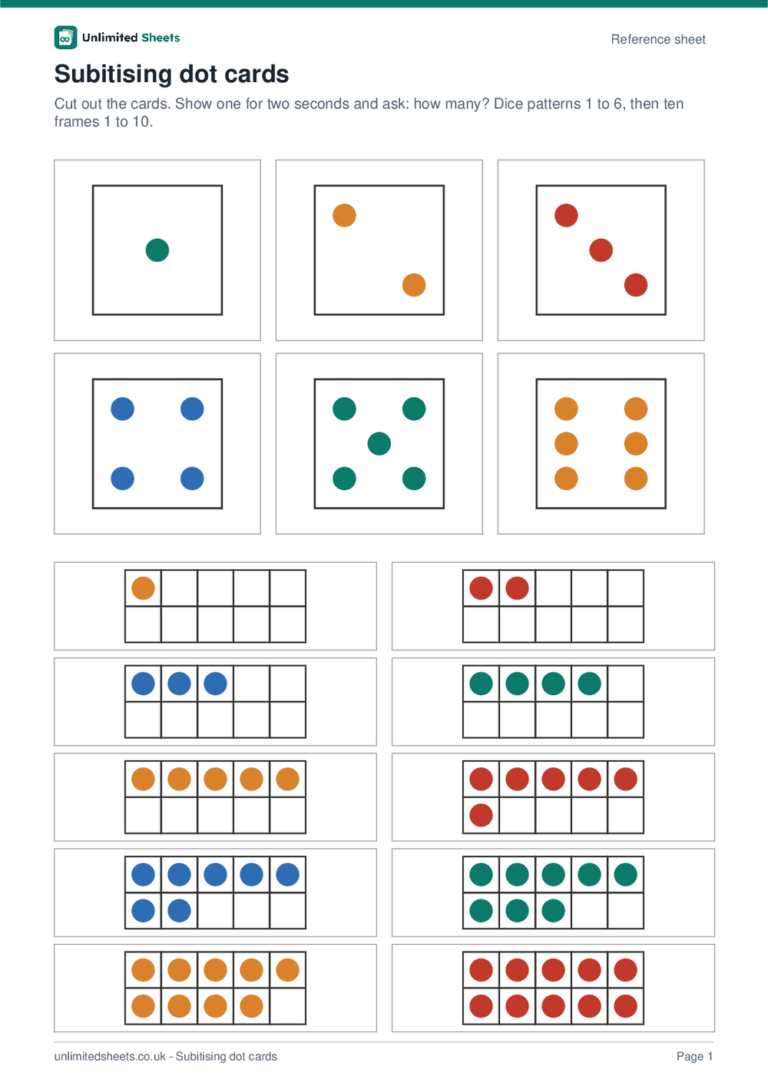
Related pages
Reception maths, number bonds, number lines, the 100 square and the early learning goals.
Sources
Early years foundation stage (EYFS) statutory framework for group and school-based providers (from September 2026), ELG: Number. Department for Education and Standards and Testing Agency, GOV.UK. Contains public sector information licensed under the Open Government Licence v3.0.
Updated 23 November 2026.