
Year 5 area and perimeter: what children learn in Year 5 and practice that marks itself. In Year 5, the national curriculum expects children to measure and calculate the perimeter of composite rectilinear shapes in centimetres and metres.
What Year 5 children learn about area and perimeter
From the statutory Year 5 programme of study for mathematics:
- Measure and calculate the perimeter of composite rectilinear shapes in centimetres and metres
- Calculate and compare the area of rectangles (including squares), and including using standard units, square centimetres (cm²) and square metres (m²), and estimate the area of irregular shapes
Worked examples
Year 5: area of rectangles (length × width) in cm²
What is the area of the rectangle in cm²?
- Area = length × width = 3 × 2 = 6 cm².
Answer: 6
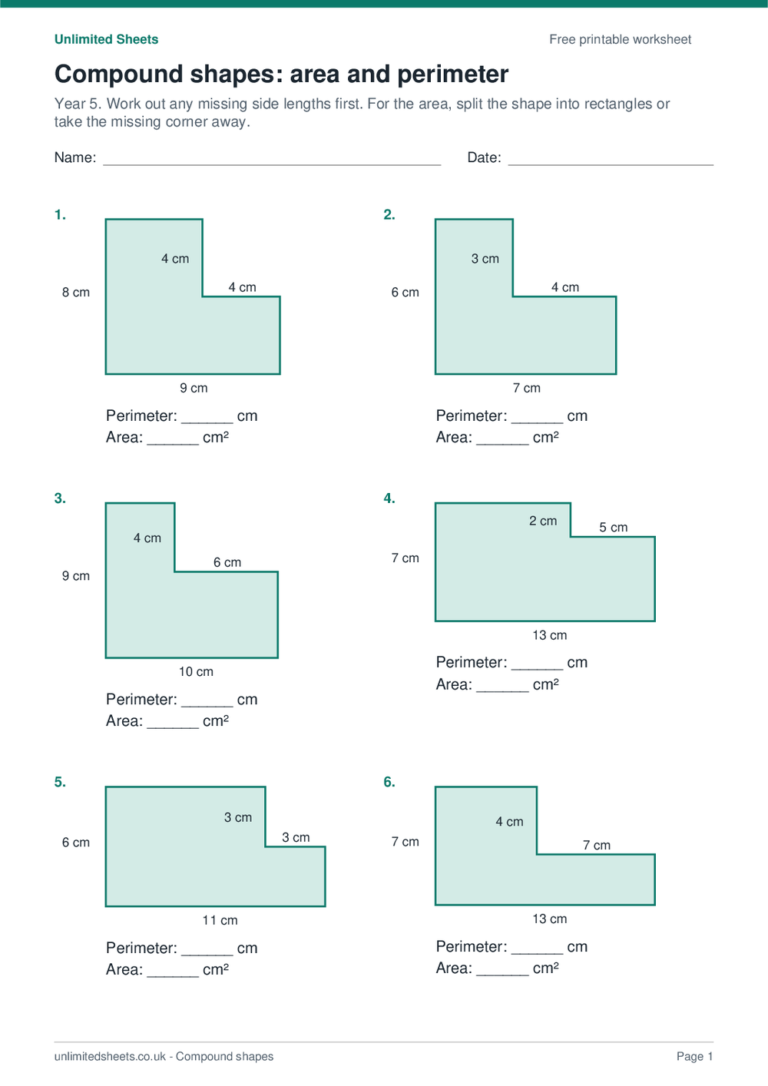
Year 5: perimeter and area of L-shaped (composite rectilinear) shapes
What is the perimeter of this shape in cm?
- Work out the missing sides: 6 − 3 = 3 cm and 6 − 3 = 3 cm.
- Add all six sides: 6 + 6 + 3 + 3 + 3 + 3 = 24 cm.
Answer: 24
Year 5 area and perimeter worksheets
Printable A4 PDFs. Practice sheets have the answers on the last page.

More area and perimeter
Other years: Year 4 area and perimeter, Year 6 area and perimeter. See how area and perimeter builds up across the primary years on the area and perimeter overview page.
More Year 5 maths: place value, addition, subtraction, multiplication, division, fractions, decimals, percentages, time, measurement, angles, statistics, roman numerals. Back to all Year 5 maths.