
The 10 times table: the digits move one place to the left. In the national curriculum for England, children are expected to know the 10 times table by the end of Year 2. Below is the full table, practice that times you, tricks that make it stick and a printable worksheet.
The 10 times table
| Multiplication | Division |
|---|---|
| 1 × 10 = 10 | 10 ÷ 10 = 1 |
| 2 × 10 = 20 | 20 ÷ 10 = 2 |
| 3 × 10 = 30 | 30 ÷ 10 = 3 |
| 4 × 10 = 40 | 40 ÷ 10 = 4 |
| 5 × 10 = 50 | 50 ÷ 10 = 5 |
| 6 × 10 = 60 | 60 ÷ 10 = 6 |
| 7 × 10 = 70 | 70 ÷ 10 = 7 |
| 8 × 10 = 80 | 80 ÷ 10 = 8 |
| 9 × 10 = 90 | 90 ÷ 10 = 9 |
| 10 × 10 = 100 | 100 ÷ 10 = 10 |
| 11 × 10 = 110 | 110 ÷ 10 = 11 |
| 12 × 10 = 120 | 120 ÷ 10 = 12 |
Tricks for the 10 times table
- When you multiply a whole number by 10, each digit moves one place to the left and a zero goes in the ones column: 10 × 7 = 70.
- Every answer ends in 0.
- The 10 times table is the base for the 5 times table (halve it) and the 9 and 11 times tables (take one lot away or add one lot on).
It also helps to practise place value.
How to practise
- Say it in order first, from 1 × 10 to 12 × 10, until it flows.
- Then mix it up. Knowing a table means answering 7 × 10 without counting up from the start.
- Turn it round. If 10 × 6 = 60, then 60 ÷ 10 = 6. Division facts come free once the table is secure.
- Go for speed last. In the Year 4 multiplication tables check, children have 6 seconds per question, so quick recall matters by then.
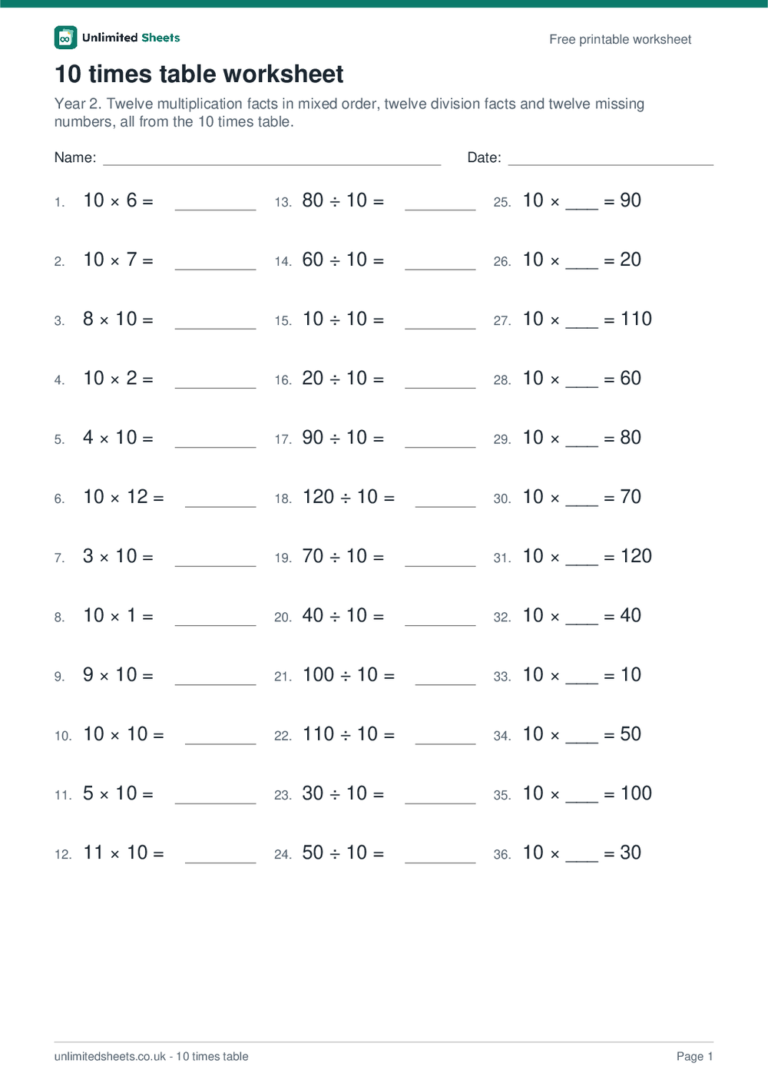
Printable 10 times table worksheet
Other times tables
2 times table · 3 times table · 4 times table · 5 times table · 6 times table · 7 times table · 8 times table · 9 times table · 11 times table · 12 times table. Or go back to all the times tables, with the 12 × 12 grid and the 25-question check, or play the times tables games.
Updated 23 November 2026.