
Year 5 division: what children learn in Year 5 and practice that marks itself. In Year 5, the national curriculum expects children to multiply and divide numbers mentally drawing upon known facts.
What Year 5 children learn about division
From the statutory Year 5 programme of study for mathematics:
- Multiply and divide numbers mentally drawing upon known facts
- Divide numbers up to 4 digits by a one-digit number using the formal written method of short division and interpret remainders appropriately for the context
- Solve problems involving multiplication and division including using their knowledge of factors and multiples, squares and cubes
- Solve problems involving addition, subtraction, multiplication and division and a combination of these, including understanding the meaning of the equals sign
Worked examples
Year 5: short division with remainders, 3-digit ÷ 1-digit. Type answers like 23 r 4
112 ÷ 3
- Write 112 inside the bus stop and 3 outside. Work from left to right.
- 1 ÷ 3 = 0 remainder 1. Write nothing above and carry 1 to the next digit.
- 11 ÷ 3 = 3 remainder 2. Write 3 above and carry 2.
- 22 ÷ 3 = 7 remainder 1. Write 7 above.
- Answer: 37 remainder 1. Check: 37 × 3 + 1 = 112.
Answer: 37 r 1
Year 5: word problems where you round up, round down or give the remainder
94 children are going on a school trip. Each minibus holds 4 children. How many minibuses are needed?
- 94 ÷ 4 = 23 remainder 2.
- The 2 left over still need a place, so round up: 24 minibuses.
Answer: 24
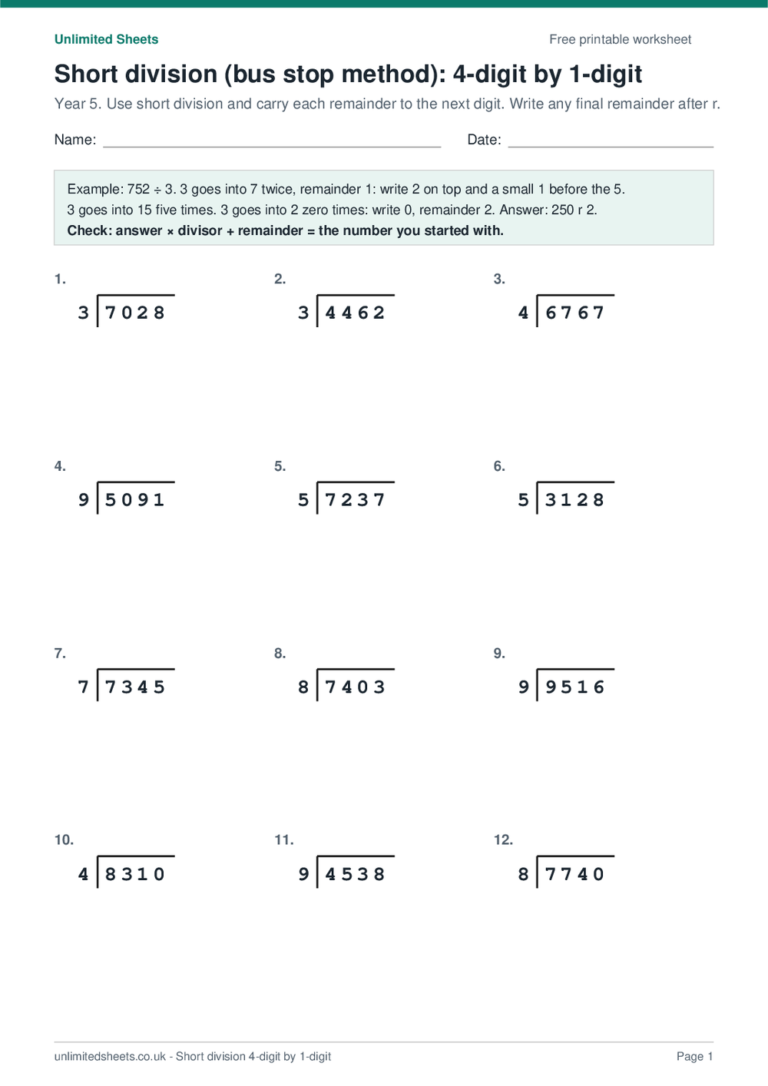
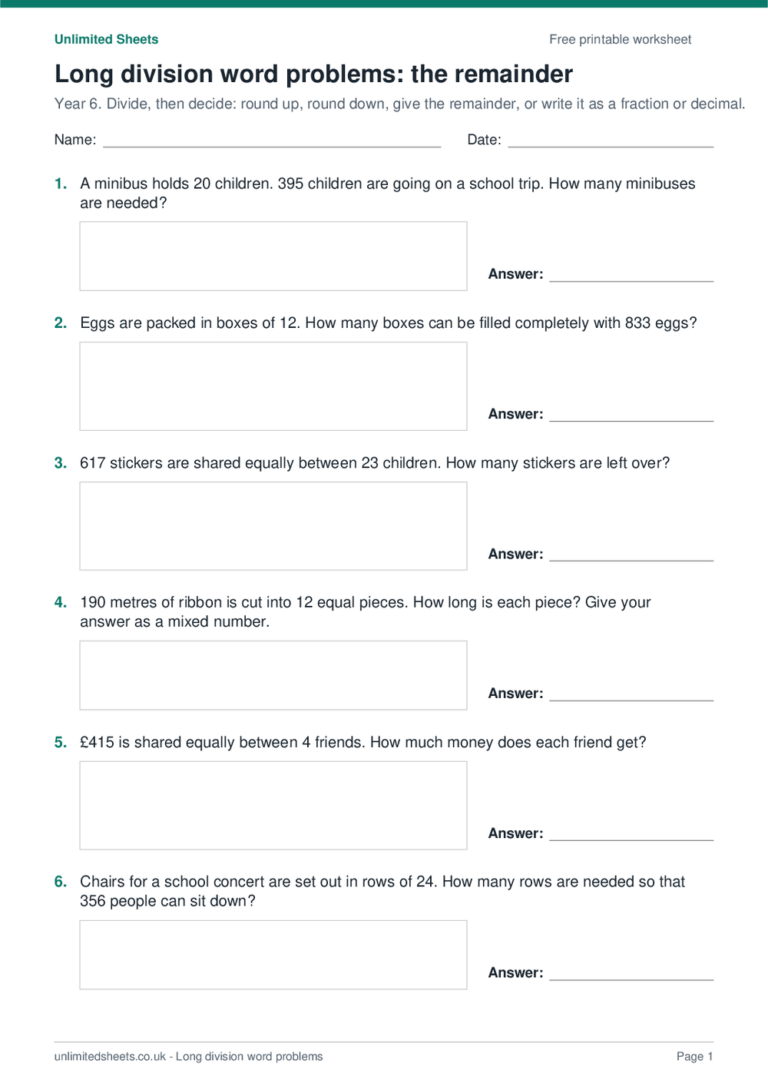
Year 5 division worksheets
Printable A4 PDFs. Practice sheets have the answers on the last page.
More division
Other years: Year 3 division, Year 4 division, Year 6 division. See how division builds up across the primary years on the division overview page.
More Year 5 maths: place value, addition, subtraction, multiplication, fractions, decimals, percentages, time, measurement, area and perimeter, angles, statistics, roman numerals. Back to all Year 5 maths.