
Year 1 time: what children learn in Year 1 and practice that marks itself. In Year 1, the national curriculum expects children to compare, describe and solve practical problems for: lengths and heights (for example, long/short, longer/shorter, tall/short, double/half); mass/weight (for example, heavy/light, heavier than, lighter than); capacity and volume (for example, full/empty, more than, less than, half, half full, quarter); time (for example, quicker, slower, earlier, later).
What Year 1 children learn about time
From the statutory Year 1 programme of study for mathematics:
- Compare, describe and solve practical problems for: lengths and heights (for example, long/short, longer/shorter, tall/short, double/half); mass/weight (for example, heavy/light, heavier than, lighter than); capacity and volume (for example, full/empty, more than, less than, half, half full, quarter); time (for example, quicker, slower, earlier, later)
- Measure and begin to record the following: lengths and heights; mass/weight; capacity and volume; time (hours, minutes, seconds)
- Sequence events in chronological order using language (for example, before and after, next, first, today, yesterday, tomorrow, morning, afternoon and evening)
- Recognise and use language relating to dates, including days of the week, weeks, months and years
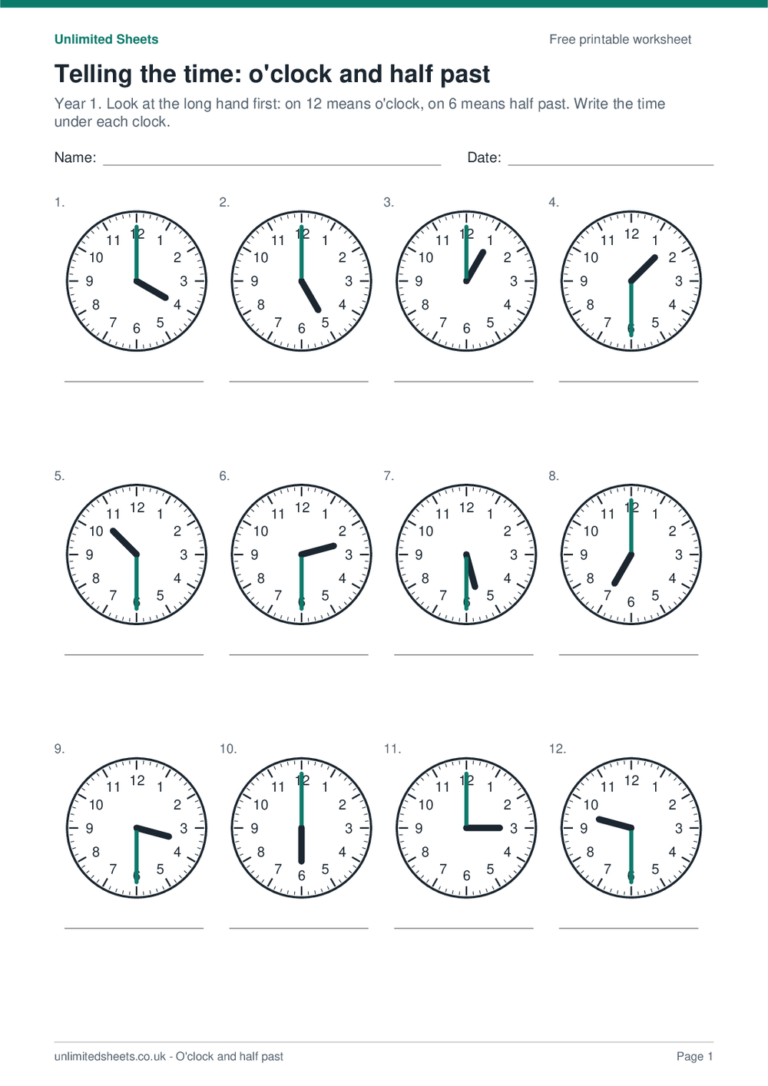
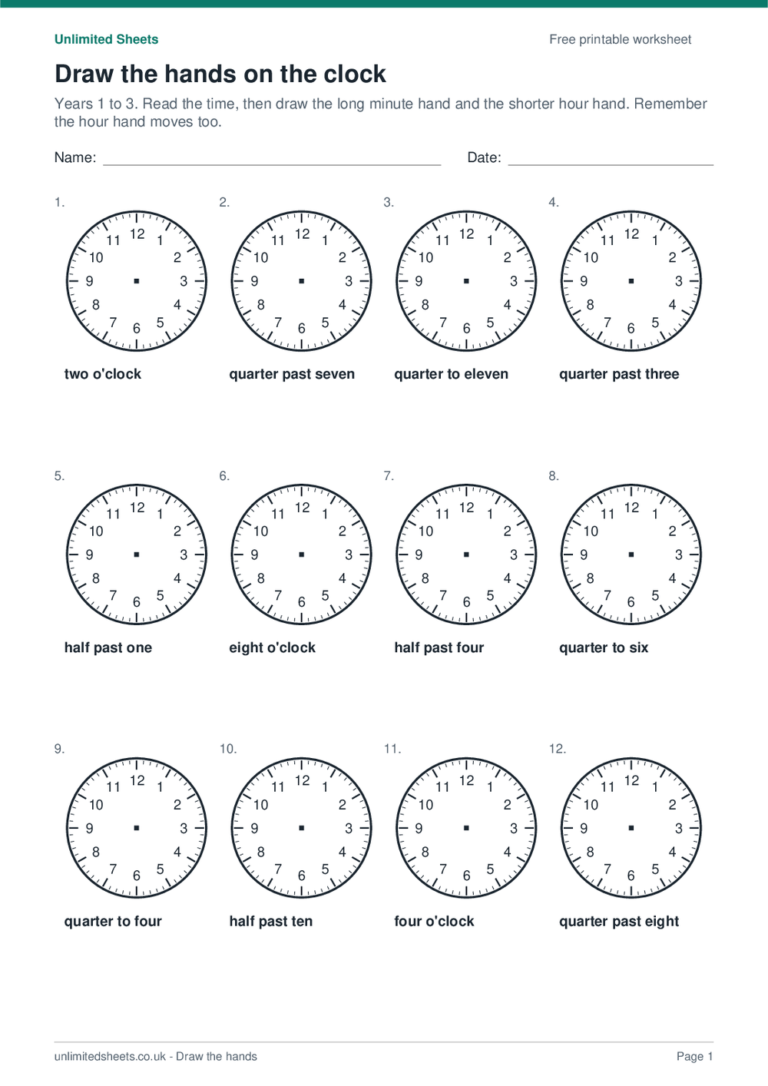
- Tell the time to the hour and half past the hour and draw the hands on a clock face to show these times
Worked example
Year 1: tell the time to the hour and half past the hour
What time does the clock show? (twelve o’clock / two o’clock / half past one / one o’clock)
- The long (minute) hand points to 12, so it is exactly on the hour.
- The short (hour) hand is on 1.
- So the time is 1:00, or one o’clock.
Answer: one o’clock
Year 1 time worksheets
Printable A4 PDFs. Practice sheets have the answers on the last page.
More time
Other years: Year 2 time, Year 3 time, Year 4 time, Year 5 time. See how time builds up across the primary years on the time overview page.
More Year 1 maths: number bonds, counting, addition, subtraction, fractions. Back to all Year 1 maths.