
Year 5 decimals: what children learn in Year 5 and practice that marks itself. In Year 5, the national curriculum expects children to identify, name and write equivalent fractions of a given fraction, represented visually, including tenths and hundredths.
What Year 5 children learn about decimals
From the statutory Year 5 programme of study for mathematics:
- Identify, name and write equivalent fractions of a given fraction, represented visually, including tenths and hundredths
- Read and write decimal numbers as fractions (for example, 0.71 = 71 )
- Recognise and use thousandths and relate them to tenths, hundredths and decimal equivalents
- Round decimals with two decimal places to the nearest whole number and to one decimal place
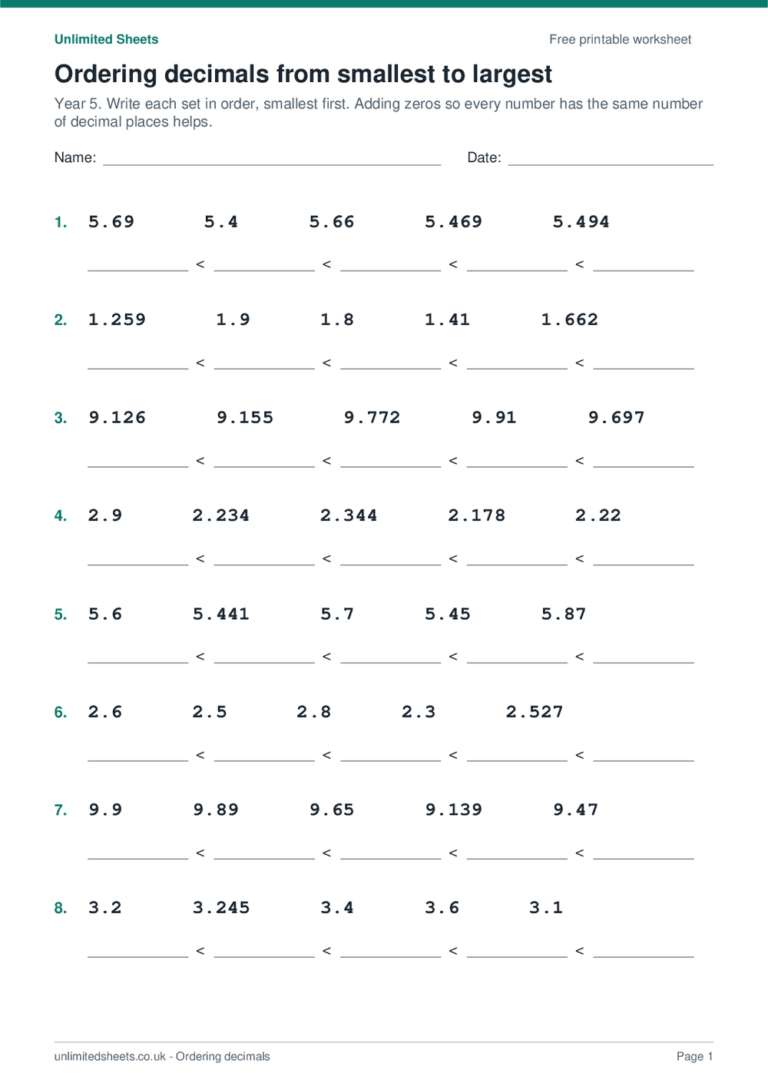
- Read, write, order and compare numbers with up to three decimal places
- Solve problems involving number up to three decimal places
- Recognise the per cent symbol (%) and understand that per cent relates to ‘number of parts per hundred’, and write percentages as a fraction with denominator 100, and as a decimal
- Solve problems which require knowing percentage and decimal equivalents of 1/2, 1/4, 1/5, 2/5, 4/5 and those fractions with a denominator of a multiple of 10 or 25
Worked examples
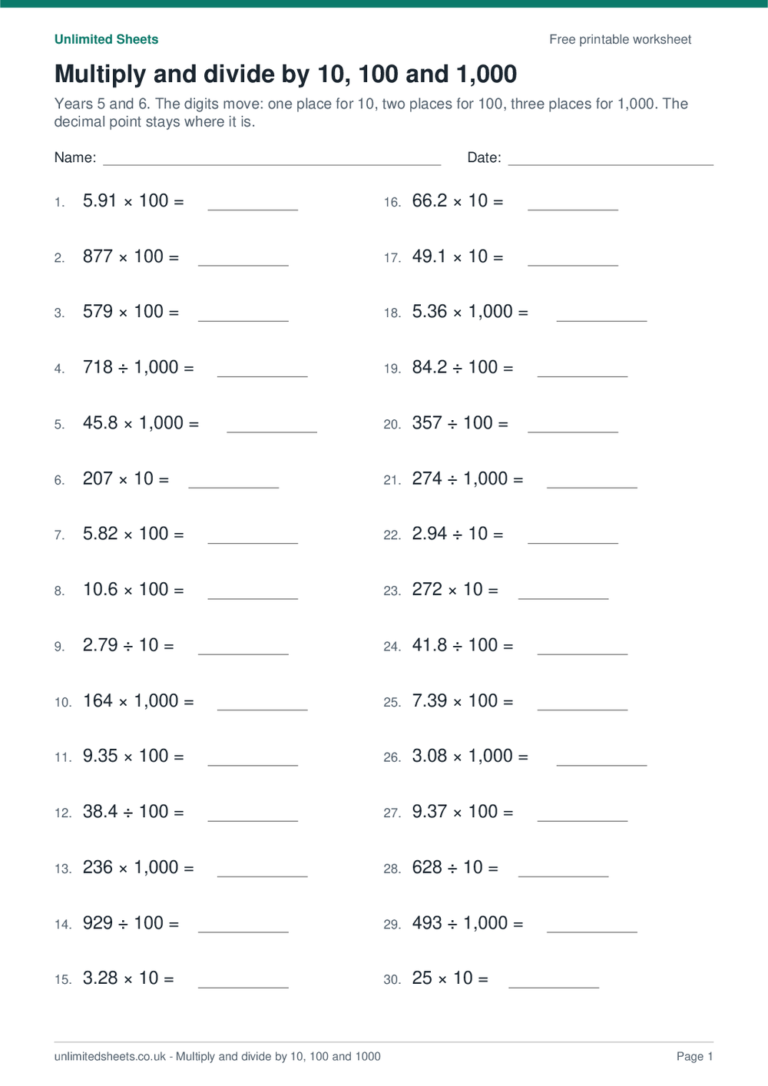
Years 5 and 6: multiply and divide by 10, 100 and 1,000
79.5 ÷ 10
- Dividing by 10 moves every digit 1 place to the right, so the number gets smaller.
- 79.5 ÷ 10 = 7.95.
Answer: 7.95
Years 4 to 6: fraction and decimal equivalents
Write 12 as a decimal
- 1/2 = 1 ÷ 2 = 0.5.
Answer: 0.5
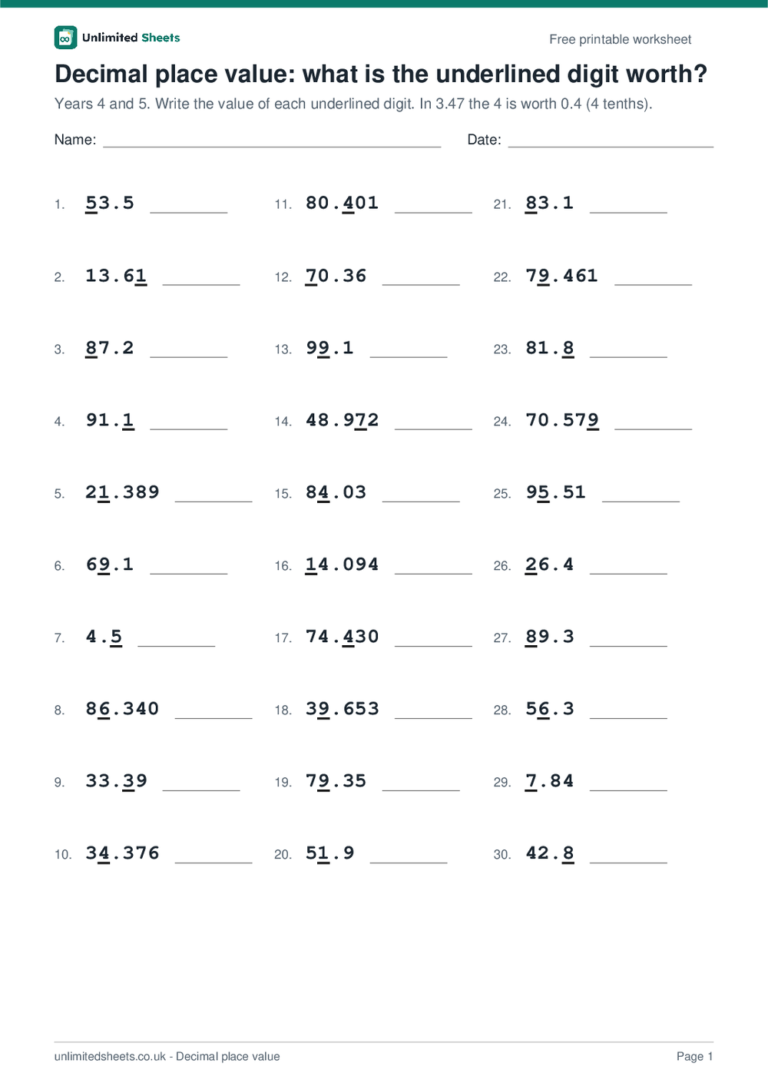
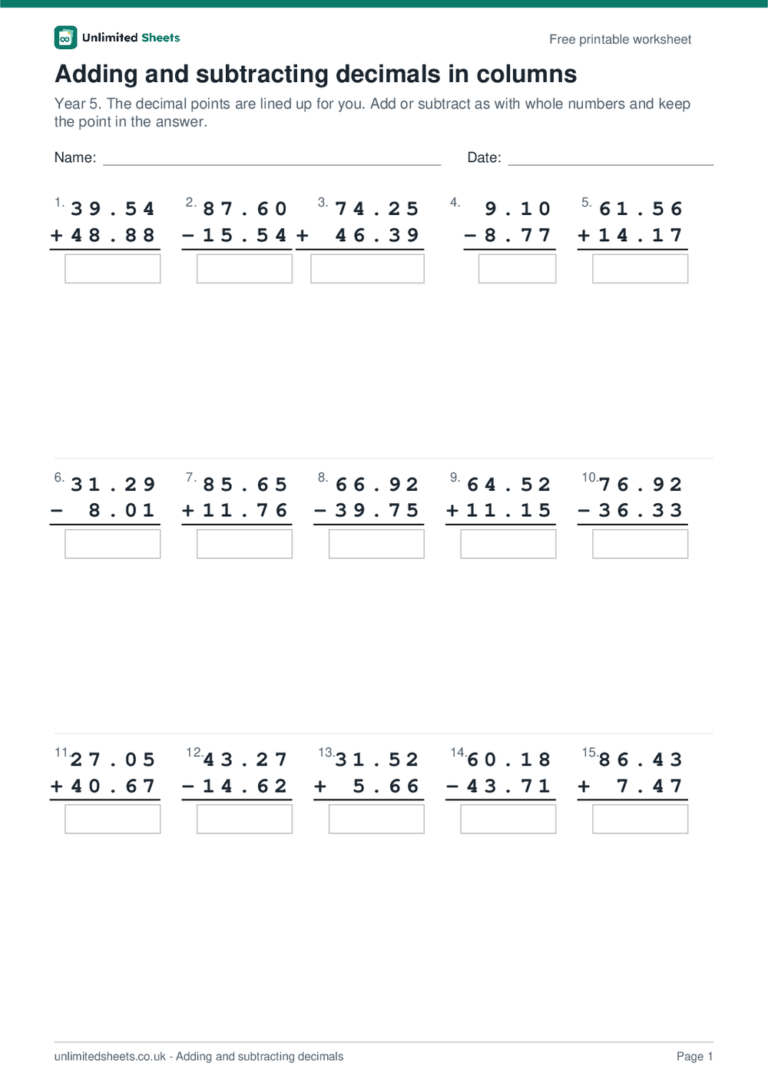
Year 5 decimals worksheets
Printable A4 PDFs. Practice sheets have the answers on the last page.
More decimals
Other years: Year 4 decimals, Year 6 decimals. See how decimals builds up across the primary years on the decimals overview page.
More Year 5 maths: place value, addition, subtraction, multiplication, division, fractions, percentages, time, measurement, area and perimeter, angles, statistics, roman numerals. Back to all Year 5 maths.