
The multiplication tables check (MTC) is a short on-screen test that every Year 4 child in England takes in June. It has 25 times tables questions, from the 2 to the 12 times table, and children have 6 seconds to answer each one. The practice check below works the same way: 3 practice questions, then 25 questions in the same mix of tables, a 6-second timer and a 3-second pause between questions. At the end you see the score and every fact to practise.
Loading the practice check…
No sign-up and nothing to download. It works on phones, tablets and computers, with the keyboard or the on-screen number pad.
How the real check works
| Questions | 25, each worth 1 mark, in the form 7 × 8 = |
|---|---|
| Time per question | 6 seconds; the answer on screen is accepted when time runs out, or the child can press Enter sooner |
| Between questions | A 3-second pause |
| Practice | 3 practice questions before the check starts |
| Tables | The 2 to 12 times tables; the 1 times table is not in the check |
| How long | Less than 5 minutes |
| How children answer | Keyboard, touchscreen or mouse, chosen by the school |
Questions are not in order of difficulty, each fact appears only once, and a check never has both 3 × 8 and 8 × 3. The check tests quick recall: there are no division questions and no word problems.
Which times tables come up most
The official framework sets how many questions each table can have in one check. There are more from the 6, 7, 8, 9 and 12 times tables because these are the hardest. Our practice check follows the same limits.
| Times table | Questions in one check |
|---|---|
| 2 times table | 0 to 2 |
| 3 times table | 1 to 3 |
| 4 times table | 1 to 3 |
| 5 times table | 1 to 3 |
| 6 times table | 2 to 4 |
| 7 times table | 2 to 4 |
| 8 times table | 2 to 4 |
| 9 times table | 2 to 4 |
| 10 times table | 0 to 2 |
| 11 times table | 1 to 3 |
| 12 times table | 2 to 4 |
Together, the 2, 5 and 10 times tables (taught in Year 2) make up only 3 to 7 of the 25 questions.
When is the MTC in 2027?
Schools must give the check in the two weeks from Monday 7 June 2027; each school chooses the day. In 2028 the window starts on Monday 5 June 2028. From April, schools can use a “try it out” area so that children see the real screens before June.
What is a good MTC score?
There is no pass mark. Schools receive a score out of 25 for each child, and the class teacher shares your child’s score with you. In June 2026 the national average was 21.6 out of 25 (up from 21.0 in 2025), and 42% of pupils scored full marks (up from 37%). Full marks was the most common score.
A score below the average is not a fail: it shows which facts still need work, which is exactly what the results table in the practice check gives you.
Access arrangements
Schools can switch on support for children who need it, for example a Next button instead of the automatic 3-second pause, different text and background colours, larger text, an audio version, an audible time alert or an adult who types the answers the child says. In the practice check you can turn on the Next button, and you can choose 9 or 12 seconds per question while your child is still learning the facts.
Printable multiplication tables check practice
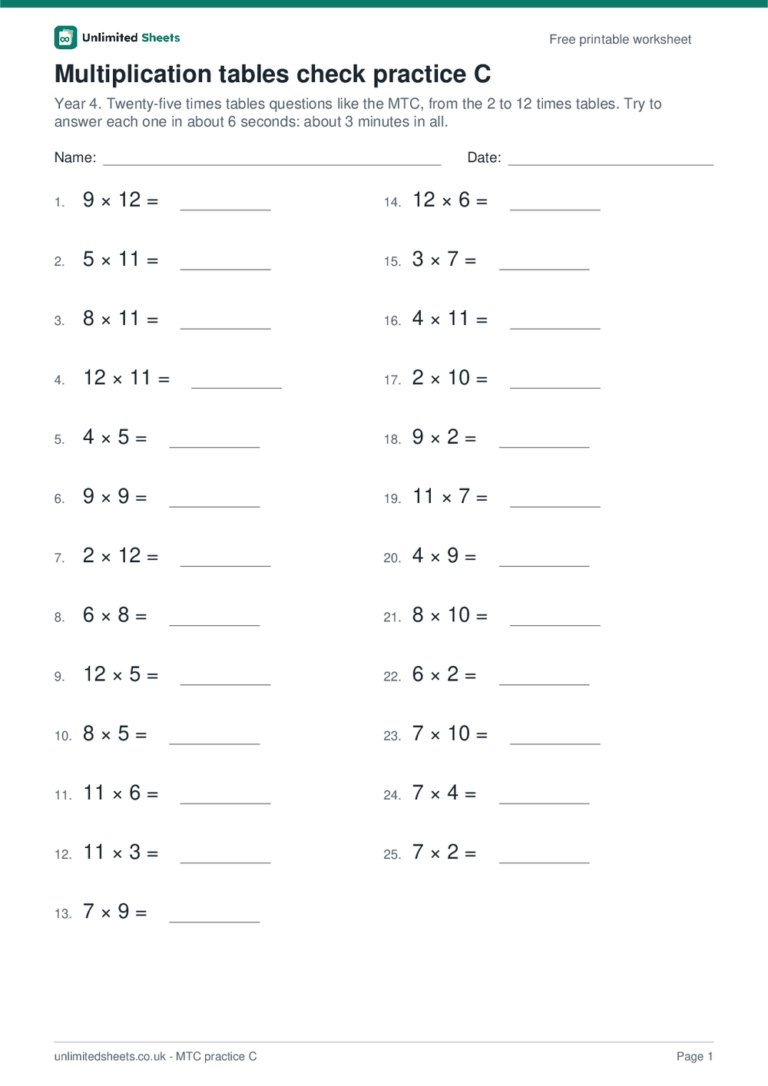
Three sheets of 25 questions in the same mix of tables as the real check, with answers on page 2. On paper, aim for about 3 minutes per sheet.


How to prepare at home
- Find the gaps. Do one full practice check and note every fact that was wrong or too slow.
- Learn one table at a time. Each table page, from the 2 times table to the 12 times table, has practice, patterns and a printable sheet.
- Practise only the missed facts. Use “Practise these facts” on the results screen.
- Make it a game. Our times tables games build speed without the pressure of a test.
- Five minutes most days works better than a long session at the weekend.
More for this year group: Year 4 times tables, the times table grid and worksheets and everything on the Year 4 page.
Sources
Multiplication tables check assessment framework; Multiplication tables check administration guidance; Multiplication tables check: information for parents; Primary assessments: future dates; Multiplication tables check attainment: 2026. Standards and Testing Agency and Department for Education, GOV.UK. Contains public sector information licensed under the Open Government Licence v3.0.
Updated 23 November 2026.