
Year 5 time: what children learn in Year 5 and practice that marks itself. In Year 5, the national curriculum expects children to convert between different units of metric measure (for example, kilometre and metre; centimetre and metre; centimetre and millimetre; gram and kilogram; litre and millilitre).
What Year 5 children learn about time
From the statutory Year 5 programme of study for mathematics:
- Convert between different units of metric measure (for example, kilometre and metre; centimetre and metre; centimetre and millimetre; gram and kilogram; litre and millilitre)
- Measure and calculate the perimeter of composite rectilinear shapes in centimetres and metres
- Calculate and compare the area of rectangles (including squares), and including using standard units, square centimetres (cm²) and square metres (m²), and estimate the area of irregular shapes
- Solve problems involving converting between units of time
Worked example
Years 3 to 5: find the duration in minutes
How many minutes from 1:10 to 2:10?
- Count on to the next o’clock: 1:10 to 2:00 is 50 minutes.
- Then 2:00 to 2:10 is 10 minutes.
- Total: 60 minutes.
Answer: 60
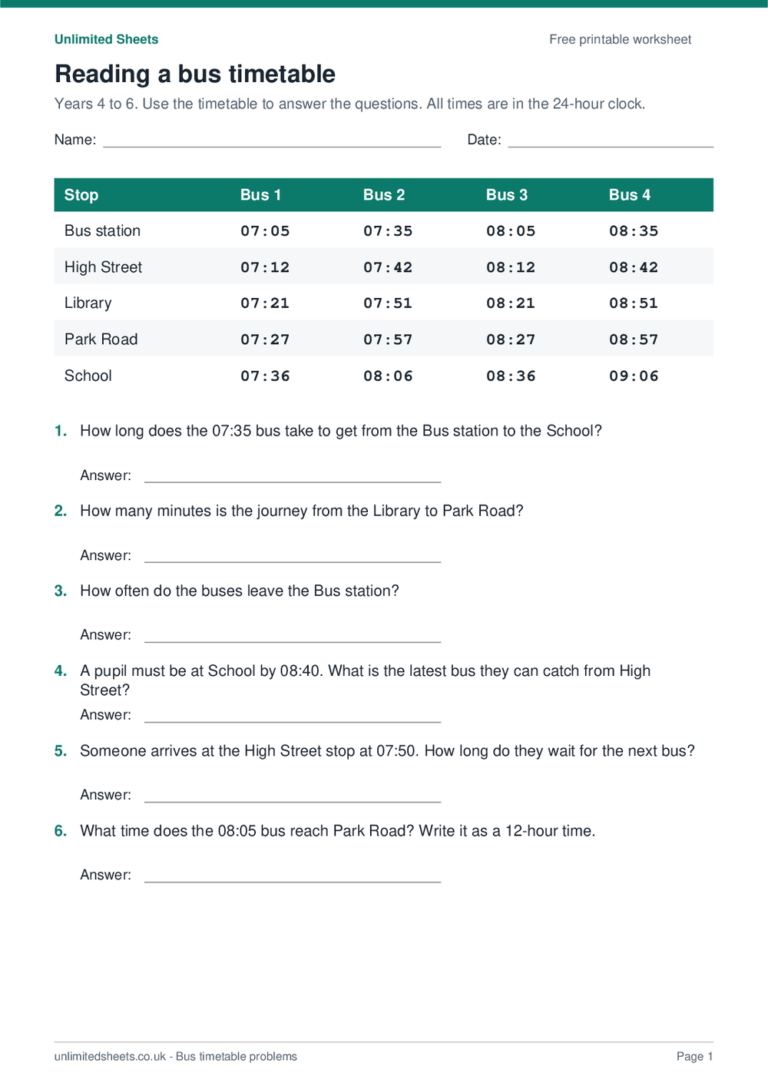
Year 5 time worksheets
Printable A4 PDFs. Practice sheets have the answers on the last page.
More time
Other years: Year 1 time, Year 2 time, Year 3 time, Year 4 time. See how time builds up across the primary years on the time overview page.
More Year 5 maths: place value, addition, subtraction, multiplication, division, fractions, decimals, percentages, measurement, area and perimeter, angles, statistics, roman numerals. Back to all Year 5 maths.