
Phonics teaches children to read by linking sounds (phonemes) to the letters that write them (graphemes), then blending the sounds together to read words. In England, children learn phonics from Reception, and in Year 1 they take the phonics screening check. Many schools and parents still talk about the six phases of Letters and Sounds, the Department for Education’s 2007 programme. Here is what each phase covers.
The six phonics phases
| Phase | When | What children learn |
|---|---|---|
| Phase 1 | Before letters | Listening to sounds, rhythm and rhyme, and oral blending and segmenting (hearing c-a-t as cat) |
| Phase 2 | Up to 6 weeks, Reception | 23 graphemes from s, a, t, p to ff, ll and ss; blending CVC words; tricky words the, to, I, no, go |
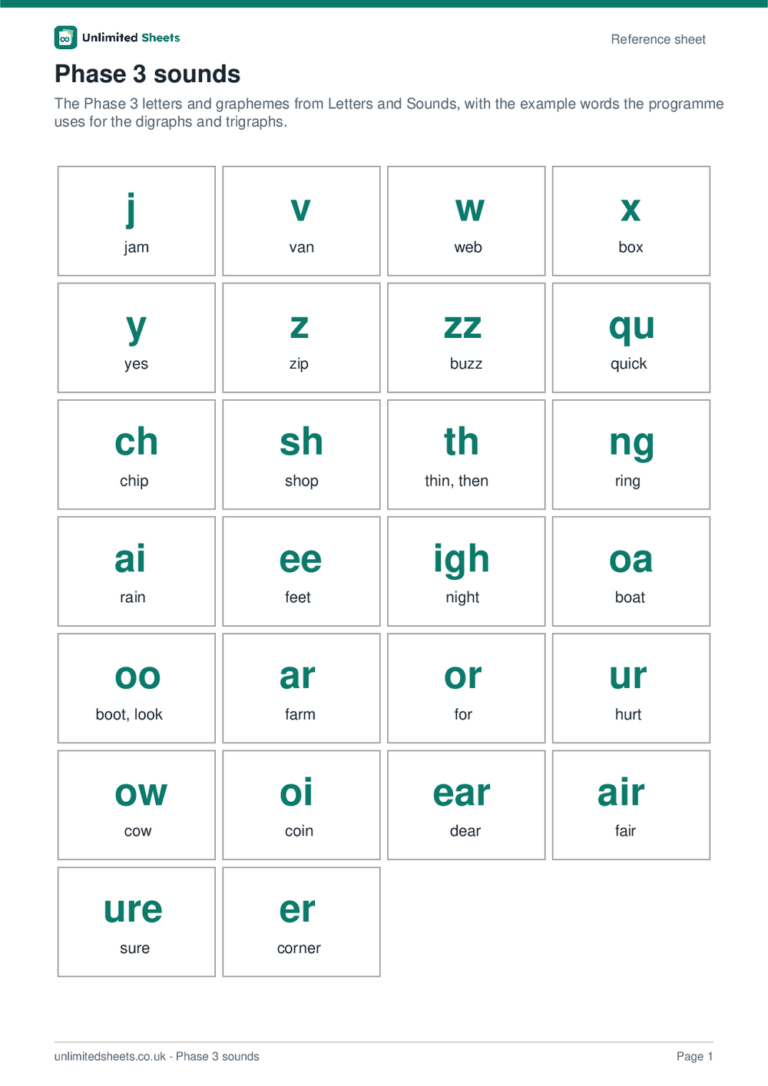
| Phase 3 | Up to 12 weeks, Reception | The rest of the alphabet and 18 digraphs and trigraphs such as ch, sh, ai, ee and igh; letter names; 12 more tricky words |
| Phase 4 | 4 to 6 weeks, Reception | No new sounds; words with adjacent consonants such as jump, frog and string |
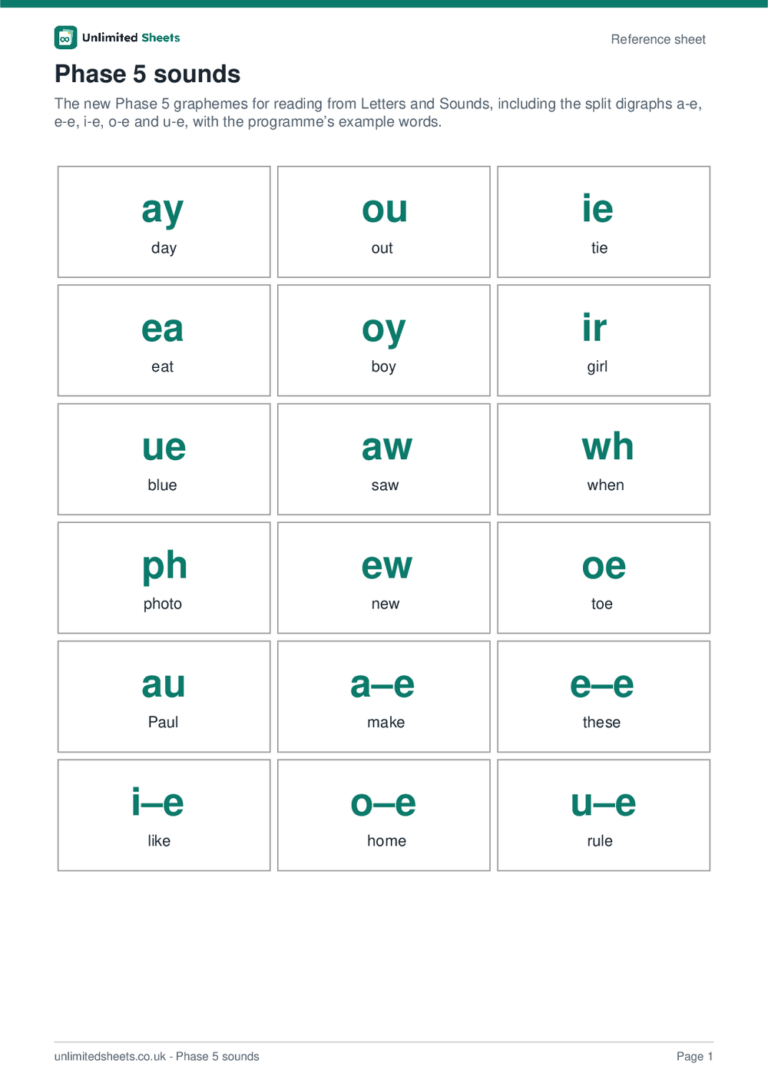
| Phase 5 | Throughout Year 1 | New graphemes for known sounds (ay, ou, ie, ea, split digraphs) and alternative pronunciations |
| Phase 6 | Throughout Year 2 | Spelling: past tense, suffixes and spelling long words |
The timings are the guidance in Letters and Sounds. Children move on when they are ready; there is no need to master every Phase 1 skill before starting Phase 2.
Your school’s scheme may differ. Many schools use one of the 45 phonics programmes validated by the Department for Education, such as Little Wandle Letters and Sounds Revised or Read Write Inc. They teach the same sounds, but in their own order and with their own names for the stages. Schools do not have to use a validated programme, but resources at home work best when they match the school’s order, so ask the class teacher which scheme they use.
Phonics practice
For something more playful, try the five phonics games, from real or alien words to building words from sounds.
Key phonics words for parents
- Phoneme: the smallest unit of sound in a word. Phonemes and graphemes explains more.
- Grapheme: a letter or group of letters that writes one phoneme, such as s, sh or igh.
- Digraph, trigraph, split digraph: two, three or separated letters making one sound. See digraphs.
- Blending: saying the sounds in order and merging them to read a word: sh-i-p, ship.
- Segmenting: splitting a spoken word into its sounds to spell it.
- CVC word: consonant, vowel, consonant, such as cat. See CVC words.
- Tricky word: a common word with a part that does not follow the phonics children know yet, such as the or was. See tricky words.
Printable sounds mats


How to help at home
- Use pure sounds: say “mmm”, not “muh”, so that blending works.
- Ask your child to sound out new words and blend from left to right, rather than guessing from the picture.
- Read the decodable book your child brings home more than once; fluency comes from rereading.
- Keep reading stories aloud to your child too, for vocabulary and enjoyment.
More for this age: Reception, Year 1 English and the common exception words.
Sources
Letters and Sounds: principles and practice of high quality phonics (DfES, 2007); Choosing a phonics teaching programme (DfE, updated November 2026); Phonics screening check: information for parents. GOV.UK. Contains public sector information licensed under the Open Government Licence v3.0.
Updated 23 November 2026.