
Reception maths is about really knowing the numbers to 10: counting objects, seeing small amounts without counting, and knowing which pairs make 5 and 10. By the end of Reception most children are expected to subitise up to 5, recall number bonds up to 5 and some bonds to 10, count beyond 20 and compare amounts up to 10. Choose a skill below and practise little and often.
What children learn in Reception maths
The early learning goals for mathematics, from the EYFS framework, say that by the end of Reception children at the expected level of development will:
- have a deep understanding of numbers to 10, including what each number is made of;
- subitise (recognise quantities without counting) up to 5;
- recall number bonds up to 5, including subtraction facts, and some number bonds to 10, including doubles;
- count beyond 20 out loud and spot the pattern of the counting system;
- compare quantities up to 10 and say which is more, fewer or the same;
- explore patterns within numbers up to 10, including odd and even numbers, doubles and sharing equally.
Counting to 10 and beyond
Good counting has three parts: saying the numbers in order, touching or moving one object for each number, and knowing that the last number said tells you how many. Children often know the words before the last part clicks, so ask “how many is that?” after they count.
Subitising
Subitising means seeing how many there are without counting, as you do with the dots on a dice. It is a goal in its own right and a big help with number bonds. There is more on the subitising page, with dot cards to print.
Number bonds to 5 and 10
A number bond is a pair of numbers that make a total: 2 and 3 make 5. Reception children learn all the bonds to 5 by heart, including the take-aways such as 5 − 2 = 3, and start on the bonds to 10. Fingers are perfect for this: show 5 fingers, fold some down and talk about how many are up and down. The number bonds page carries on to 10 and 20 for Year 1.
More, fewer and the same
To compare two groups, line them up one to one. The group with some left over has more. Use “fewer” for things you can count and “less” for amounts such as water or sand.
Shape and pattern
Most Reception classes also explore shape and space: naming circles, triangles, squares and rectangles, noticing that a shape keeps its name when it is turned round, and continuing repeating patterns such as red, blue, red, blue.
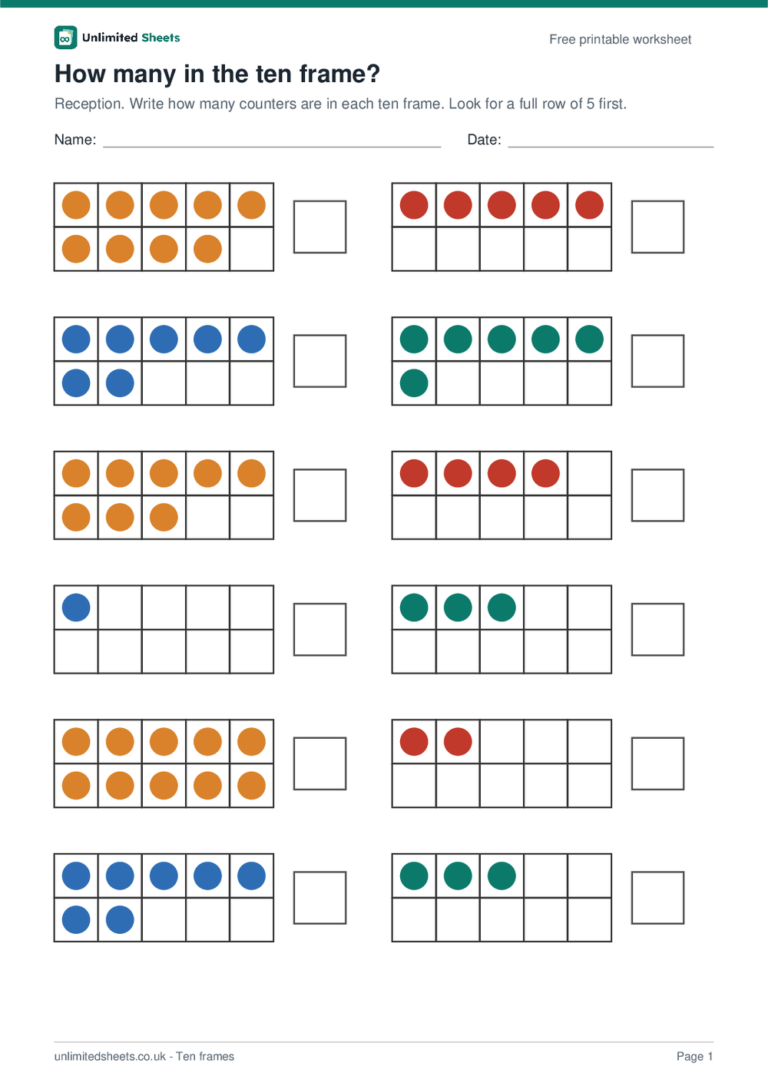
Reception maths worksheets


EYFS maths activities at home
- Snack-time maths: share grapes between two plates and check it is fair.
- Dice games: snakes and ladders builds dice patterns and counting on.
- Hide and count: hide some of 5 toys under a cup: how many are hiding?
- Number walks: spot numbers on doors, buses and signs.
- Tidy-up counting: count toys into the box and say one more each time.
Next steps
Ready for more? Year 1 maths builds on all of this with number bonds to 20 and adding and subtracting within 20. See everything for this year on the Reception page.
Sources
Early years foundation stage (EYFS) statutory framework for group and school-based providers (from September 2026); National curriculum in England: mathematics programmes of study. Department for Education and Standards and Testing Agency, GOV.UK. Contains public sector information licensed under the Open Government Licence v3.0.
Updated 23 November 2026.