
Year 2 shapes: what children learn in Year 2 and practice that marks itself. In Year 2, the national curriculum expects children to identify and describe the properties of 2-D shapes, including the number of sides and line symmetry in a vertical line.
What Year 2 children learn about shapes
From the statutory Year 2 programme of study for mathematics:
- Identify and describe the properties of 2-D shapes, including the number of sides and line symmetry in a vertical line
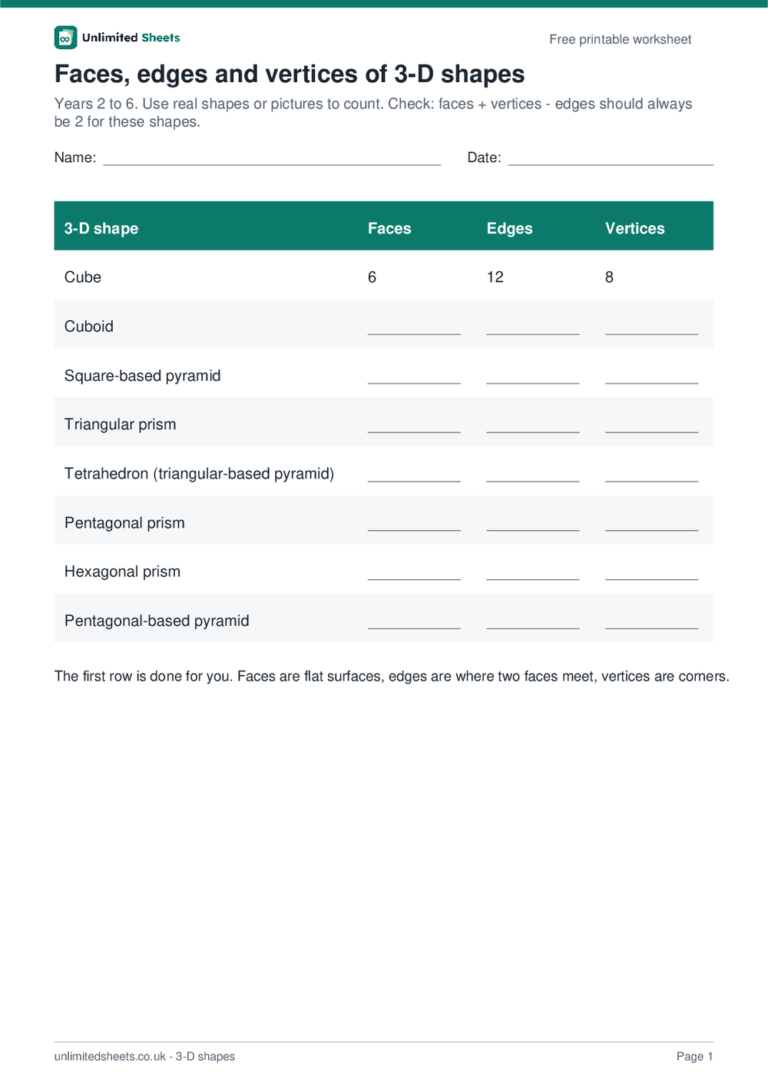
- Identify and describe the properties of 3-D shapes, including the number of edges, vertices and faces
- Identify 2-D shapes on the surface of 3-D shapes, (for example, a circle on a cylinder and a triangle on a pyramid)
- Compare and sort common 2-D and 3-D shapes and everyday objects
Worked examples
Years 1 and 2: name 2-D shapes and count their sides
What is the name of this shape? (octagon / hexagon / heptagon / triangle)
- Count the straight sides: there are 3.
- A shape with 3 straight sides is a triangle.
Answer: triangle
Year 2: faces, edges and vertices of 3-D shapes
How many edges does a cube have?
- A cube has 6 faces, 12 edges and 8 vertices.
- Check with Euler’s rule: faces + vertices − edges = 6 + 8 − 12 = 2.
Answer: 12
Year 2 shapes worksheets
Printable A4 PDFs. Practice sheets have the answers on the last page.
More shapes
See how shapes builds up across the primary years on the shapes overview page.
More Year 2 maths: counting, place value, addition, subtraction, times tables, fractions, time, statistics. Back to all Year 2 maths.