
Year 3 time: what children learn in Year 3 and practice that marks itself. In Year 3, the national curriculum expects children to tell and write the time from an analogue clock, including using Roman numerals from I to XII, and 12-hour and 24-hour clocks.
What Year 3 children learn about time
From the statutory Year 3 programme of study for mathematics:
- Tell and write the time from an analogue clock, including using Roman numerals from I to XII, and 12-hour and 24-hour clocks
- Estimate and read time with increasing accuracy to the nearest minute; record and compare time in terms of seconds, minutes and hours; use vocabulary such as o’clock, a.m./p.m., morning, afternoon, noon and midnight
- Know the number of seconds in a minute and the number of days in each month, year and leap year
- Compare durations of events (for example to calculate the time taken by particular events or tasks)
Worked examples
Year 3: read the time to the nearest minute. Type it like 7:43
What time does the clock show? (for example 3:42)
- The long (minute) hand points to a small mark 39 minutes past the 12.
- The short (hour) hand is past halfway between 1 and 2.
- So the time is 1:39, or 21 minutes to two.
Answer: 1:39
Years 3 to 5: find the duration in minutes
How many minutes from 1:45 to 3:10?
- Count on to the next o’clock: 1:45 to 2:00 is 15 minutes.
- Then 2:00 to 3:00 is 1 hour = 60 minutes.
- Then 3:00 to 3:10 is 10 minutes.
- Total: 85 minutes.
Answer: 85
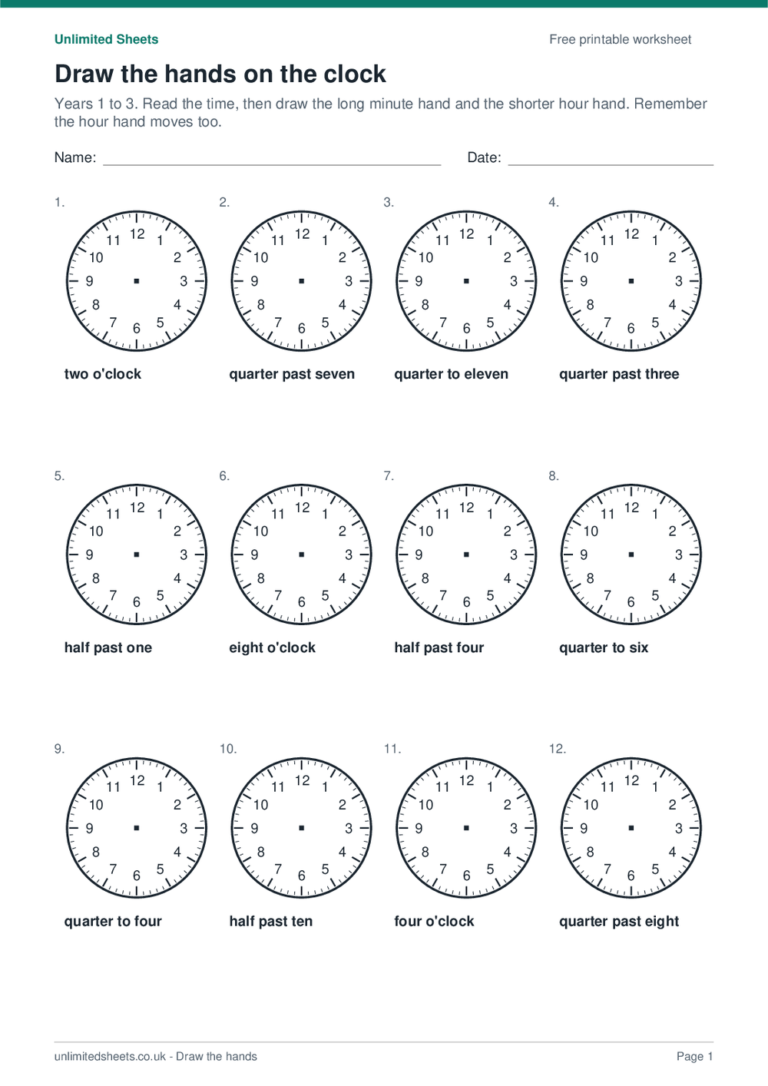
Year 3 time worksheets
Printable A4 PDFs. Practice sheets have the answers on the last page.
More time
Other years: Year 1 time, Year 2 time, Year 4 time, Year 5 time. See how time builds up across the primary years on the time overview page.
More Year 3 maths: place value, addition, subtraction, times tables, multiplication, division, fractions, measurement, angles, statistics. Back to all Year 3 maths.