
Number bonds are pairs of numbers that add up to a given total, such as 7 + 3 = 10. Knowing the bonds to 10 and 20 by heart is one of the main Year 1 maths objectives, and Year 2 children use them to work out facts up to 100.
Choose a level below. The questions mark themselves, and each one shows a quick way to work it out.
What the national curriculum says
In Year 1, pupils should be taught to “represent and use number bonds and related subtraction facts within 20” and to add and subtract one-digit and two-digit numbers to 20, including zero. In Year 2 they recall and use addition and subtraction facts to 20 fluently, and derive and use related facts up to 100.
All the number bonds to 10, 20 and 100
| Bonds to 10 | Bonds to 20 | Bonds to 100 (tens) |
|---|---|---|
| 0 + 10 = 10 | 10 + 10 = 20 | 0 + 100 = 100 |
| 1 + 9 = 10 | 11 + 9 = 20 | 10 + 90 = 100 |
| 2 + 8 = 10 | 12 + 8 = 20 | 20 + 80 = 100 |
| 3 + 7 = 10 | 13 + 7 = 20 | 30 + 70 = 100 |
| 4 + 6 = 10 | 14 + 6 = 20 | 40 + 60 = 100 |
| 5 + 5 = 10 | 15 + 5 = 20 | 50 + 50 = 100 |
| 6 + 4 = 10 | 16 + 4 = 20 | 60 + 40 = 100 |
| 7 + 3 = 10 | 17 + 3 = 20 | 70 + 30 = 100 |
| 8 + 2 = 10 | 18 + 2 = 20 | 80 + 20 = 100 |
| 9 + 1 = 10 | 19 + 1 = 20 | 90 + 10 = 100 |
| 10 + 0 = 10 | 20 + 0 = 20 | 100 + 0 = 100 |
Look along each row: the bonds to 20 are the bonds to 10 with ten added to the first number, and the bonds to 100 are the bonds to 10 multiplied by ten. Learning one set gives you the other two.
Related subtraction facts
Every bond gives two subtraction facts. From 6 + 4 = 10 you also know 10 − 4 = 6 and 10 − 6 = 4. This is why the curriculum puts number bonds and subtraction together: a child who knows the bonds can subtract within 10 or 20 without counting back.
How to learn number bonds
- Use ten fingers. Hold up 7 fingers; the fingers that are down show the bond, 3.
- Draw a ten frame. Fill some of the ten boxes with dots; the empty boxes are the missing number.
- Learn them in pairs. 1 and 9, 2 and 8, 3 and 7, 4 and 6, 5 and 5. Saying them as pairs makes them easier to remember.
- Use them to cross 10. For 8 + 5, take 2 from the 5 to make 10, then add the 3 left: 13.
Counting in 2s, 5s and 10s
Alongside number bonds, Year 1 children count to 100, find one more and one less than a number, and count in multiples of 2, 5 and 10. These skills are practised on the Year 1 maths page and lead straight into the 2, 5 and 10 times tables in Year 2.
Common mistakes
- Counting all instead of counting on: for 8 + 5, starting from 1 instead of from 8.
- Forgetting zero: 0 + 10 and 10 + 0 are bonds too.
- Reading the sign wrongly in a page of mixed additions and subtractions.
Printable number bonds worksheets
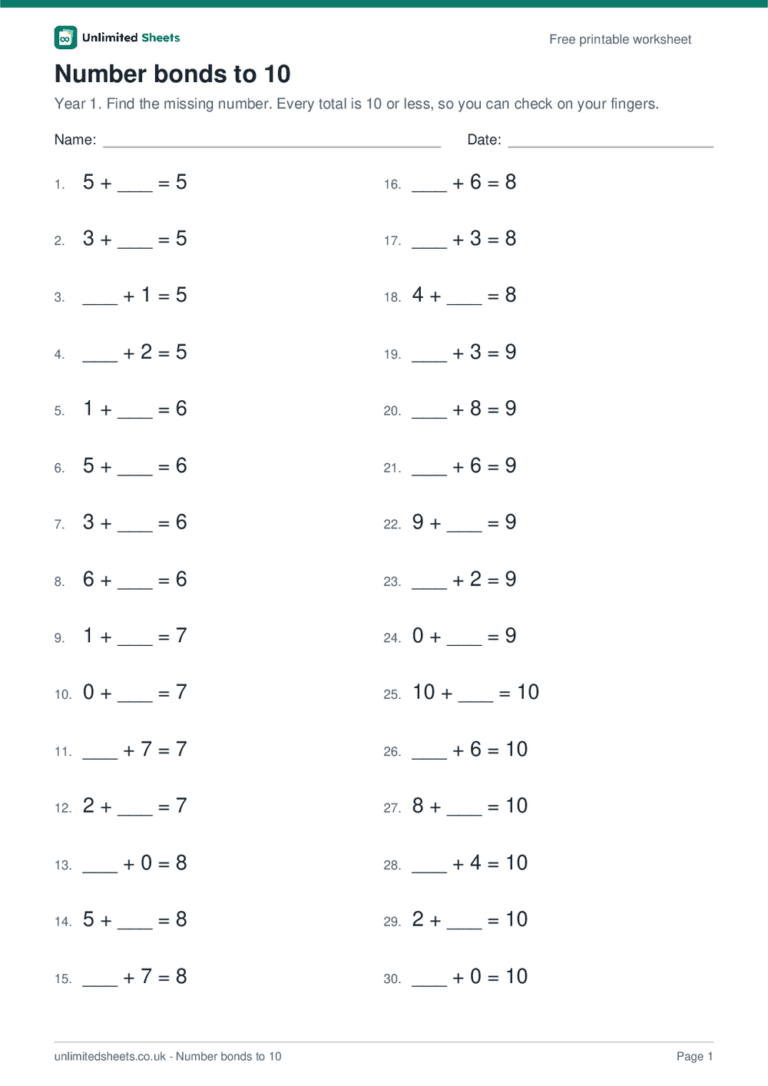

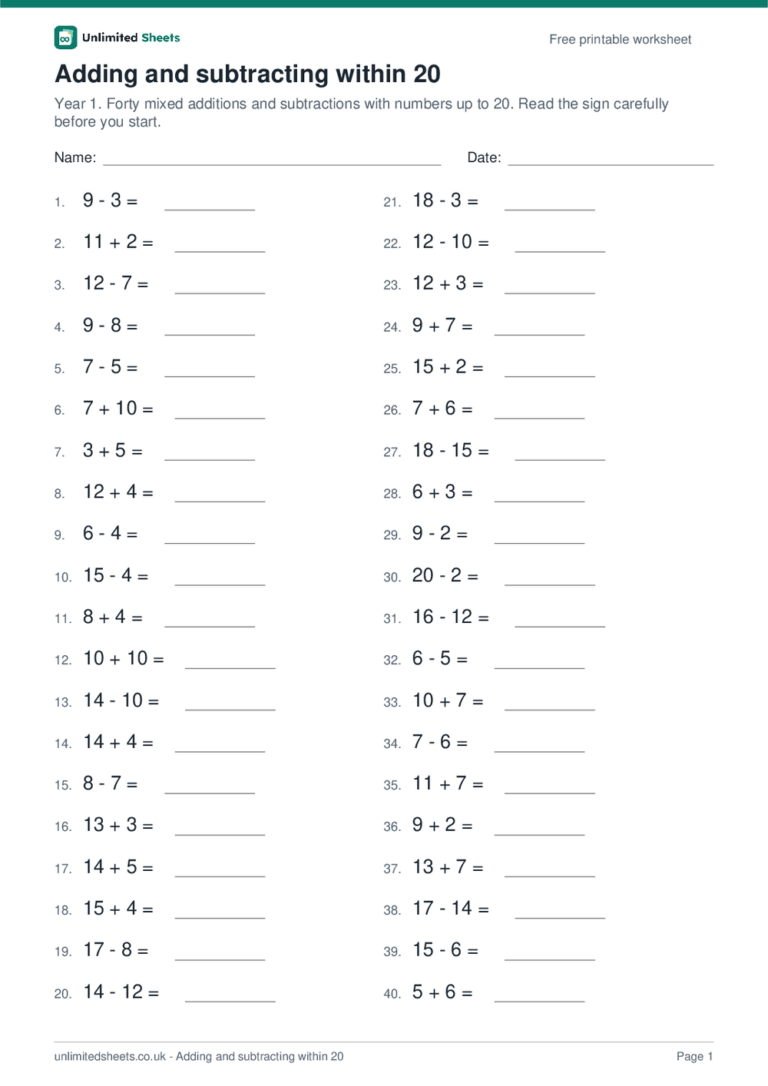
- Number bonds to 10 (Year 1). Thirty number bonds with totals from 5 to 10, with the missing number sometimes first and sometimes second.
- Number bonds to 20 (Year 1). Bonds to 20 written as missing-number additions and as subtractions, so children see the related facts together.
- Adding and subtracting within 20 (Year 1). Forty mixed calculations within 20, the Year 1 objective that underpins all later mental maths.
Practice for each year group
Each page below has only the practice, curriculum objectives and worksheets for that year.
Keep practising
Updated 23 November 2026.