
Negative numbers are numbers less than zero, written with a minus sign: −1, −2, −3 and so on. You see them on thermometers in winter, on lift buttons for floors below ground and on bank statements. Children start counting back through zero in Year 4 and work out differences across zero by Year 6.
Think of a number line
Every question about negative numbers is easier with a number line. Zero sits in the middle; positive numbers go to the right and negative numbers to the left. The further left a number is, the smaller it is, so −8 is smaller than −3, even though 8 is bigger than 3.
| −5 | −4 | −3 | −2 | −1 | 0 | 1 | 2 | 3 | 4 | 5 |
Counting back through zero (Year 4)
Start at 3 and count back 5: 2, 1, 0, −1, −2. So 3 − 5 = −2. A quick way: it takes 3 steps to reach zero, and the other 2 steps go below it.
Temperature (Year 5)
Temperature is the context children meet most. If it is 4°C and the temperature falls by 9 degrees, count down 4 to reach 0°C, then 5 more: −5°C. If it is −6°C and it rises by 10 degrees, count up 6 to reach 0°C, then 4 more: 4°C.
The difference across zero (Year 6)
To find the difference between −7°C and 5°C, split the jump at zero: from −7 up to 0 is 7, from 0 up to 5 is 5, so the difference is 7 + 5 = 12 degrees. The same method works for heights above and below sea level.
Common mistakes
- Thinking −8 is bigger than −3 because 8 is bigger than 3. On a number line, −8 is further left, so it is smaller and colder.
- Forgetting zero when counting: counting back 5 from 3 must pass through 0, not jump from 1 to −1.
- Subtracting for a difference across zero: the difference between −7 and 5 is 12, not 2.
In the national curriculum
- Year 4: count backwards through zero to include negative numbers.
- Year 5: interpret negative numbers in context, and count forwards and backwards through zero.
- Year 6: use negative numbers in context, and calculate intervals across zero.
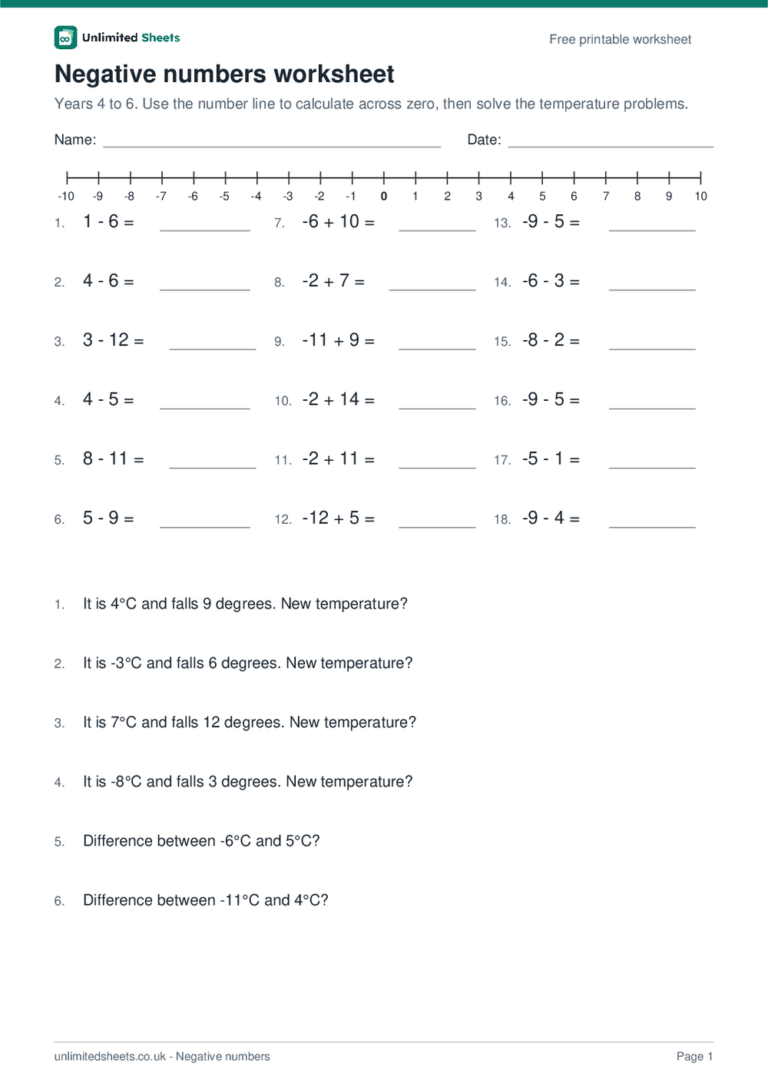
Printable negative numbers worksheet
Related pages
Place value, Year 4 place value, Year 5 place value and Year 6 place value.
Sources
National curriculum in England: mathematics programmes of study, Department for Education, GOV.UK.
Updated 23 November 2026.