
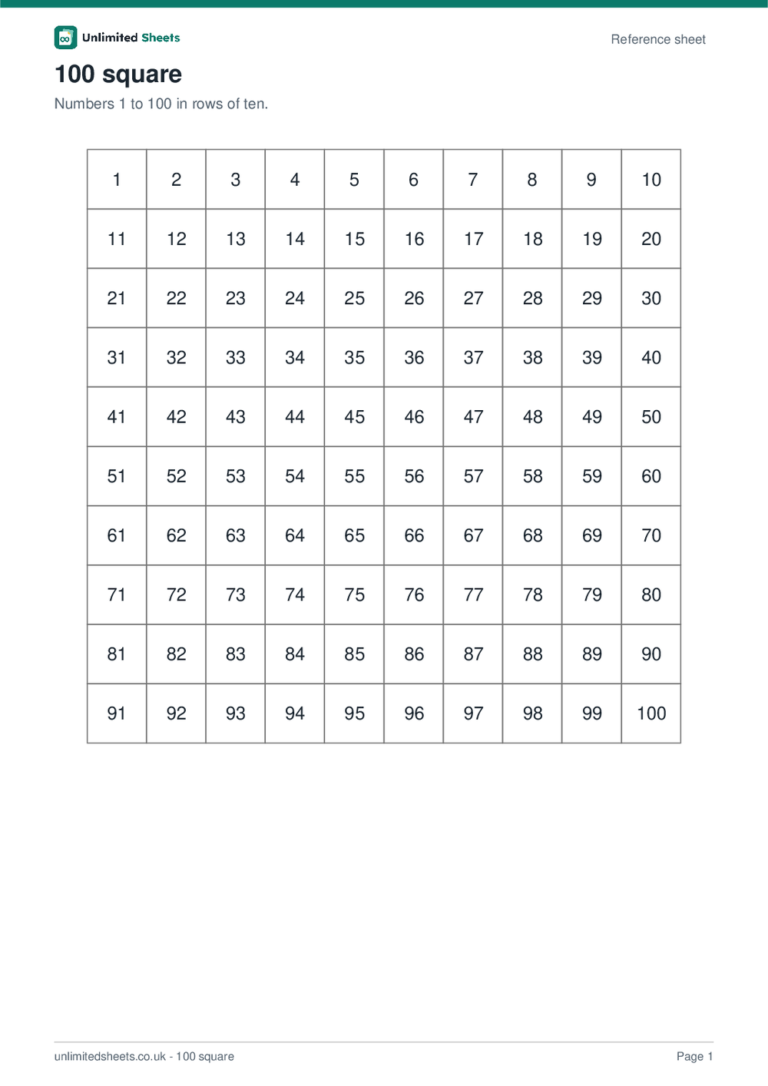
A 100 square, or hundred square, shows the numbers 1 to 100 in ten rows of ten. It is one of the most useful tools in primary maths: children use it to count, to add and subtract 10, and to see the patterns made by the times tables. Use the interactive version below or print one.
Loading the 100 square…
What the 100 square shows
- Moving right adds 1; moving left takes away 1.
- Moving down adds 10; moving up takes away 10. The ones digit stays the same, which is a great way to see place value.
- Columns all end in the same digit, so 7, 17, 27 and 37 line up.
- Multiples make patterns: multiples of 10 fill the last column, multiples of 5 make two columns, multiples of 9 make a diagonal, and multiples of 2 make stripes. Try them with the buttons above.
Five quick activities
- Count on and back: start on any number and count on 10, then back 3. Where do you land?
- Ten more, ten less: point to a number; your child says the number above and below it.
- Number bonds to 100: find 30, then count the jumps of 10 to reach 100. 30 + 70 = 100.
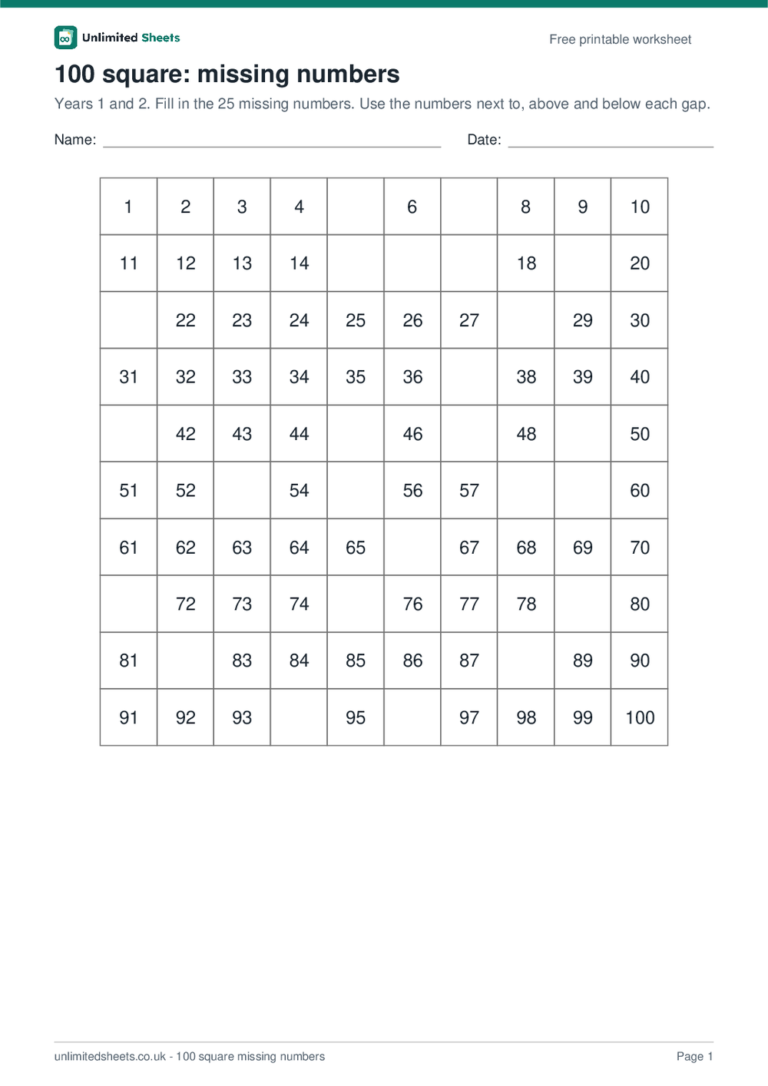
- Missing numbers: press Missing numbers above, or print the missing numbers sheet.
- Times table patterns: colour the multiples of 3, then of 6. What do you notice?
The 100 square in the national curriculum
- Year 1: count to and across 100, forwards and backwards, from any number; count in multiples of 2, 5 and 10.
- Year 2: count in steps of 2, 3 and 5 from 0, and in tens from any number; recognise the place value of each digit in a two-digit number.
- Years 3 to 6: the same grid helps with times tables, square numbers and prime numbers.
Printable 100 squares

Related pages
Year 1 counting, number bonds, place value, times tables, square numbers and prime numbers.
Sources
National curriculum in England: mathematics programmes of study (Key Stages 1 to 3), Department for Education, GOV.UK.
Updated 23 November 2026.