
A cube number is a whole number multiplied by itself three times. 2 × 2 × 2 = 8, so 8 is a cube number. We write it as 2³ and say “two cubed”. The cube numbers up to 1,000 are 1, 8, 27, 64, 125, 216, 343, 512, 729 and 1,000. Children learn them, with the ³ notation, in Year 5.
Cube numbers from 1³ to 12³
| Written | Means | Cube number |
|---|---|---|
| 1³ | 1 × 1 × 1 | 1 |
| 2³ | 2 × 2 × 2 | 8 |
| 3³ | 3 × 3 × 3 | 27 |
| 4³ | 4 × 4 × 4 | 64 |
| 5³ | 5 × 5 × 5 | 125 |
| 6³ | 6 × 6 × 6 | 216 |
| 7³ | 7 × 7 × 7 | 343 |
| 8³ | 8 × 8 × 8 | 512 |
| 9³ | 9 × 9 × 9 | 729 |
| 10³ | 10 × 10 × 10 | 1,000 |
| 11³ | 11 × 11 × 11 | 1,331 |
| 12³ | 12 × 12 × 12 | 1,728 |
Children are usually expected to know the cubes up to 5³ = 125 and 10³ = 1,000 by heart, and to work out the others.
Why are they called cube numbers?
Because that many small cubes build one bigger cube. 8 small cubes make a cube 2 long, 2 wide and 2 high; 27 make one that is 3 by 3 by 3. That is also how to find the volume of a cube: a cube with edges of 4 cm holds 4 × 4 × 4 = 64 one-centimetre cubes, so its volume is 64 cm³. Year 6 children use this when they calculate the volume of cubes and cuboids.
How to work out a cube number
Multiply in two steps: first square the number, then multiply by it once more. For 6³: 6 × 6 = 36, then 36 × 6 = 216. For 12³: 12 × 12 = 144, then 144 × 12 = 1,728. A multiple of 10 is quick: 20³ = 2 × 2 × 2 with three zeros for each ten, so 8,000.
Square and cube numbers
Some numbers are both. Up to 1,000 there are three: 1 (1² and 1³), 64 (8² and 4³) and 729 (27² and 9³). The square numbers page has the squares up to 144 and practice for both.
Patterns to spot
- Odd and even: an odd number cubed is odd (3³ = 27); an even number cubed is even (4³ = 64).
- Last digits: the cubes of 1 to 9 all end in different digits: 1, 8, 7, 4, 5, 6, 3, 2, 9. So 343 ends in 3 and must be 7³.
- They grow fast: the squares to 10² stop at 100, but the cubes to 10³ reach 1,000.
Going backwards: cube roots
Finding the number that was cubed is called finding the cube root. The cube root of 125 is 5, because 5 × 5 × 5 = 125. Cube roots are not named in the primary curriculum, but questions such as ?³ = 64 practise the same idea.
Common mistakes
- Multiplying by 3: 4³ is 4 × 4 × 4 = 64, not 4 × 3 = 12.
- Stopping after two: 5 × 5 = 25 is 5², not 5³; multiply by 5 once more to get 125.
- Mixing up the little numbers: ² means squared (twice) and ³ means cubed (three times).
In the national curriculum
- Year 5: recognise and use square numbers and cube numbers, and the notation for squared (²) and cubed (³); solve problems using knowledge of factors and multiples, squares and cubes.
- Year 6: calculate, estimate and compare the volume of cubes and cuboids using cm³ and m³, and use the order of operations, where powers come before multiplying.
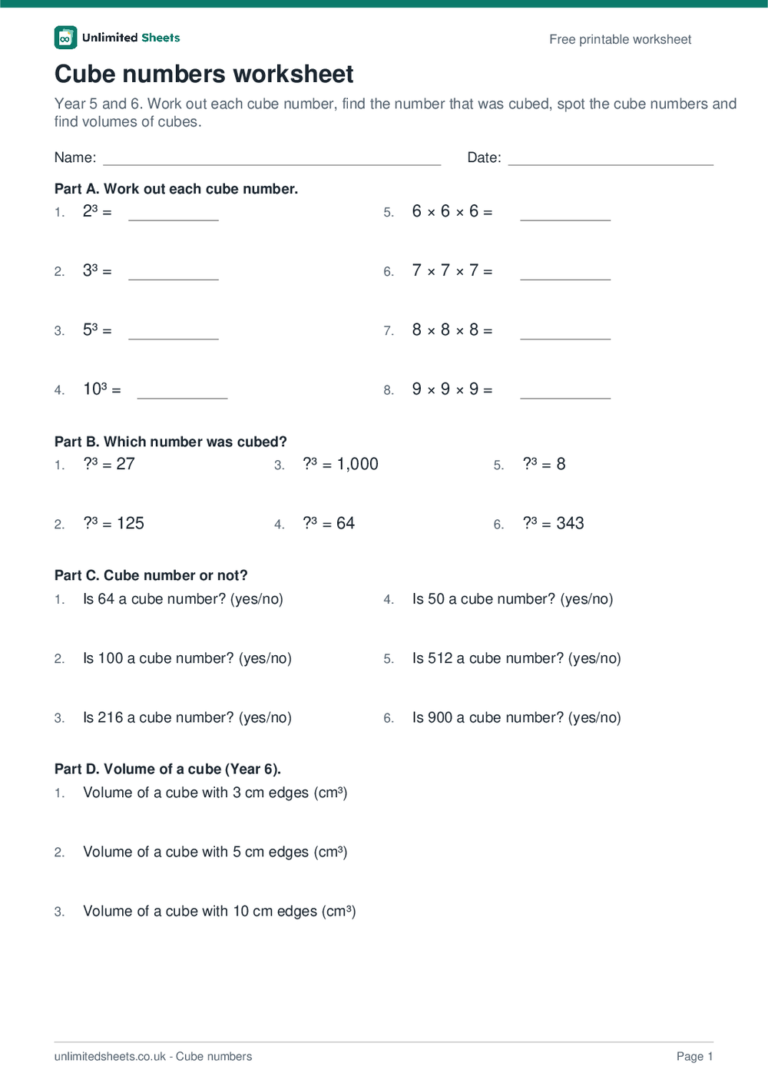
Printable cube numbers worksheet and chart

Related pages
Square numbers, factors and multiples, prime numbers, Year 5 multiplication and Year 6 measurement.
Sources
National curriculum in England: mathematics programmes of study, Department for Education, GOV.UK.
Updated 23 November 2026.