
A factor is a number that divides exactly into another number; a multiple is the result of multiplying a number by a whole number. 4 is a factor of 12 because 12 ÷ 4 = 3 exactly, and 12 is a multiple of 4 because it is in the 4 times table. The two ideas are opposite sides of the same fact: 3 × 4 = 12.
Factors and factor pairs
Factors come in pairs that multiply to make the number. To find them all, start at 1 and work upwards, stopping when the pairs start to repeat:
| Number | Factor pairs | Factors |
|---|---|---|
| 12 | 1 × 12, 2 × 6, 3 × 4 | 1, 2, 3, 4, 6, 12 |
| 18 | 1 × 18, 2 × 9, 3 × 6 | 1, 2, 3, 6, 9, 18 |
| 24 | 1 × 24, 2 × 12, 3 × 8, 4 × 6 | 1, 2, 3, 4, 6, 8, 12, 24 |
| 36 | 1 × 36, 2 × 18, 3 × 12, 4 × 9, 6 × 6 | 1, 2, 3, 4, 6, 9, 12, 18, 36 |
36 has an odd number of factors because 6 × 6 pairs 6 with itself. That only happens with square numbers. A number with exactly two factors, 1 and itself, is a prime number.
Multiples
The multiples of a number are its times table, carrying on for ever: the multiples of 6 are 6, 12, 18, 24, 30 and so on. Every number is a multiple of itself and a factor of itself.
Common factors and common multiples
- Common factors divide into both numbers. The factors of 12 are 1, 2, 3, 4, 6, 12 and the factors of 18 are 1, 2, 3, 6, 9, 18, so the common factors are 1, 2, 3 and 6. The highest common factor (HCF) is 6.
- Common multiples are in both times tables. Multiples of 4: 4, 8, 12, 16, 20, 24. Multiples of 6: 6, 12, 18, 24. The lowest common multiple (LCM) is 12.
Children use common factors to simplify fractions and common multiples to give fractions the same denominator, so this topic pays off on our equivalent fractions page.
Quick divisibility checks
- 2: the last digit is even.
- 3: the digits add up to a multiple of 3 (51: 5 + 1 = 6).
- 5: the last digit is 0 or 5.
- 9: the digits add up to a multiple of 9.
- 10: the last digit is 0.
Common mistakes
- Mixing up the words: factors are the small numbers that go into a number; multiples are the big numbers that come out of the times table.
- Forgetting 1 and the number itself when listing factors.
- Stopping too early: keep testing until the pairs meet in the middle.
In the national curriculum
- Year 4: recognise and use factor pairs and commutativity in mental calculations.
- Year 5: identify multiples and factors, including finding all factor pairs of a number, and common factors of two numbers.
- Year 6: identify common factors, common multiples and prime numbers.
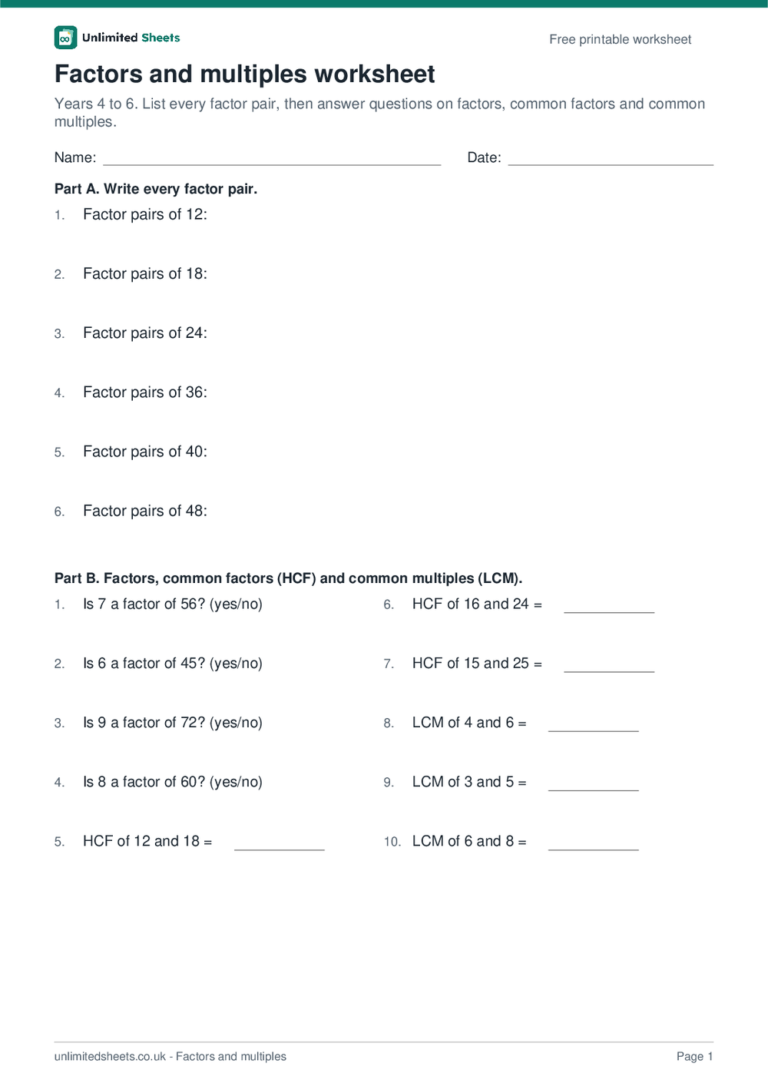
Printable factors and multiples worksheet
Related pages
Prime numbers, square numbers, times tables, Year 5 multiplication and Year 6 division.
Sources
National curriculum in England: mathematics programmes of study, Department for Education, GOV.UK.
Updated 23 November 2026.