
To convert metric units, multiply or divide by 10, 100 or 1,000. Going to a smaller unit (km to m, kg to g, l to ml) means more of them, so multiply: 2.5 km = 2,500 m. Going to a bigger unit means fewer, so divide: 350 g = 0.35 kg. The key facts are 1 cm = 10 mm, 1 m = 100 cm, 1 km = 1,000 m, 1 kg = 1,000 g and 1 litre = 1,000 ml.
Unit converter
Choose length, mass or capacity, type an amount and pick the units. Metric answers are exact; imperial answers are rounded to 3 decimal places and marked with ≈. The line underneath explains the conversion.
Metric conversion chart
| Measure | Conversion | To change to the smaller unit |
|---|---|---|
| Length | 1 cm = 10 mm | × 10 |
| 1 m = 100 cm = 1,000 mm | × 100 (to cm), × 1,000 (to mm) | |
| 1 km = 1,000 m | × 1,000 | |
| Mass | 1 kg = 1,000 g | × 1,000 |
| Capacity | 1 l = 1,000 ml | × 1,000 |
| Money | £1 = 100p | × 100 |
To change to the bigger unit, do the opposite and divide. A printable version of this chart, with a conversion ladder, is in the worksheets section below.
Converting units practice
Seven levels, from Year 3 metres and centimetres to Year 6 conversions with three decimal places and miles to kilometres. You can type the unit after your answer if you like (2500 or 2500 m both count).
Next exercise
Conversions use decimals: practise tenths, hundredths and multiplying by 10, 100 and 1,000.
Why multiplying by 10, 100 or 1,000 works
Every metric unit is 10, 100 or 1,000 times another, which is why converting is just place value. Multiplying by 1,000 moves every digit three places to the left: 2.5 km becomes 2,500 m. Dividing by 1,000 moves them three places right: 350 g becomes 0.35 kg. The prefixes help: kilo means a thousand, centi a hundredth and milli a thousandth.
Measures from Year 2 to Year 6
- Year 2: measure in m and cm, kg and g, litres and ml; use £ and p and give change.
- Year 3: measure, compare, add and subtract lengths (m, cm, mm), mass (kg, g) and capacity (l, ml).
- Year 4: convert between different units of measure, such as kilometres to metres; money in pounds and pence.
- Year 5: convert between metric units, including km and m, cm and m, cm and mm, g and kg, l and ml; know approximate equivalences between metric units and common imperial units such as inches, pounds and pints.
- Year 6: convert using decimal notation to up to 3 decimal places, and convert between miles and kilometres.
Source: National Curriculum mathematics (GOV.UK).
Imperial units in the UK
The UK still uses some imperial units every day: miles on road signs, pints of milk, and feet and inches or stones and pounds for height and weight. Year 5 pupils learn rough equivalences, and Year 6 pupils convert between miles and kilometres, usually with 5 miles ≈ 8 km.
| Imperial unit | About | Exactly |
|---|---|---|
| 1 inch | 2.5 cm | 2.54 cm |
| 1 foot (12 inches) | 30 cm | 30.48 cm |
| 1 mile | 1.6 km | 1.609 km |
| 1 pound (lb) | 450 g | 453.6 g |
| 1 stone (14 lb) | 6.35 kg | 6.350 kg |
| 1 pint (UK) | 570 ml | 568.3 ml |
| 1 gallon (UK, 8 pints) | 4.5 litres | 4.546 litres |
Common conversion mistakes
- Multiplying when you should divide. Ask: will there be more of the new unit, or fewer? There are more metres than kilometres, so km to m multiplies.
- Using 100 for everything. Only centimetres to metres and pence to pounds use 100. Grams, millilitres, metres to kilometres and millimetres to metres use 1,000.
- Moving the decimal point instead of the digits, then losing a zero: 0.05 kg is 50 g, not 5 g.
- Adding mixed units. 1 kg + 250 g is 1,250 g or 1.25 kg, never 251.
Printable unit conversion worksheets
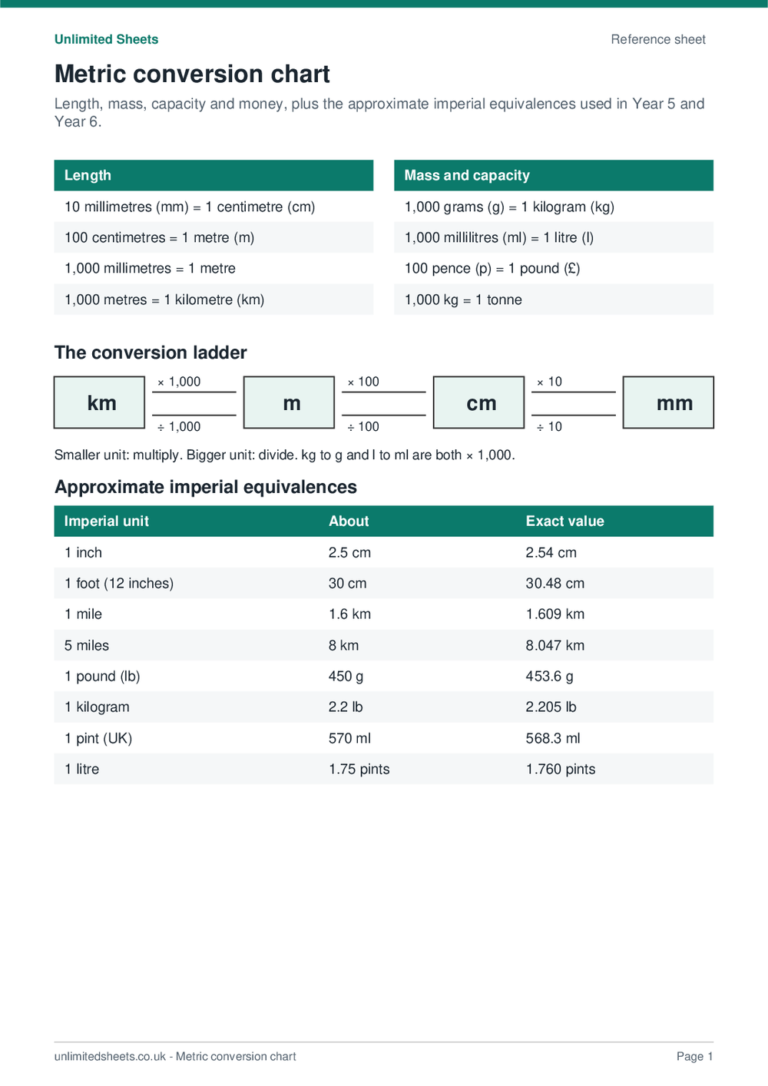

- Metric conversion chart (Reference). One page to keep: every metric conversion children need, a conversion ladder showing when to multiply and divide, and the imperial equivalences such as 5 miles to about 8 km.
- Converting metric units (Year 4). Thirty conversions with whole numbers between km and m, m and cm, cm and mm, kg and g, and l and ml, in both directions.
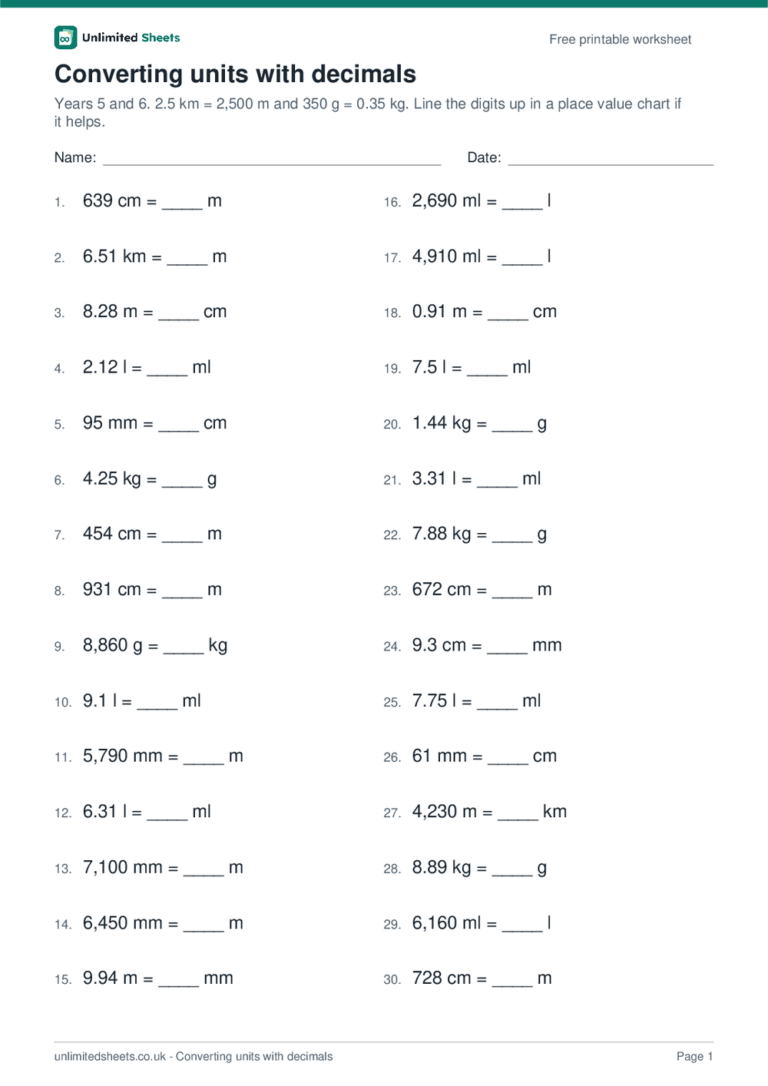
- Converting units with decimals (Year 5–6). Thirty conversions that need decimals, for the Year 5 and Year 6 objectives on converting with decimal notation.
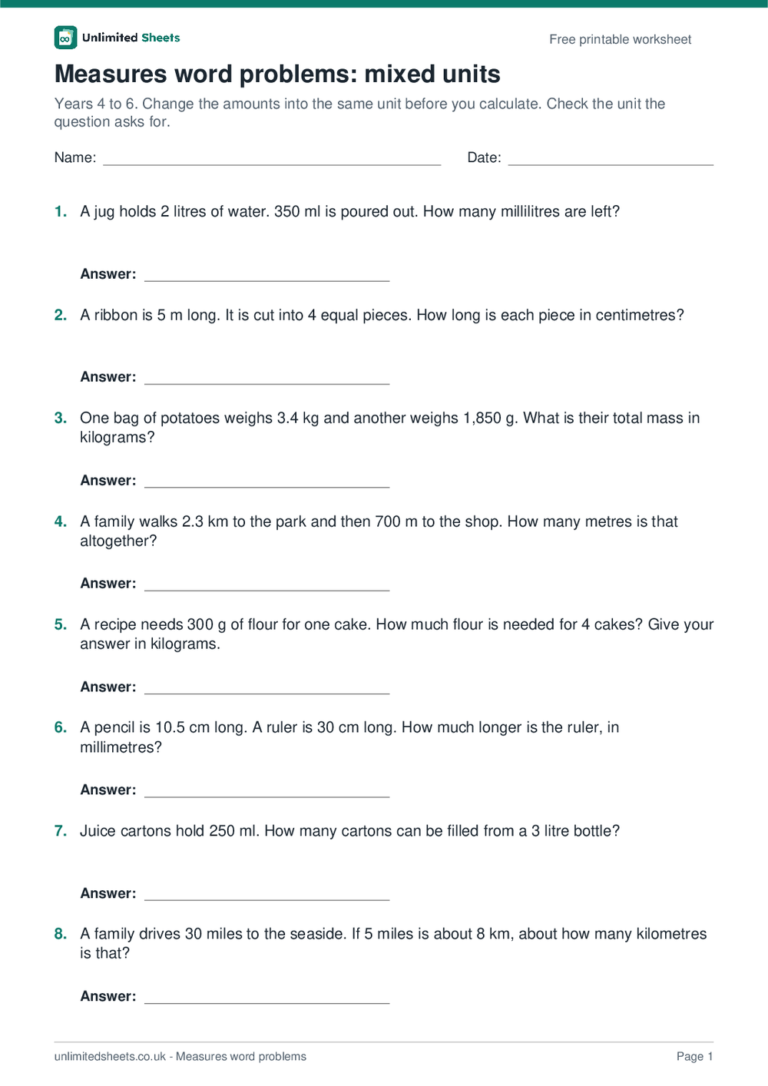
- Measures word problems (Year 4–6). Eight problems where the units are mixed, so the first step is always to convert. Covers length, mass, capacity and a miles question.
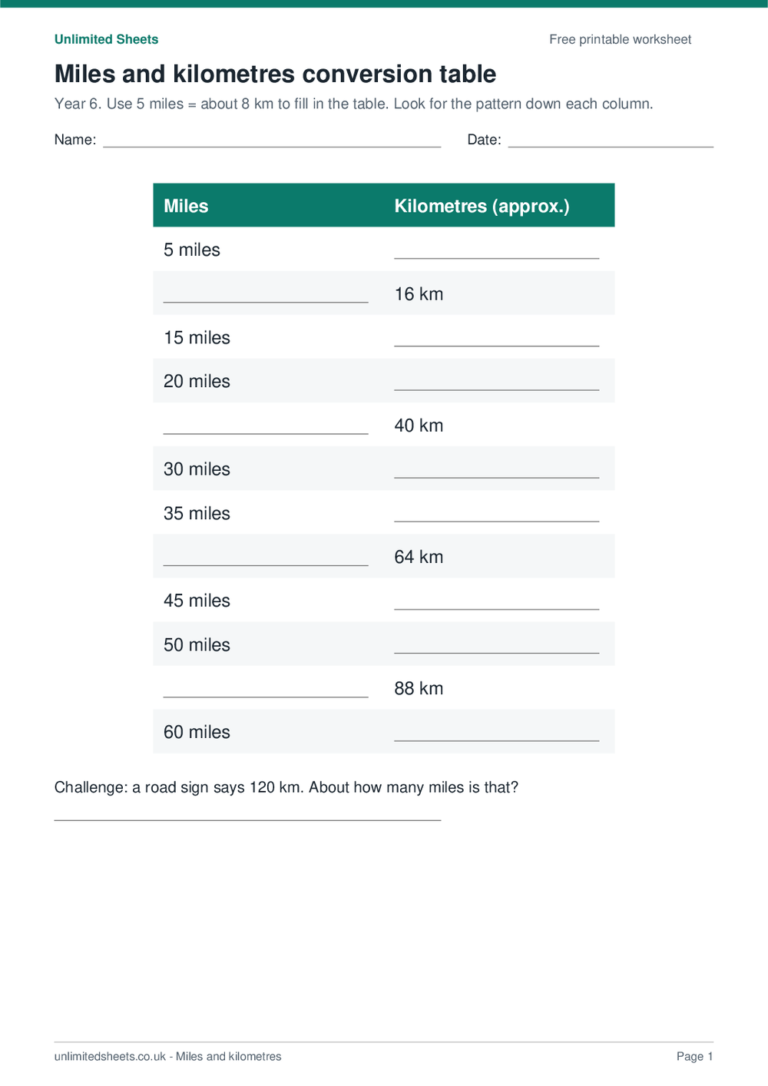
- Miles and kilometres conversion table (Year 6). A conversion table from 5 to 60 miles with gaps in both columns, using 5 miles to about 8 km, plus a road-sign challenge.
Unit conversion questions
How many centimetres are in a metre?
There are 100 centimetres in 1 metre and 1,000 millimetres in 1 metre. There are 10 millimetres in 1 centimetre.
How do you convert grams to kilograms?
Divide by 1,000, because there are 1,000 grams in a kilogram. 750 g = 0.75 kg and 2,400 g = 2.4 kg.
How many kilometres is 5 miles?
5 miles is about 8 kilometres (8.047 km exactly). This is the approximation used in primary school, so 10 miles is about 16 km and 50 miles is about 80 km.
When do children learn to convert units?
Converting between units is a Year 4 objective (for example kilometres to metres), Year 5 covers all the common metric conversions and imperial approximations, and Year 6 adds decimals to 3 places and miles to kilometres.
Practice for each year group
Each page below has only the practice, curriculum objectives and worksheets for that year.
Keep practising
- Decimals
- Telling the time: units of time
- Place value
- All maths topics
Updated 23 November 2026.