
A decimal is a way of writing numbers smaller than one using place value. The digits after the decimal point are tenths, hundredths and thousandths: in 23.407, the 4 is worth 4 tenths (0.4), the 0 shows there are no hundredths, and the 7 is worth 7 thousandths (0.007). Decimals are another way to write fractions with denominators of 10, 100 and 1,000.
The eight practice levels follow the National Curriculum from Year 4 to Year 6: decimal place value, dividing by 10 and 100, multiplying and dividing by 10, 100 and 1,000, comparing, adding and subtracting, multiplying, and fraction equivalents.
Next exercise
Per cent means out of 100: turn decimals into percentages and find percentages of amounts.
Decimal place value
| Tens | Ones | Tenths | Hundredths | Thousandths | |
|---|---|---|---|---|---|
| 2 | 3 | . | 4 | 0 | 7 |
Each column is ten times smaller than the one to its left: ten thousandths make one hundredth, ten hundredths make one tenth and ten tenths make one. The decimal point simply marks where the ones end. This is why 0.5 and 0.50 are the same number, but 0.05 is ten times smaller.
Multiplying and dividing by 10, 100 and 1,000
Multiplying by 10 moves every digit one place to the left; by 100, two places; by 1,000, three places. Dividing moves the digits to the right. The decimal point does not move, the digits do, and empty places at the end of a whole number are filled with zeros:
- 4.6 × 100 = 460
- 37 ÷ 100 = 0.37
- 5.2 ÷ 1,000 = 0.0052, which has 4 decimal places, so in Year 6 questions the answers go up to 3 places only
Comparing and ordering decimals
A longer decimal is not always a bigger one: 0.45 is smaller than 0.5. To compare, give both numbers the same number of decimal places by adding zeros (0.45 and 0.50), then compare digit by digit from the left. The ordering worksheet uses sets of numbers with the same whole number part, so children have to look at the tenths, hundredths and thousandths.
Adding and subtracting decimals
Line up the decimal points, not the last digits, and fill gaps with zeros. 12.6 + 3.45 is set out as 12.60 + 3.45 = 16.05. After that it is ordinary column addition or subtraction, with the decimal point dropped straight down into the answer.
Multiplying a decimal by a whole number
Year 6 pupils multiply one-digit numbers with up to 2 decimal places by whole numbers. A reliable method: ignore the point, multiply, then put the same number of decimal places back. For 0.35 × 4: 35 × 4 = 140, and 0.35 has two decimal places, so the answer is 1.40, or 1.4.
Decimals and fractions
Tenths and hundredths convert directly: 0.7 = 7/10 and 0.71 = 71/100. The equivalents worth knowing by heart are 0.5 = 1/2, 0.25 = 1/4, 0.75 = 3/4, 0.2 = 1/5 and 0.125 = 1/8. Our fractions and percentages pages practise the same equivalences from the other side.
Common mistakes with decimals
- Thinking longer means bigger: choosing 0.125 over 0.5.
- Lining up the right-hand digits instead of the decimal points when adding.
- Adding a zero to multiply by 10: 2.5 × 10 is 25, not 2.50.
- Reading 0.35 as “nought point thirty-five”. It is “nought point three five”: 3 tenths and 5 hundredths.
Printable decimals worksheets
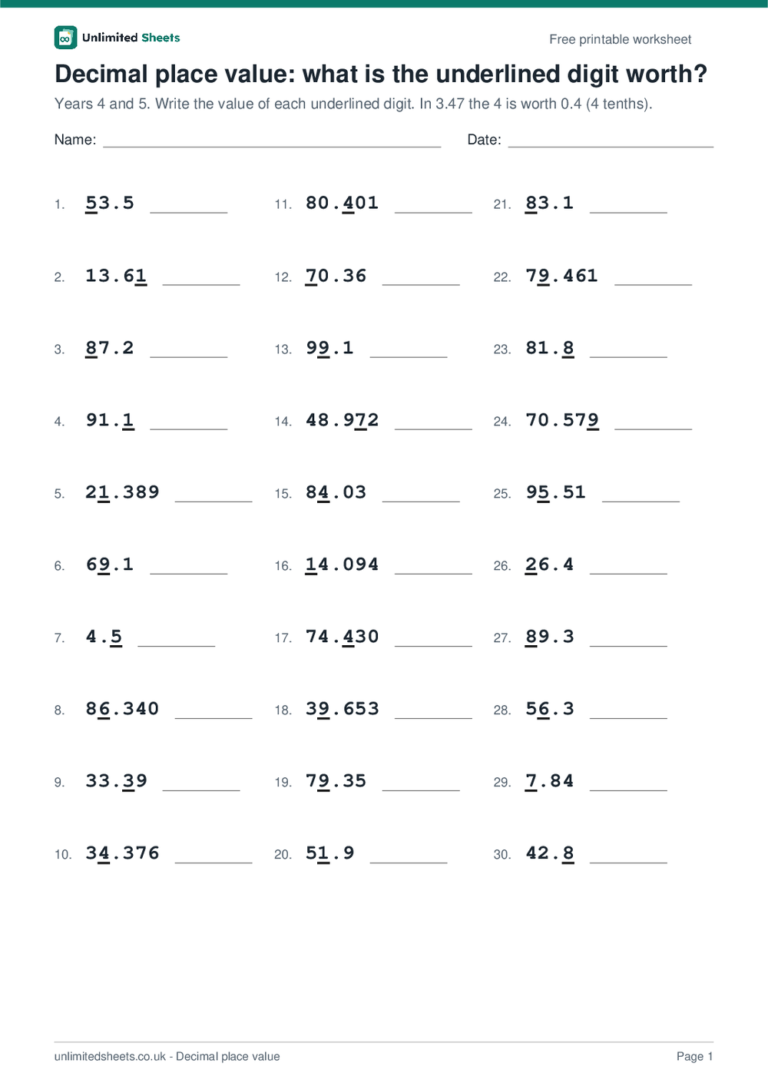
- Decimal place value (Year 4–5). Thirty decimals with tenths, hundredths and thousandths. Children write what the underlined digit is worth, such as 0.04.
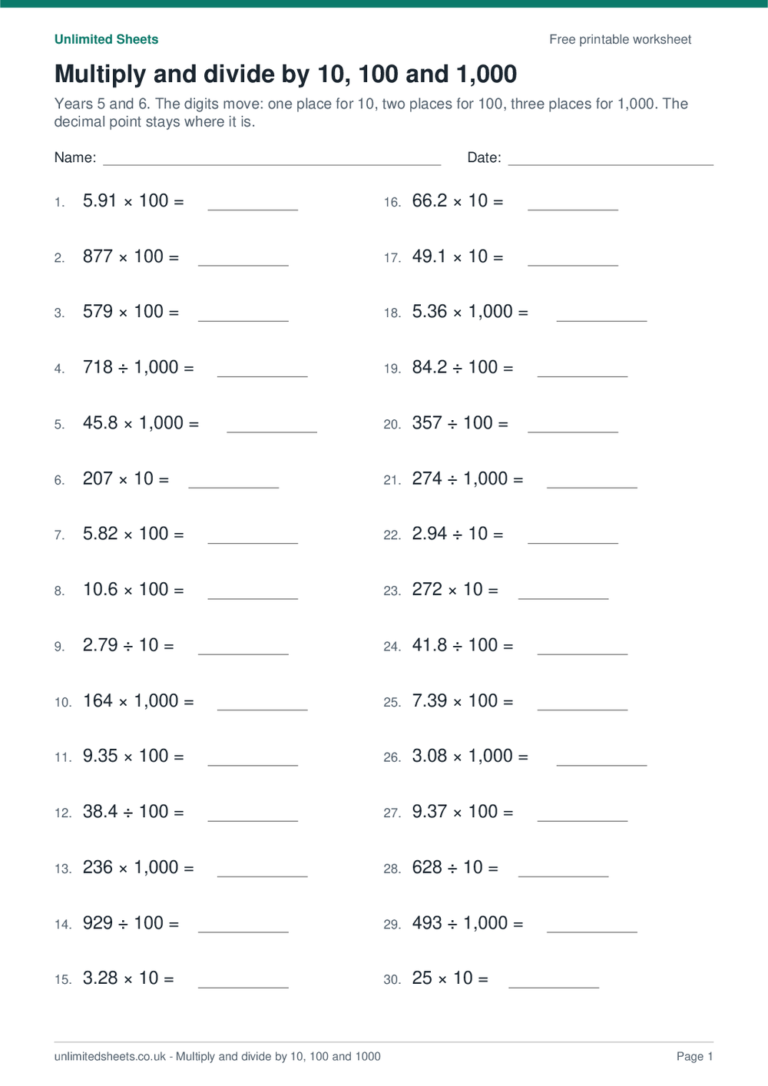
- Multiply and divide by 10, 100 and 1,000 (Year 5–6). Thirty mixed questions with answers up to 3 decimal places, matching the Year 6 objective.
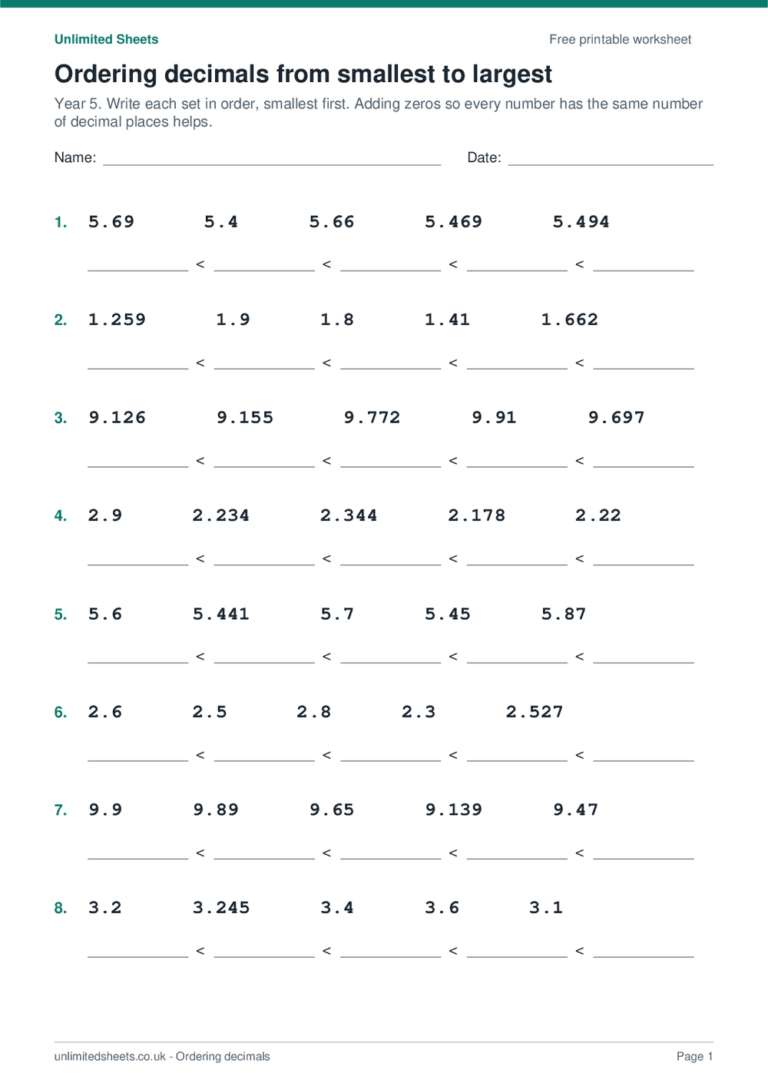
- Ordering decimals (Year 5). Eight sets of five decimals to put in order. The numbers in each set share the same whole number, so children must compare tenths, hundredths and thousandths.
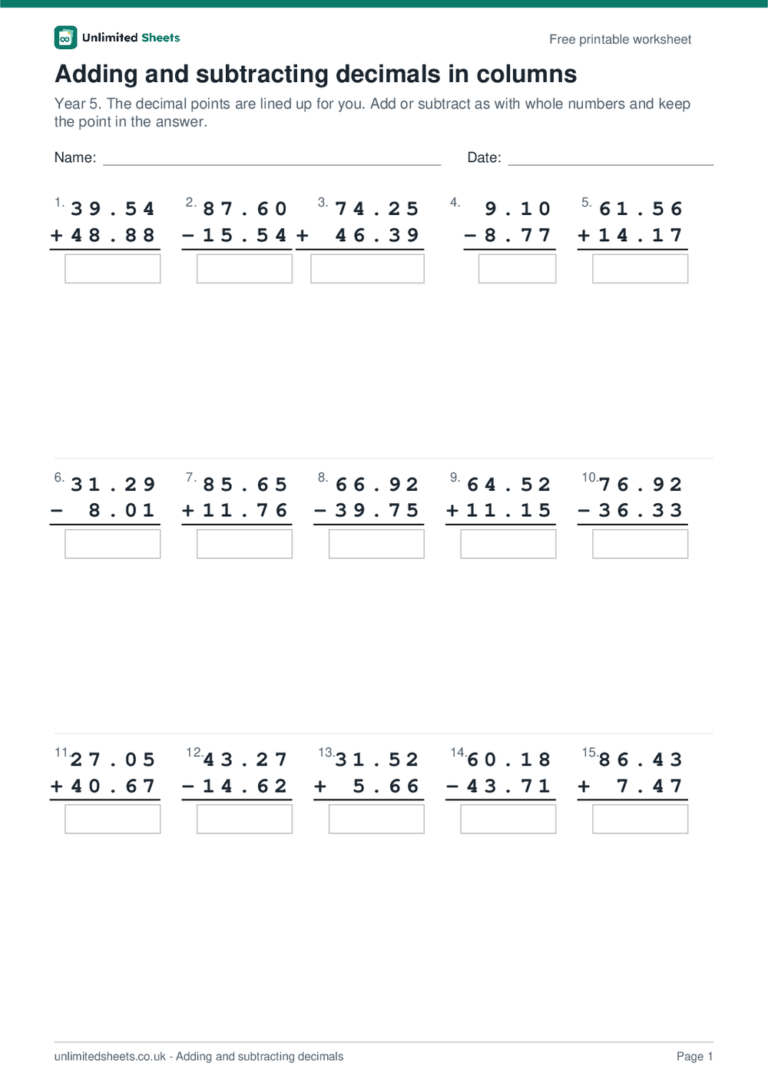
- Adding and subtracting decimals in columns (Year 5). Fifteen column calculations with money-style numbers to 2 decimal places, alternating addition and subtraction, with no negative answers.
Decimals questions
What year do children learn decimals?
Tenths appear in Year 3 as fractions. Decimals proper start in Year 4 with tenths and hundredths, dividing by 10 and 100, and money. Year 5 adds thousandths, comparing and ordering to 3 decimal places, and Year 6 multiplies decimals by whole numbers.
Is 0.5 bigger than 0.45?
Yes. Write 0.5 as 0.50 so both numbers have two decimal places: 50 hundredths is more than 45 hundredths.
How do you multiply a decimal by 100?
Move every digit two places to the left. 3.6 × 100 = 360 and 0.072 × 100 = 7.2.
Why do we line up the decimal points?
So that digits with the same value are added together: tenths with tenths and hundredths with hundredths, exactly like lining up tens and ones in whole numbers.
Practice for each year group
Each page below has only the practice, curriculum objectives and worksheets for that year.
Keep practising
- Percentages
- Fractions
- Unit conversion
- Place value and rounding: including rounding decimals
Updated 23 November 2026.