
A blank times table grid has the numbers along the top and down the side, and empty squares for your child to fill in with the answers. Below are five printable grids, each with the completed grid on page 2, and an online grid that checks the answers. Filling in a whole 12 × 12 grid covers every fact children need for the Year 4 multiplication tables check.
Printable blank times table grids

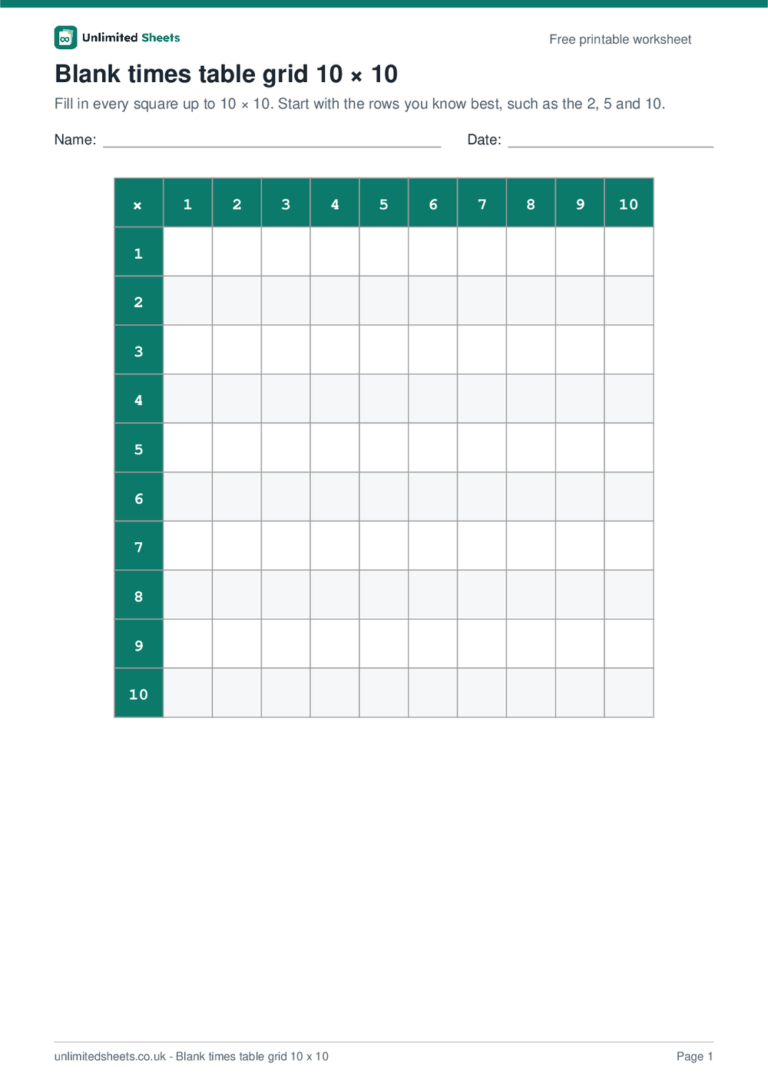
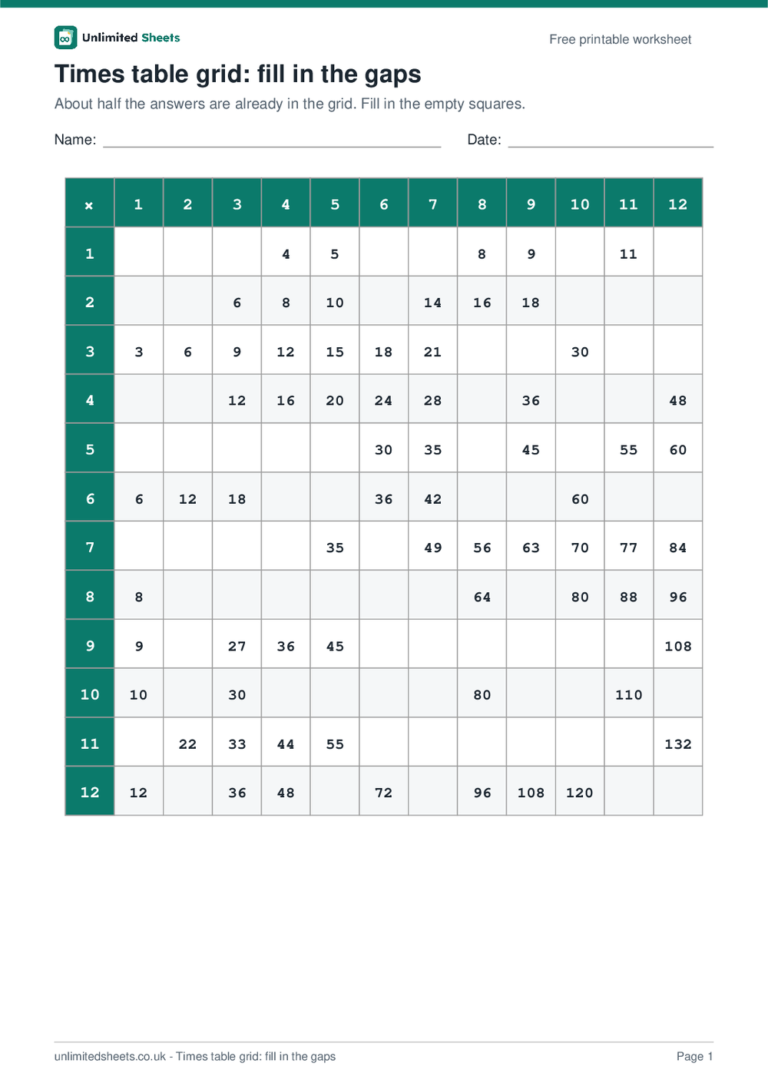
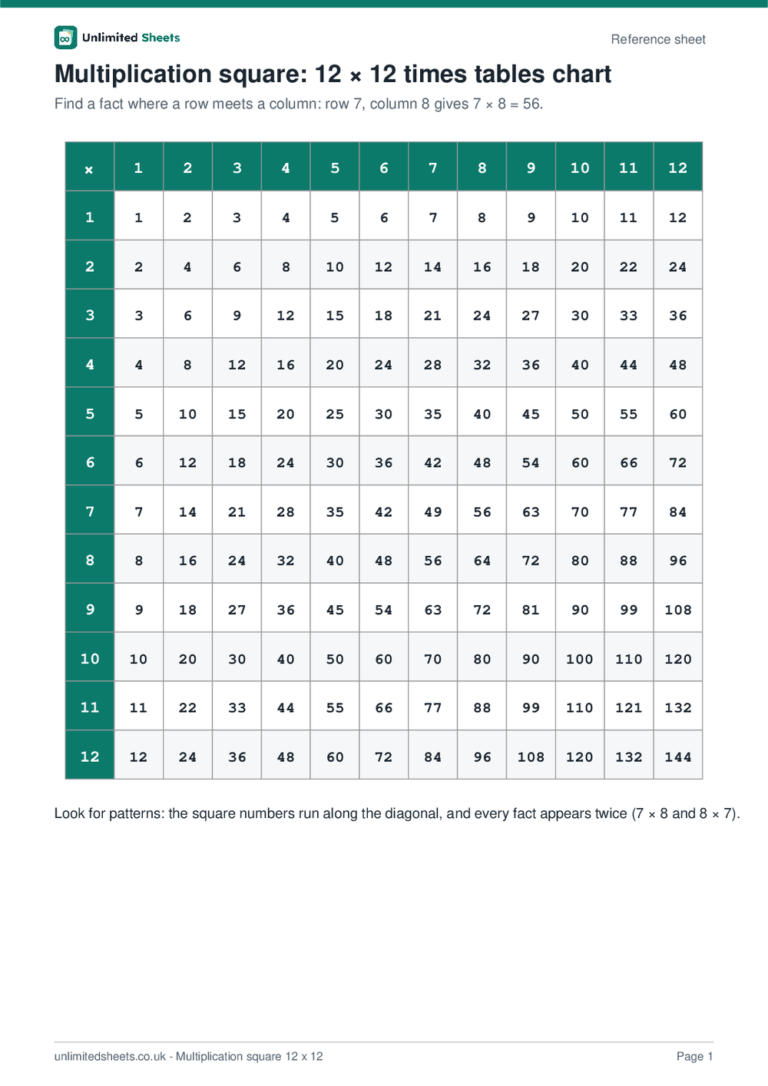
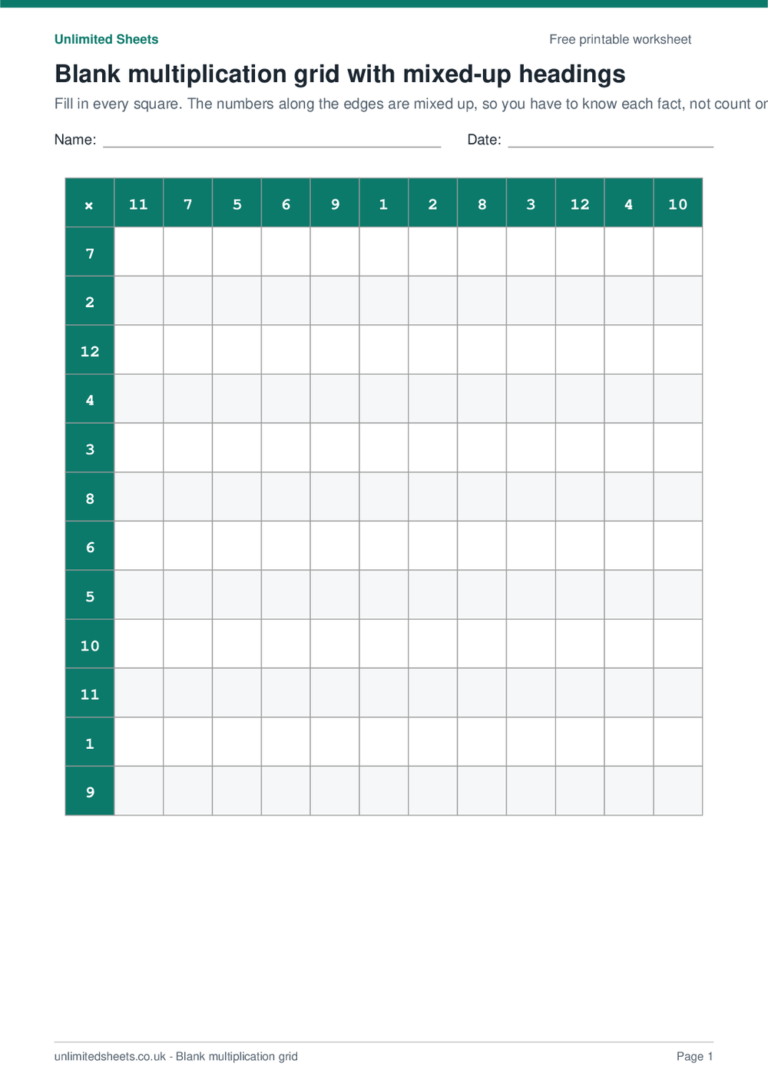
Two more: a blank grid with the headings mixed up, so children cannot just count along, and the full multiplication square for checking or sticking on the wall.
Fill in a grid online
Choose the size, whether the headings are in order or mixed up, and whether some answers are given. Type an answer in each square, then press Check my answers: right answers turn green and wrong ones red. The timer starts when you type the first answer.
Loading the grid…
How to use a blank grid
- Row by row: each row is one times table, so filling in row 7 is saying the 7 times table.
- Easy rows first: fill in the 1, 2, 5 and 10 rows and columns first. Then the 3, 4 and 11. What is left is a much smaller set of harder facts.
- Use the mirror: 7 × 8 and 8 × 7 are the same, so each answer appears twice. A 12 × 12 grid has 144 squares but only 78 different facts.
- Diagonal: the square numbers 1, 4, 9, 16 and so on run from corner to corner.
- Time it: repeat the same grid once a week and write the time at the top. Watching the time fall is very motivating.
Which grid for which year?
| Year | Times tables | Grid to use |
|---|---|---|
| Year 2 | 2, 5 and 10 | 10 × 10 grid, those rows and columns only |
| Year 3 | 3, 4 and 8 as well | 10 × 10 grid, then fill in the gaps |
| Year 4 | All tables up to 12 × 12 | 12 × 12 grid, then the mixed-order grid |
| Years 5 and 6 | Keeping all facts quick | Mixed-order grid against the clock |
The national curriculum expects children to recall multiplication and division facts for all tables up to 12 × 12 by the end of Year 4.
Patterns to look for once it is full
- The 2, 4, 6, 8, 10 and 12 rows contain only even numbers.
- The 5 row ends in 5 or 0, and the 10 row always ends in 0.
- The 9 row: the digits of each answer up to 9 × 10 add up to 9 (18, 27, 36…).
- The 11 row up to 11 × 9 is a repeated digit: 22, 33, 44.
Related pages
Times tables (with the full grid and practice), times tables games, the multiplication tables check practice, the 100 square and practice by year: Year 2, Year 3, Year 4.
Sources
National curriculum in England: mathematics programmes of study, Department for Education, GOV.UK.
Updated 23 November 2026.