
Perimeter is the distance all the way around the edge of a shape; area is the amount of flat surface inside it. For a rectangle 5 cm long and 3 cm wide, the perimeter is 5 + 3 + 5 + 3 = 16 cm and the area is 5 × 3 = 15 cm². Perimeter is measured in units of length (cm, m) and area in square units (cm², m²).
Practise seven levels below, from counting squares in Years 3 and 4 to the area of triangles and parallelograms in Year 6. Every shape is drawn, and Show how explains each step.
Area and perimeter are different
Two shapes can have the same area but different perimeters, or the same perimeter but different areas. A 6 cm by 1 cm rectangle and a 3 cm by 2 cm rectangle both have an area of 6 cm², but their perimeters are 14 cm and 10 cm. Year 6 pupils are expected to recognise this, and the counting-squares levels make it easy to see.
Rectangles and squares
- Perimeter = length + width + length + width, or 2 × (length + width).
- Area = length × width.
- Missing side from the area: divide the area by the side you know. Area 24 cm² and length 6 cm gives a width of 4 cm.
- Missing side from the perimeter: halve the perimeter, then take away the side you know. Perimeter 20 cm and length 6 cm: 20 ÷ 2 = 10, so the width is 4 cm.
Compound (L-shaped) shapes
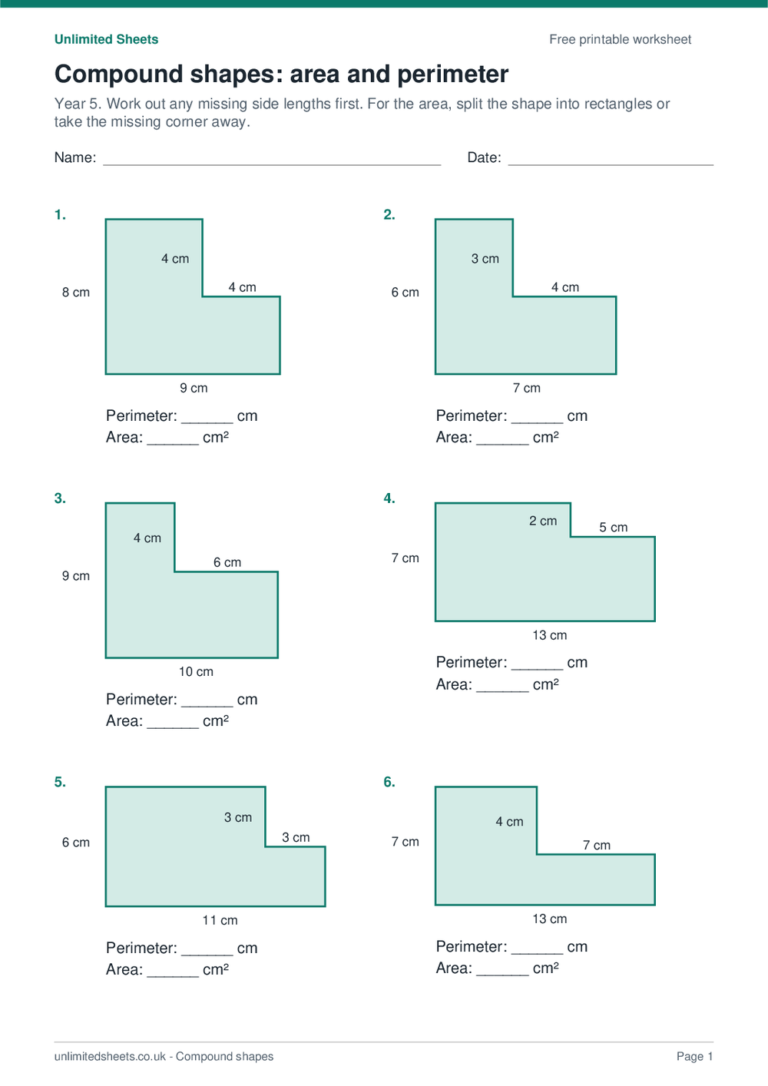
A compound rectilinear shape is made of rectangles joined together. For the perimeter, first work out any missing sides from the ones you know, then add all of them. For the area, either split the shape into two rectangles and add their areas, or work out the area of the whole rectangle around it and take away the missing corner. Both give the same answer, so one can check the other.
Triangles and parallelograms (Year 6)
A parallelogram can be cut and rearranged into a rectangle with the same base and height, so its area is base × perpendicular height. A triangle is exactly half of a parallelogram, so its area is base × height ÷ 2. The height must be measured at right angles to the base; the length of a sloping side is never used.
Area and perimeter in the National Curriculum
- Year 3: measure the perimeter of simple 2-D shapes.
- Year 4: measure and calculate the perimeter of rectilinear figures, including squares, in cm and m; find the area of rectilinear shapes by counting squares.
- Year 5: perimeter of composite rectilinear shapes; calculate and compare the area of rectangles in cm² and m²; estimate the area of irregular shapes.
- Year 6: recognise that shapes with the same area can have different perimeters and vice versa; calculate the area of parallelograms and triangles.
Common mistakes
- Mixing up area and perimeter, or giving area in cm instead of cm².
- Adding only two sides of a rectangle for the perimeter.
- Forgetting the hidden sides of an L-shape that have no label.
- Using the slanted side as the height of a triangle or parallelogram.
Printable area and perimeter worksheets



- Area and perimeter by counting squares (Year 3–4). Six shapes drawn on centimetre-square grids. Children count squares for the area and count edges for the perimeter, which shows clearly that the two are different.
- Area and perimeter of rectangles (Year 4–5). Eight labelled rectangles. Find the perimeter and the area of each, using length times width for the area.
- Compound shapes: area and perimeter (Year 5). Six L-shapes where two sides are not labelled. Children work out the missing lengths, then the perimeter and the area.
- Area of triangles and parallelograms (Year 6). Six shapes: right-angled triangles, other triangles and parallelograms, each with the perpendicular height drawn as a dashed line.
Area and perimeter questions
What is the difference between area and perimeter?
Perimeter is the total length around the outside of a shape, measured in cm or m. Area is the space inside the shape, measured in square units such as cm² or m².
How do you find the area of a rectangle?
Multiply the length by the width. A rectangle 7 cm long and 4 cm wide has an area of 28 cm².
How do you find the area of a triangle?
Multiply the base by the perpendicular height and halve the answer. A triangle with a base of 10 cm and a height of 6 cm has an area of 30 cm².
What year do children learn area?
They find area by counting squares in Year 4, calculate the area of rectangles in Year 5, and find the area of triangles and parallelograms in Year 6.
Practice for each year group
Each page below has only the practice, curriculum objectives and worksheets for that year.
Keep practising
Updated 23 November 2026.