
Per cent means “out of 100”, so a percentage is a fraction with a denominator of 100. 35% means 35 out of 100, which is 35/100 or 0.35. To find a percentage of an amount, use known facts: 50% is half, 25% is a quarter and 10% is a tenth. For 15% of 360, find 10% (36) and 5% (18) and add them: 54.
The practice below starts with the Year 5 meaning of per cent and builds to Year 6 problems such as sale prices and comparing test scores.
Fractions, decimals and percentages
These are three ways of writing the same amount. Year 5 pupils need the equivalents for halves, quarters, fifths and fractions with denominators that are multiples of 10 or 25; Year 6 pupils recall and use them in context.
| Fraction | Decimal | Percentage |
|---|---|---|
| 1/2 | 0.5 | 50% |
| 1/4 | 0.25 | 25% |
| 3/4 | 0.75 | 75% |
| 1/5 | 0.2 | 20% |
| 2/5 | 0.4 | 40% |
| 1/10 | 0.1 | 10% |
| 1/20 | 0.05 | 5% |
| 1/25 | 0.04 | 4% |
| 1/100 | 0.01 | 1% |
- Decimal to percentage: multiply by 100. 0.35 = 35%.
- Percentage to decimal: divide by 100. 8% = 0.08, not 0.8.
- Fraction to percentage: make the denominator 100 if you can. 3/20 = 15/100 = 15%. Otherwise divide: 1/8 = 0.125 = 12.5%.
Finding a percentage of an amount
Build any percentage from easy pieces:
- 10%: divide by 10. 10% of 360 = 36.
- 5%: half of 10%. 5% of 360 = 18.
- 1%: divide by 100. 1% of 360 = 3.6.
- Combine: 35% = 10% + 10% + 10% + 5% = 36 + 36 + 36 + 18 = 126.
For 50%, halve; for 25%, halve and halve again; for 75%, take 25% three times or take 25% away from the whole.
Percentage problems
In real problems the percentage is often only the first step. A £40 jumper with 25% off: 25% of £40 is £10, so the sale price is £30. A box with 20% extra free: 20% of 500 g is 100 g, so the box holds 600 g. To compare two test scores out of different totals, such as 31 out of 40 and 21 out of 25, change both to percentages: 77.5% and 84%.
Seeing percentages on a hundred square
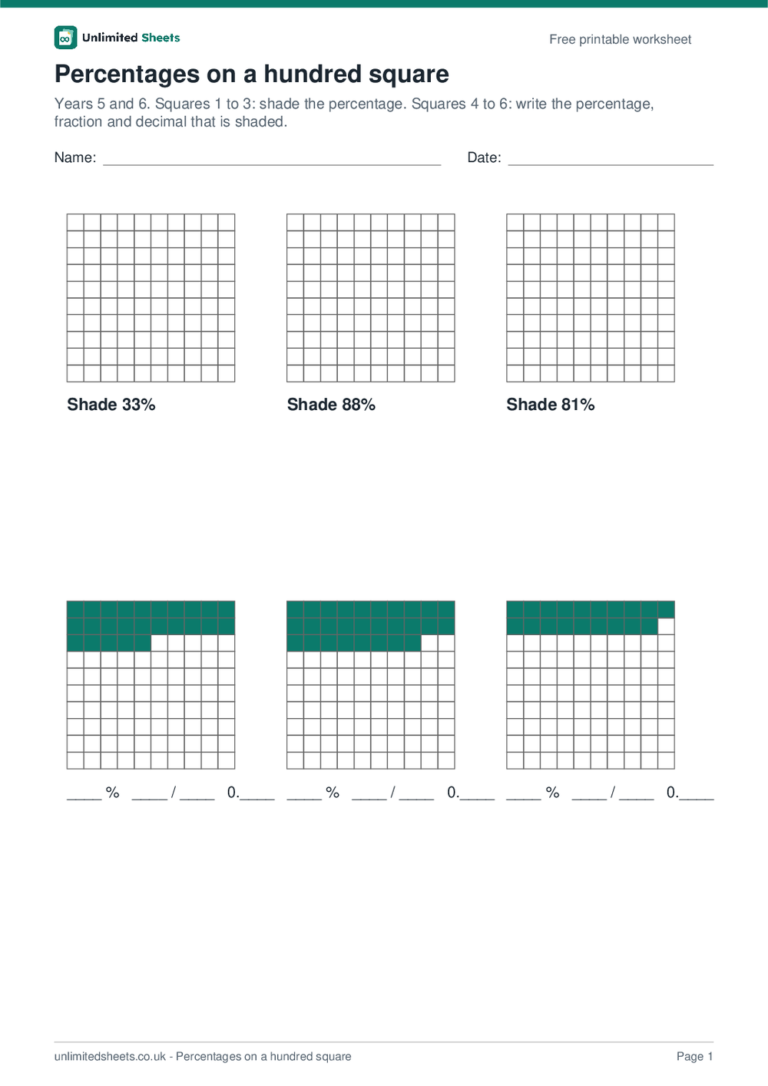
A 10 × 10 grid has exactly 100 small squares, so every square is 1%. Shading 37 squares shows 37%, which is also 37/100 and 0.37. The hundred-square worksheet below is a good starting point for children who find percentages abstract.
Common mistakes with percentages
- Thinking 10% means divide by 10 for every percentage, so 20% of 80 becomes 80 ÷ 20 = 4. It is 2 lots of 10%: 16.
- Writing 5% as 0.5. It is 0.05, five hundredths.
- Forgetting the second step in a sale price question and giving the discount instead of the new price.
Printable percentages worksheets


- Fractions, decimals and percentages table (Year 5–6). Fifteen rows of equivalent fractions, decimals and percentages, from halves and quarters to eighths and hundredths. One value is given in each row.
- Percentages of amounts (Year 5–6). Thirty questions from 1% to 75% of amounts up to 800. Every answer is a whole number.
- Percentage word problems (Year 6). Six problems including a sale price, comparing two test scores using percentages, and a percentage increase.
- Percentages on a hundred square (Year 5–6). Six hundred squares that show what per cent means: shade a percentage, or read one and write it as a fraction and a decimal.
Percentages questions
What year do children learn percentages?
Percentages are introduced in Year 5, when children learn that per cent means parts per 100 and write percentages as fractions and decimals. Year 6 covers percentages of amounts, such as 15% of 360, and using percentages to compare.
How do you work out 15% of a number?
Find 10% by dividing by 10, halve that to get 5%, then add the two. 15% of 360 = 36 + 18 = 54.
What is 1/8 as a percentage?
1/8 = 0.125, which is 12.5%. It is half of 1/4 (25%).
How do you work out a percentage score?
Write the score as a fraction of the total and change it to hundredths. 21 out of 25 = 84/100 = 84%. If the total does not go into 100, divide the score by the total and multiply by 100.
Practice for each year group
Each page below has only the practice, curriculum objectives and worksheets for that year.
Keep practising
Updated 23 November 2026.