
A line of symmetry divides a shape into two halves that are mirror images of each other. If you fold a shape along a line of symmetry, the two halves match exactly. A square has four lines of symmetry; a parallelogram has none. Children meet symmetry in Year 2 and find lines of symmetry in shapes turned at any angle in Year 4.
Lines of symmetry in common shapes
| Shape | Lines of symmetry |
|---|---|
| Circle | Infinitely many: any line through the centre |
| Square | 4 |
| Rectangle (not a square) | 2 |
| Rhombus (not a square) | 2 |
| Equilateral triangle | 3 |
| Isosceles triangle | 1 |
| Scalene triangle | 0 |
| Kite | 1 |
| Isosceles trapezium | 1 |
| Parallelogram (not a rectangle or rhombus) | 0 |
| Regular pentagon, hexagon, octagon | 5, 6, 8 |
A regular shape, with all sides and angles equal, has as many lines of symmetry as it has sides.
The diagonal trap
Many children think a rectangle’s diagonals are lines of symmetry. Fold a paper rectangle corner to corner and the halves do not match: the diagonals of a rectangle are not lines of symmetry. A square’s diagonals are, which is why a square has four lines and a rectangle only two.
How to check for symmetry
- Fold it: cut the shape out of paper and fold along the line. If the edges meet exactly, it is a line of symmetry.
- Use a mirror: stand a small mirror on the line. If the reflection completes the shape exactly, the line is a line of symmetry.
- Count squares: on squared paper, every corner on one side should be the same distance from the line as its partner on the other side.
Symmetry around us
Butterflies, many leaves, faces, buildings and capital letters such as A, H, M, T and X show symmetry. Spotting it on a walk is a good way to practise.
In the national curriculum
- Year 2: identify and describe the properties of 2-D shapes, including the number of sides and line symmetry in a vertical line.
- Year 4: identify lines of symmetry in 2-D shapes presented in different orientations, and complete a simple symmetric figure with respect to a specific line of symmetry.
- Years 5 and 6: describe and draw reflections of shapes, including on a coordinate grid.
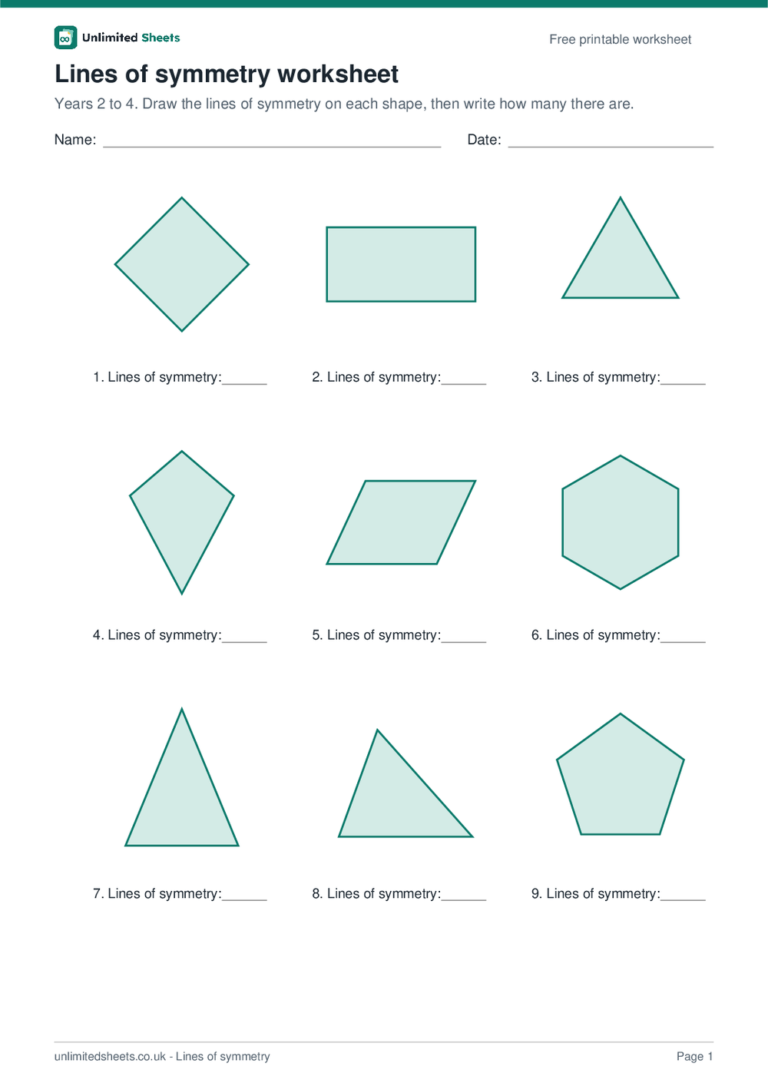
Printable lines of symmetry worksheet
Related pages
Shapes and angles, types of triangles, Year 2 shapes and Year 4 angles.
Sources
National curriculum in England: mathematics programmes of study, Department for Education, GOV.UK.
Updated 23 November 2026.