
Angles measure turn, in degrees (°). A right angle is 90°, an acute angle is smaller than that, an obtuse angle is between 90° and 180°, and a reflex angle is more than 180°. Angles on a straight line add up to 180°, angles around a point add up to 360°, and the three angles of any triangle add up to 180°.
This page covers the geometry of primary school: naming 2-D and 3-D shapes, right angles, types of angle, missing angles and coordinates. Pick a level and the shapes are drawn for you.
Next exercise
Statistics: charts and graphs →
Tally charts, pictograms, bar charts, line graphs and the mean.
2-D shapes
2-D shapes are flat and are named by their number of straight sides: a triangle has 3, a quadrilateral 4, a pentagon 5, a hexagon 6, a heptagon 7 and an octagon 8. A shape does not need to look “normal” to keep its name: any closed shape with six straight sides is a hexagon. In Year 5, pupils learn that a regular polygon has all sides and all angles equal, and an irregular one does not.
3-D shapes: faces, edges and vertices
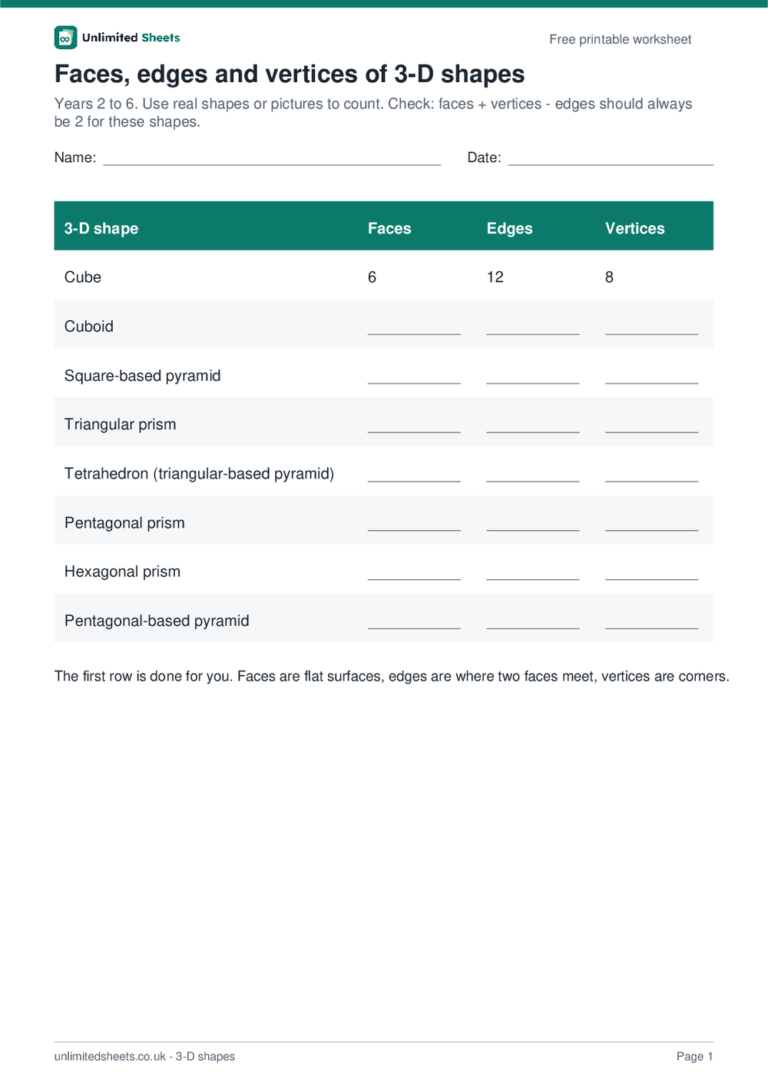
Faces are the flat surfaces, edges are where two faces meet, and vertices are the corners. For every shape in this table, faces + vertices − edges = 2, a handy check known as Euler’s rule.
| 3-D shape | Faces | Edges | Vertices |
|---|---|---|---|
| Cube | 6 | 12 | 8 |
| Cuboid | 6 | 12 | 8 |
| Square-based pyramid | 5 | 8 | 5 |
| Triangular prism | 5 | 9 | 6 |
| Tetrahedron (triangular-based pyramid) | 4 | 6 | 4 |
| Pentagonal prism | 7 | 15 | 10 |
| Hexagonal prism | 8 | 18 | 12 |
Types of angle
| Angle | Size |
|---|---|
| Acute | Less than 90° |
| Right angle | Exactly 90° (a quarter turn) |
| Obtuse | Between 90° and 180° |
| Straight line | 180° (a half turn) |
| Reflex | Between 180° and 360° |
Year 3 pupils compare angles with a right angle, often using the corner of a piece of paper. Year 4 introduces acute and obtuse, and Year 5 adds reflex angles, degrees and protractors.
Finding missing angles
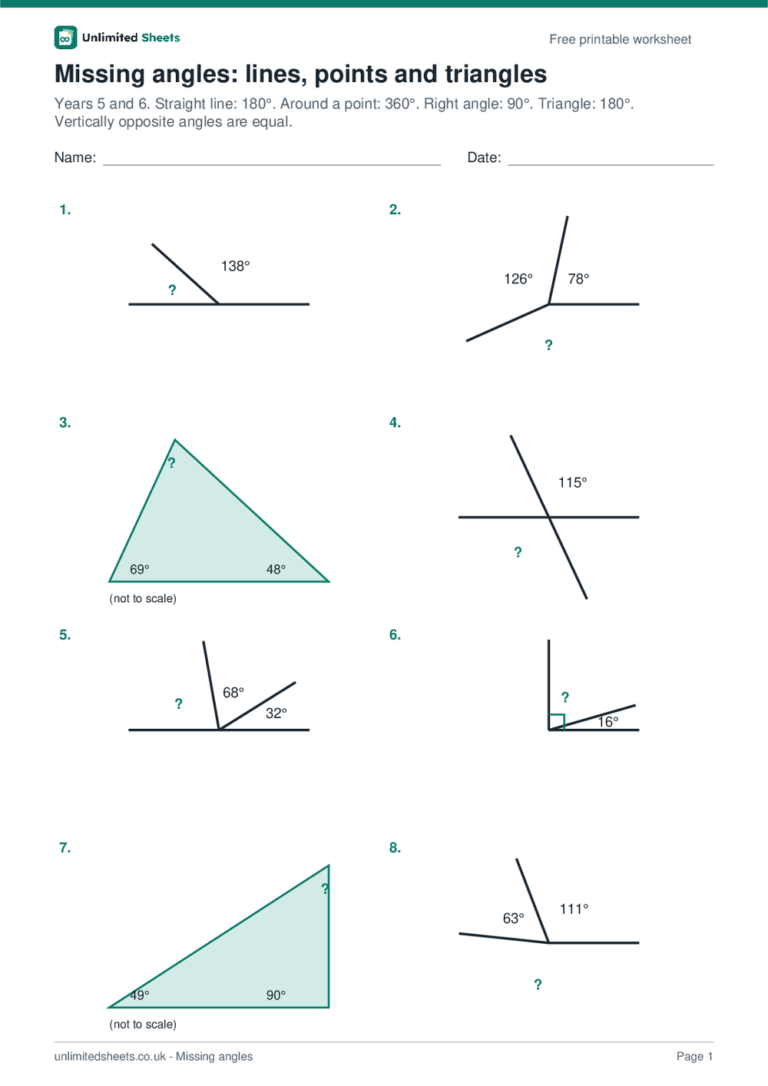
- On a straight line: the angles add up to 180°. If one is 125°, the other is 55°.
- Around a point: the angles add up to 360°.
- In a triangle: the angles add up to 180°. With 70° and 45°, the third angle is 65°.
- In a quadrilateral: the angles add up to 360°, because it splits into two triangles.
- Vertically opposite angles, made where two straight lines cross, are equal.
Coordinates
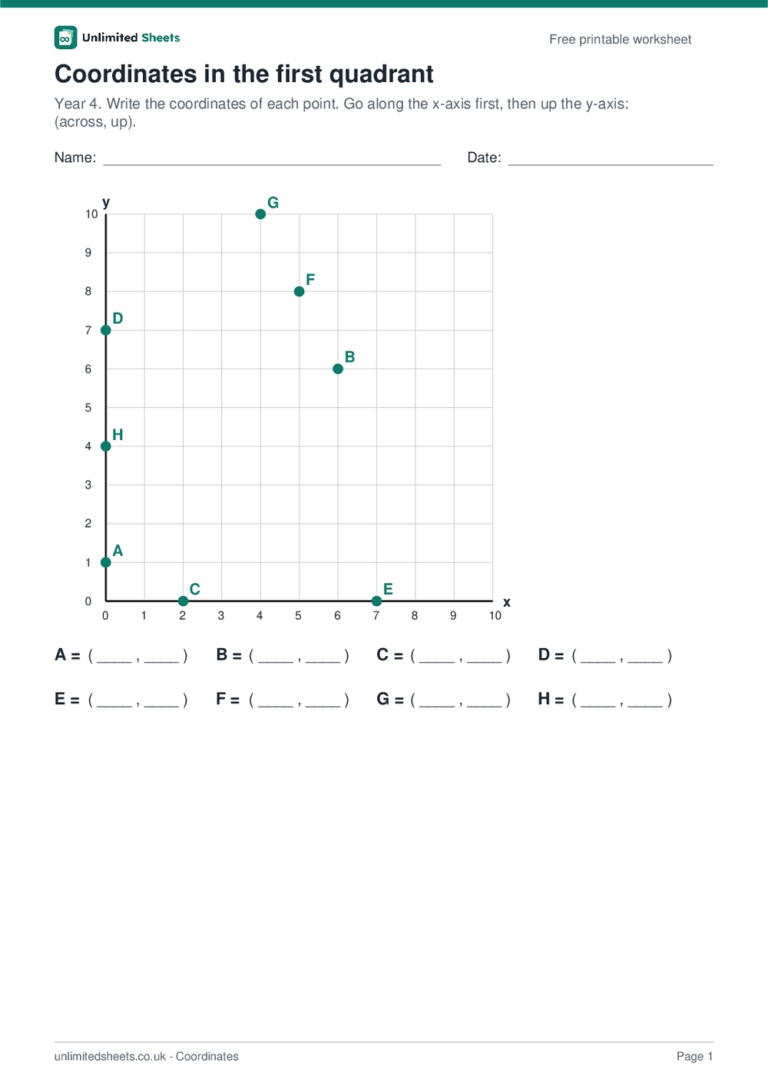
A coordinate gives a position on a grid as (x, y): first how far along the horizontal x-axis, then how far up the vertical y-axis. A common way to remember the order is “along the corridor, then up the stairs”. Year 4 pupils use the first quadrant, where both numbers are positive; Year 6 pupils use all four quadrants, where (−3, 2) is 3 to the left of the origin and 2 up.
Geometry in the National Curriculum
- Year 1: recognise and name common 2-D and 3-D shapes; half, quarter and three-quarter turns.
- Year 2: number of sides of 2-D shapes and line symmetry; edges, vertices and faces of 3-D shapes.
- Year 3: right angles; angles greater or less than a right angle; parallel and perpendicular lines.
- Year 4: acute and obtuse angles; classifying triangles and quadrilaterals; coordinates in the first quadrant.
- Year 5: degrees and reflex angles; angles at a point (360°) and on a straight line (180°); regular and irregular polygons.
- Year 6: unknown angles in triangles, quadrilaterals and regular polygons; vertically opposite angles; all four quadrants.
In more depth
Equilateral, isosceles and scalene; acute, right-angled and obtuse; and the 180° rule, with practice and a worksheet: types of triangles. For symmetry in every common 2-D shape, see lines of symmetry. For acute, right, obtuse, straight and reflex angles, how to measure them and angle facts, see types of angles.
Printable shapes, angles and coordinates worksheets
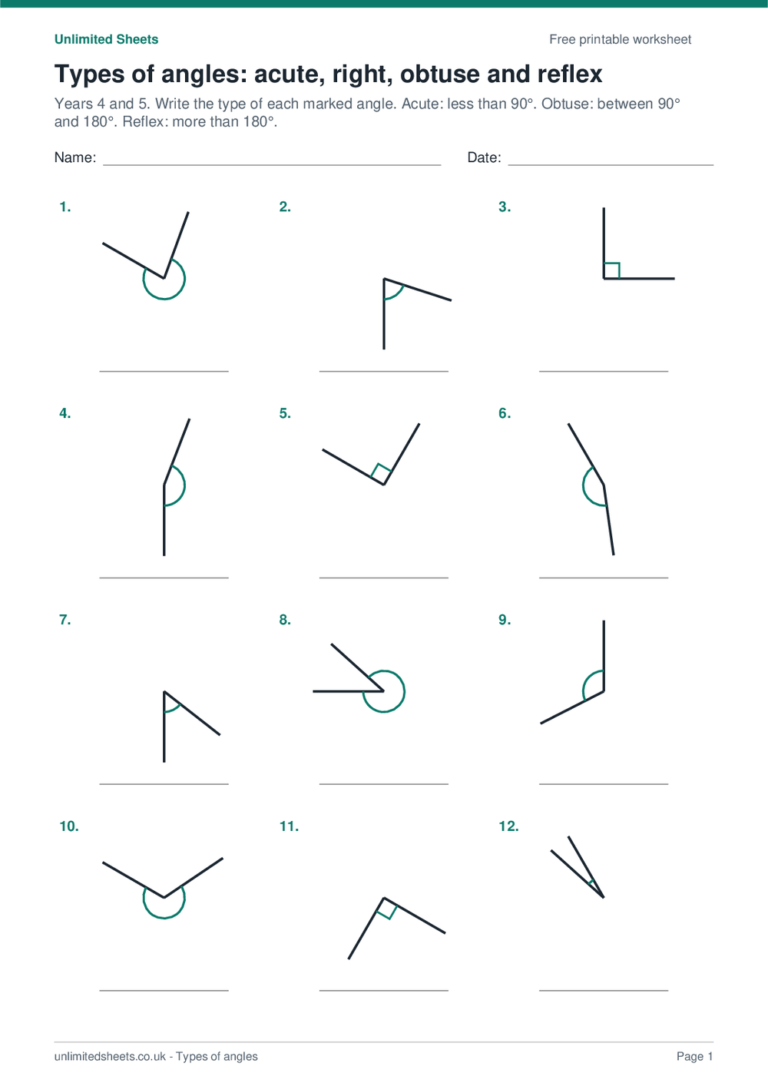
- Types of angles (Year 4–5). Twelve angles turned in different directions, so children judge the angle itself rather than the way it faces. The key gives each angle in degrees.
- Missing angles (Year 5–6). Eight diagrams covering every Year 5 and Year 6 angle fact: straight lines, points, right angles, vertically opposite angles and triangles.
- Coordinates in the first quadrant (Year 4). One large coordinate grid with eight points to read. Children write each one as (across, up).
- Faces, edges and vertices of 3-D shapes (Year 2–6). A table of eight solids, from cubes and pyramids to pentagonal and hexagonal prisms, with an Euler check so children can test their own answers.
Shapes and angles questions
What is an obtuse angle?
An obtuse angle is bigger than a right angle (90°) but smaller than a straight line (180°). Angles of 100° and 160° are both obtuse.
How many edges does a cube have?
A cube has 12 edges, 6 faces and 8 vertices.
Do the angles in every triangle add up to 180°?
Yes. Whatever its shape or size, the three interior angles of a triangle always total 180°.
Which coordinate comes first?
The x-coordinate (along) always comes first and the y-coordinate (up or down) second, written as (x, y).
Practice for each year group
Each page below has only the practice, curriculum objectives and worksheets for that year.
- Year 2 shapes
- Year 3 angles
- Year 4 angles
- Year 4 coordinates
- Year 5 angles
- Year 6 angles
- Year 6 coordinates
Keep practising
- Area and perimeter
- Statistics
- Telling the time: turns and right angles on a clock
- All maths topics
Updated 23 November 2026.