
Triangles are named in two ways: by their sides (equilateral, isosceles, scalene) and by their angles (acute, right-angled, obtuse). Every triangle has one name from each list, so a triangle can be, for example, a right-angled isosceles triangle. Children classify triangles in Year 4 and work out missing angles in Year 6.
Types of triangle by their sides
| Type | Sides | Angles |
|---|---|---|
| Equilateral | All three sides equal | All three angles are 60° |
| Isosceles | Two sides equal | The two angles opposite the equal sides are equal |
| Scalene | No sides equal | No angles equal |
On diagrams, equal sides are often shown with small matching marks, called hatch marks.
Types of triangle by their angles
| Type | Angles | Example |
|---|---|---|
| Acute | All three angles less than 90° | 60°, 70°, 50° |
| Right-angled | One angle exactly 90° | 90°, 45°, 45° |
| Obtuse | One angle more than 90° | 110°, 40°, 30° |
A triangle can never have two right angles or two obtuse angles, because the three angles would add up to more than 180°.
The angles add up to 180°
The three angles inside any triangle always add up to 180°. To find a missing angle, add the two you know and take the total away from 180°. If two angles are 50° and 60°, the third is 180° − 110° = 70°. A quick way to see why: tear the three corners off a paper triangle and put them together; they make a straight line, which is 180°.
Common mistakes
- Judging by how it is turned: a triangle is still isosceles when it is upside down or on its side.
- Measuring instead of reading the labels: diagrams are often not to scale, so use the given lengths and angles.
- Thinking a right-angled triangle cannot be isosceles: 90°, 45°, 45° is both.
In the national curriculum
- Year 4: compare and classify geometric shapes, including quadrilaterals and triangles, based on their properties and sizes; identify acute and obtuse angles.
- Year 5: know angles are measured in degrees and draw given angles.
- Year 6: find unknown angles in any triangles, quadrilaterals and regular polygons.
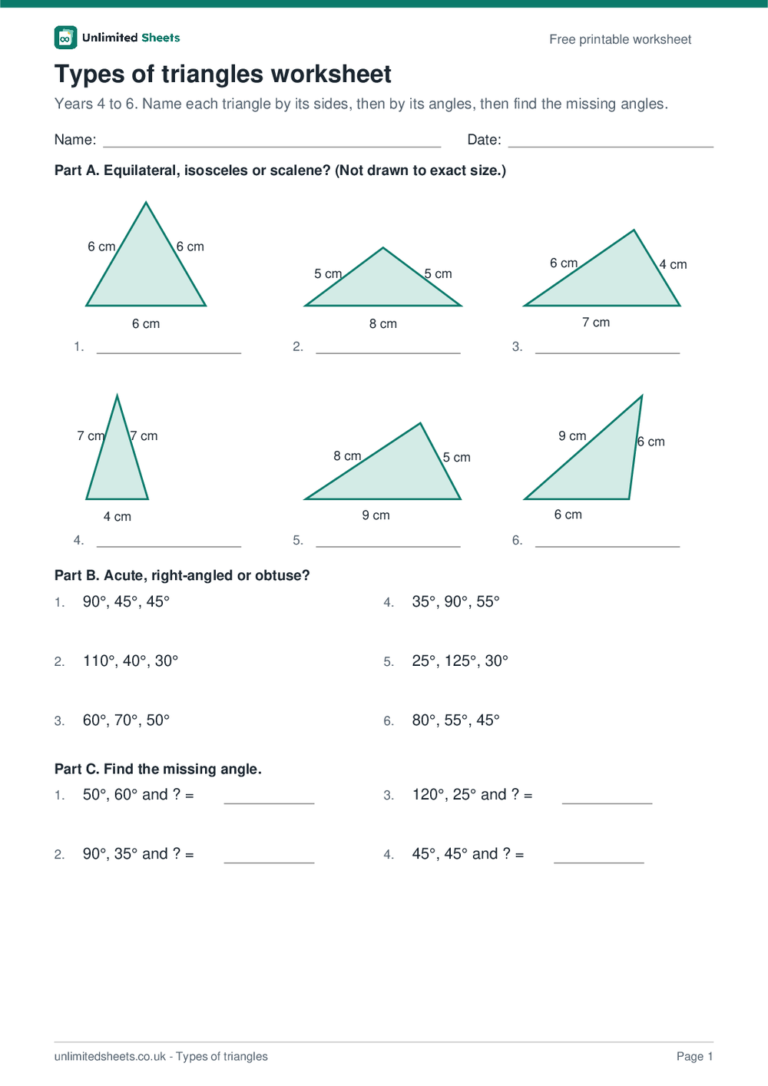
Printable types of triangles worksheet
Related pages
Shapes and angles, Year 4 angles, Year 6 angles and area and perimeter.
Sources
National curriculum in England: mathematics programmes of study, Department for Education, GOV.UK.
Updated 23 November 2026.