
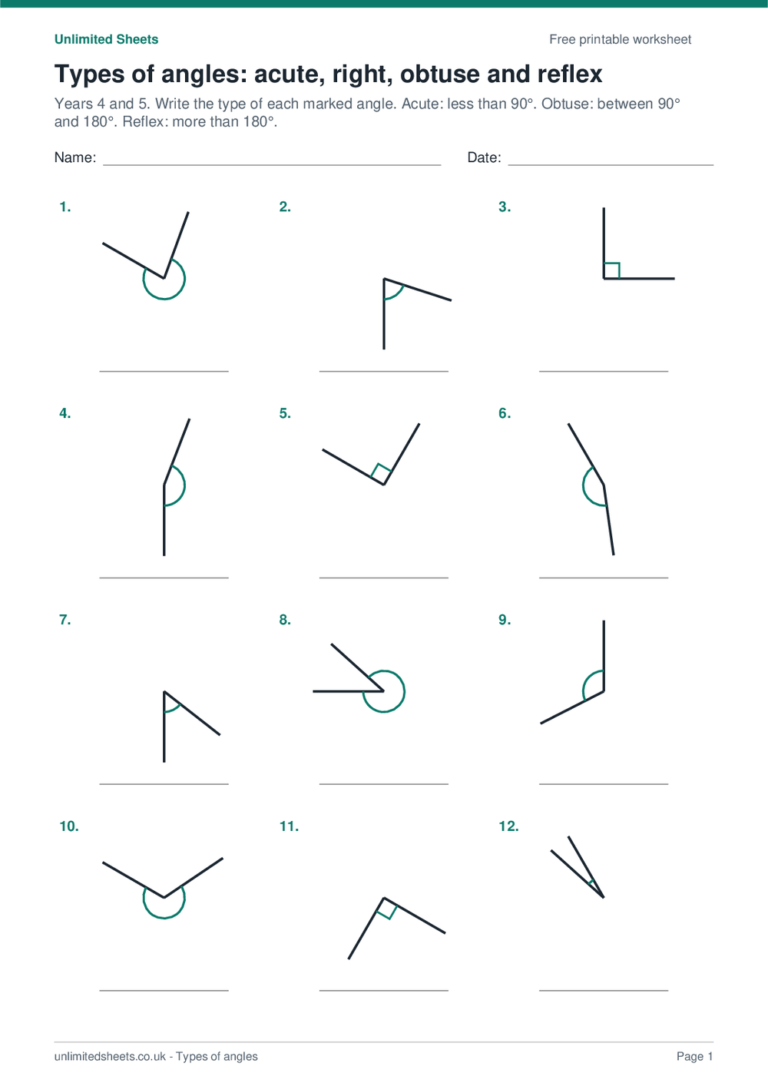
There are five types of angle, named by their size: acute (less than 90°), right (exactly 90°), obtuse (between 90° and 180°), straight (exactly 180°) and reflex (between 180° and 360°). A full turn is 360°. Children compare angles with a right angle in Year 3, name acute and obtuse angles in Year 4 and measure reflex angles in degrees in Year 5.
The types of angle
| Type | Size | How it looks |
|---|---|---|
| Acute | Less than 90° | Sharper than the corner of a book |
| Right angle | Exactly 90° | A square corner, marked with a small square |
| Obtuse | More than 90° but less than 180° | Opened wider than a square corner |
| Straight angle | Exactly 180° | A straight line |
| Reflex | More than 180° but less than 360° | The angle on the outside of an acute or obtuse angle |
| Full turn | 360° | All the way round |
A quick way to remember: acute sounds like “a cute little angle”, and obtuse is the wide one.
Angles as turns
In Year 3 children learn that an angle is an amount of turn. A quarter turn is one right angle (90°), a half turn is two right angles (180°), a three-quarter turn is three (270°) and a whole turn is four (360°). That is why a reflex angle is any turn bigger than a half turn but smaller than a whole one.
Every angle has a reflex partner
Where two lines meet there are two angles: the one inside and the one outside. They add up to 360°. If the inside angle is 50°, the outside one is 360° − 50° = 310°, a reflex angle. Always check which side of the lines an angle is marked on.
How to measure an angle with a protractor
- Put the centre cross of the protractor exactly on the point where the two lines meet.
- Line up the zero line with one arm of the angle.
- Follow the scale that starts at 0 on that arm, and read where the other arm crosses it.
- Check the answer makes sense: an acute angle must be less than 90°, so if you read 130° for a sharp angle you used the wrong scale.
To measure a reflex angle, measure the smaller angle inside and take it away from 360°.
Angle facts
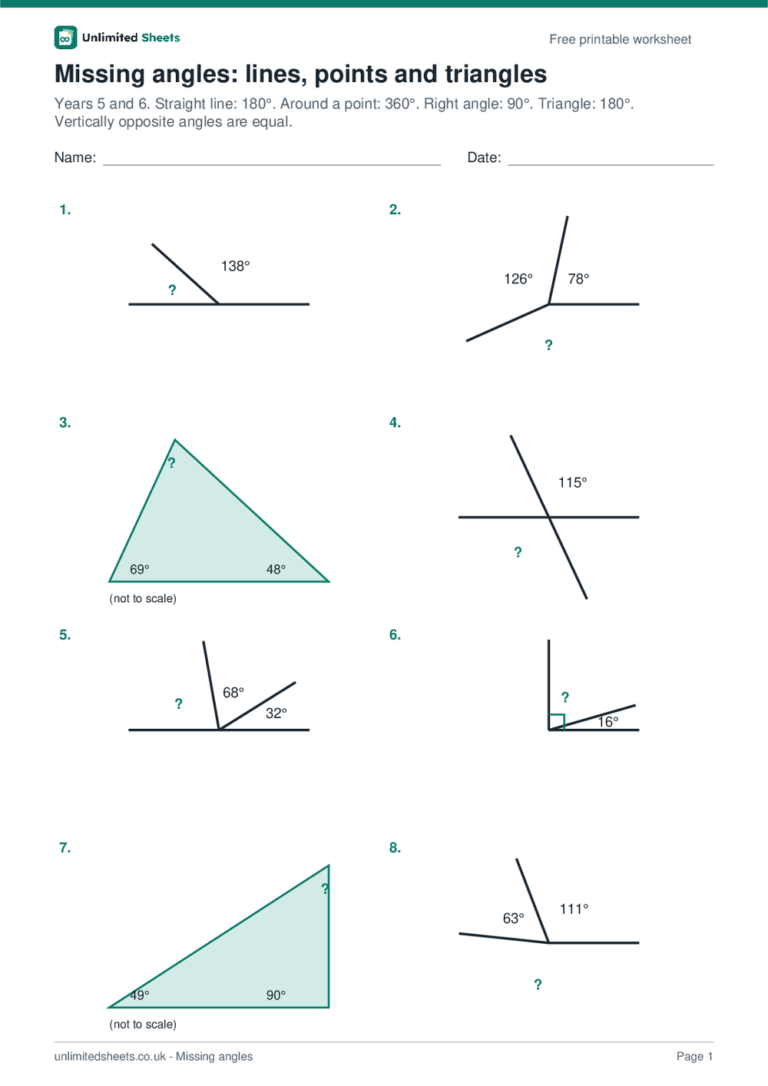
- On a straight line angles add up to 180°.
- Around a point angles add up to 360°.
- Vertically opposite angles, where two straight lines cross, are equal.
- In a triangle the angles add up to 180°, and in a quadrilateral 360°. See types of triangles.
Common mistakes
- Judging by the length of the lines: longer arms do not make a bigger angle; only the amount of turn counts.
- Reading the wrong scale on a protractor, so a 50° angle is read as 130°.
- Calling a 180° angle obtuse: obtuse stops just before 180°; exactly 180° is a straight angle.
In the national curriculum
- Year 3: recognise angles as a property of shape or a description of a turn; identify right angles; recognise that two right angles make a half-turn, three make three quarters of a turn and four a complete turn; identify whether angles are greater than or less than a right angle.
- Year 4: identify acute and obtuse angles and compare and order angles up to two right angles by size.
- Year 5: know angles are measured in degrees; estimate and compare acute, obtuse and reflex angles; draw given angles and measure them; angles at a point (360°) and on a straight line (180°).
- Year 6: recognise angles where they meet at a point, are on a straight line, or are vertically opposite, and find missing angles.
Printable angles worksheets
Angles by year
Year 3 angles, Year 4 angles, Year 5 angles and Year 6 angles. More on shapes and angles.
Sources
National curriculum in England: mathematics programmes of study, Department for Education, GOV.UK.
Updated 23 November 2026.