
A relative clause is a kind of subordinate clause that tells us more about a noun. In The girl who won the race was only seven, the relative clause tells us which girl. Relative clauses are taught in Year 5.
Try the two practice sets below: Spot it asks your child to find relative clauses in sentences, and Use it asks them to choose the correct one. Every answer is explained.
Relative pronouns
A relative clause usually starts with a relative pronoun. The Year 5 programme of study lists who, which, where, when, whose and that, and notes that the pronoun can sometimes be left out.
| Pronoun | Used for | Example |
|---|---|---|
| who | people | My aunt, who lives in Leeds, is a vet. |
| which | things and animals | The castle, which is 800 years old, has a moat. |
| that | people or things | This is the bike that I wanted. |
| where | places | That is the shop where we buy bread. |
| when | times | I remember the day when it snowed. |
| whose | belonging | The boy whose dog barked said sorry. |
Where a relative clause goes
A relative clause sits straight after the noun it describes, which can be in the middle of the main clause: The cake that Dad made was delicious. Children sometimes find this odd at first, because the main clause is split in two. Covering the relative clause with a finger shows that The cake was delicious still makes sense on its own.
Commas with relative clauses
If the relative clause adds extra information that could be removed, put commas around it: My brother, who is twelve, plays the drums. If it is needed to say which one we mean, leave the commas out: The boy who is twelve plays the drums (not the other boys). Commas around extra information are a kind of parenthesis, which children also learn in Year 5.
When the pronoun is left out
In This is the film I told you about, the word that has been left out: the film (that) I told you about. This is still a relative clause. It is sometimes called an omitted relative pronoun.
Common mistakes
- Using which for people: the teacher which helped me should be who or that.
- Who’s and whose: whose shows belonging; who’s means who is.
- Missing the second comma: My aunt, who lives in Leeds is a vet needs a comma after Leeds.
Printable relative clauses worksheet
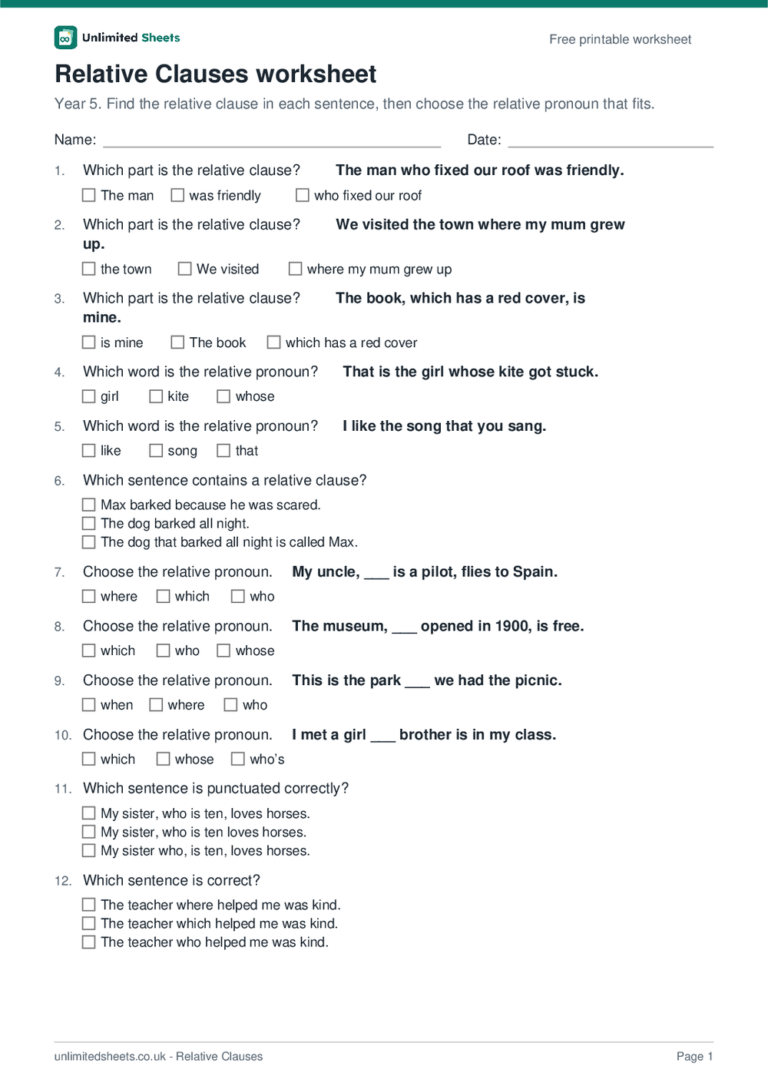
The worksheet mixes questions that ask your child to spot relative clauses with questions that ask them to use them, each with tick boxes, followed by an answer key. It is A4 and prints in black and white.
Related pages
- By year: Year 5 English.
- More in Grammar: Active and Passive Voice.
- Other grammar terms: Modal Verbs, Conjunctions, Prepositions, Determiners, Apostrophes, Inverted Commas. See them all on the KS2 grammar page.
Sources
National curriculum in England: English programmes of study, including English Appendix 2: vocabulary, grammar and punctuation, Department for Education, GOV.UK.
Updated 23 November 2026.