
A preposition is a word that shows how a noun or pronoun is linked to the rest of the sentence, often telling us where or when. In The cat hid under the table, under is the preposition: it tells us where the cat hid. Children learn the term in Year 3.
Try the two practice sets below: Spot it asks your child to find prepositions in sentences, and Use it asks them to choose the correct one. Every answer is explained.
Prepositions by meaning
| Type | Examples | In a sentence |
|---|---|---|
| Place | in, on, under, behind, beside, between, above, below, inside, near | The keys are behind the sofa. |
| Time | at, on, in, before, after, during, until, since | We swim on Mondays after school. |
| Direction | to, into, onto, across, through, along, towards, past | The dog ran across the field. |
| Other links | with, without, by, for, about, like, of | She came with her brother. |
Prepositional phrases
A preposition usually comes before a noun phrase, and together they make a prepositional phrase: under the old bridge, during the storm, with a smile. In Year 4, children use these phrases to build longer noun phrases, such as the house at the end of the lane, and as fronted adverbials, such as After lunch, we went outside.
What Year 3 learn
The Year 3 programme of study asks children to express “time, place and cause” using conjunctions, adverbs and prepositions, with examples such as before, after, during, in and because of. A good Year 3 sentence uses a preposition to add a clear detail: We read quietly during the afternoon.
Preposition, conjunction or adverb?
Some words can belong to more than one class, so look at what follows them:
- Preposition: followed by a noun or pronoun. We waited outside the shop.
- Adverb: stands alone. We waited outside.
- Conjunction: followed by a clause with a verb. We waited until the shop opened. Compare the preposition: We waited until nine.
Common mistakes
- In, on or at for time: at 3 o’clock, on Monday, in July.
- Different from, not different to/than in formal writing.
- Of for have: could of is not a preposition mistake but a spelling of could have.
Printable prepositions worksheet
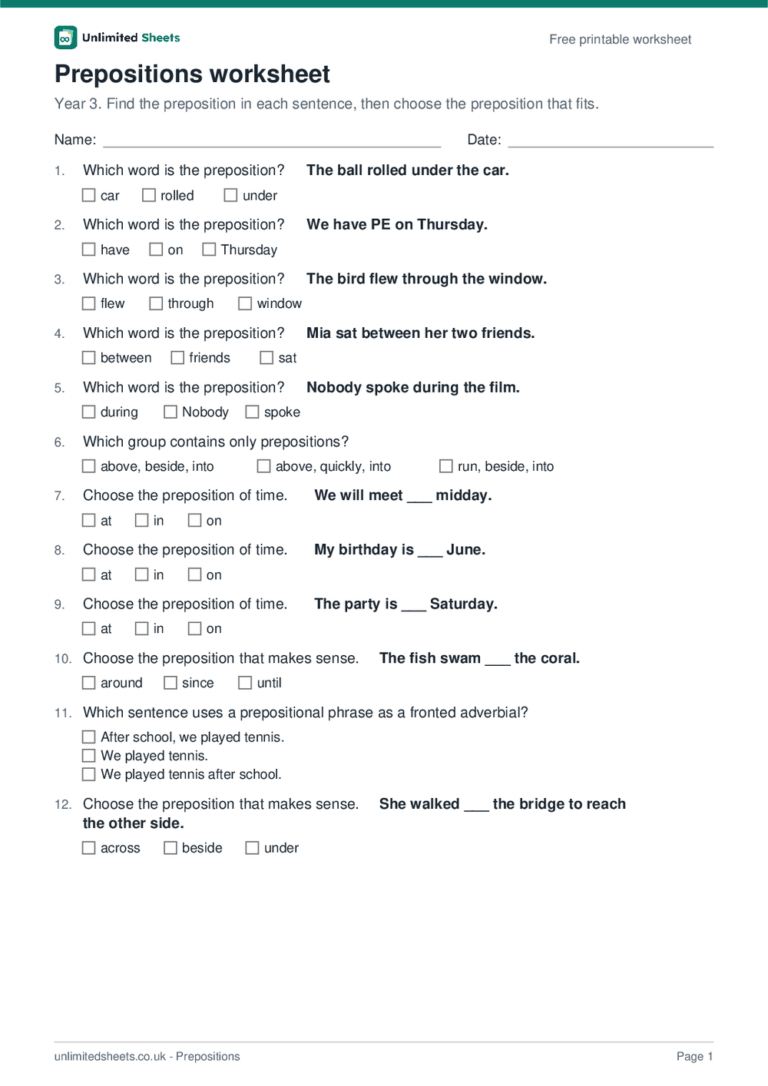
The worksheet mixes questions that ask your child to spot prepositions with questions that ask them to use them, each with tick boxes, followed by an answer key. It is A4 and prints in black and white.
Related pages
- By year: Year 3 grammar, Year 4 grammar.
- More in Word classes: Modal Verbs, Conjunctions, Determiners.
- Other grammar terms: Relative Clauses, Active and Passive Voice, Apostrophes, Inverted Commas, Parenthesis, Homophones. See them all on the KS2 grammar page.
Sources
National curriculum in England: English programmes of study, including English Appendix 2: vocabulary, grammar and punctuation, Department for Education, GOV.UK.
Updated 23 November 2026.