
A modal verb is a helping verb that goes in front of another verb to show how likely, possible or necessary something is. In It might rain, might is the modal verb: it tells us rain is possible but not certain. Children learn modal verbs in Year 5.
Try the two practice sets below: Spot it asks your child to find modal verbs in sentences, and Use it asks them to choose the correct one. Every answer is explained.
The modal verbs children learn
There are nine core modal verbs: can, could, may, might, shall, should, will, would and must. Ought to works in the same way. Each one sits in front of the main verb, which stays in its plain form: she can swim, never she can swims or she can to swim.
Modal verbs and degrees of possibility
The Year 5 programme of study asks children to show “degrees of possibility using adverbs or modal verbs”. Put simply, some modal verbs sound more certain than others:
| How sure? | Modal verb | Example |
|---|---|---|
| Certain | will, must | The match will start at 3 o’clock. |
| Likely | should | The parcel should arrive today. |
| Possible | may, might, could | We might go to the park later. |
| Not possible | cannot, will not | Penguins cannot fly. |
Adverbs such as perhaps, surely, definitely and probably do the same job, and children are often asked to use both together: Perhaps we could leave early.
Other jobs modal verbs do
- Ability: I can ride a bike. When she was five, she could already read.
- Permission: May I borrow your pencil? You can go out to play.
- Obligation and advice: You must wear a helmet. You should drink more water.
- Offers and suggestions: Shall I carry that? We could try again tomorrow.
How to spot a modal verb
Look for a small verb that comes straight before another verb and never changes its ending. We say he runs and she runs, but he must and she must: modal verbs have no -s, -ing or -ed forms. They also make questions and negatives on their own, without do: Can you swim? and I can’t swim.
Common mistakes
- Adding to: You must to finish should be You must finish. Only ought to keeps the to.
- Writing “of” for “have”: I should of known comes from how should’ve sounds. The correct form is should have.
- Mixing up the certainty: The sun might rise tomorrow is grammatical but sounds odd, because sunrise is certain.
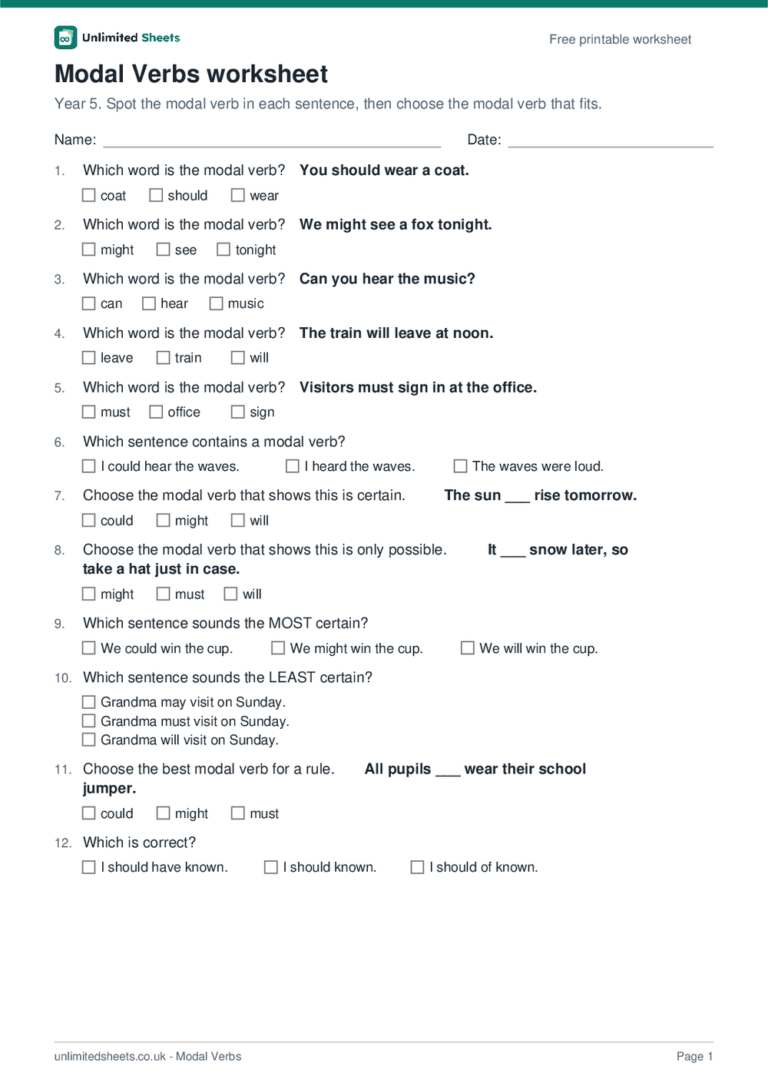
Printable modal verbs worksheet
The worksheet mixes questions that ask your child to spot modal verbs with questions that ask them to use them, each with tick boxes, followed by an answer key. It is A4 and prints in black and white.
Related pages
- By year: Year 5 English.
- More in Word classes: Conjunctions, Prepositions, Determiners.
- Other grammar terms: Relative Clauses, Active and Passive Voice, Apostrophes, Inverted Commas, Parenthesis, Homophones. See them all on the KS2 grammar page.
Sources
National curriculum in England: English programmes of study, including English Appendix 2: vocabulary, grammar and punctuation, Department for Education, GOV.UK.
Updated 23 November 2026.