
An apostrophe has two jobs: it shows where letters are missing, and it shows that something belongs to someone. Don’t uses it for missing letters; Sam’s coat uses it for belonging. Children learn both in Year 2 and the plural form in Year 4.
Try the two practice sets below: Spot it asks your child to find apostrophes in sentences, and Use it asks them to choose the correct one. Every answer is explained.
Job 1: missing letters (contractions)
When two words are pushed together, the apostrophe goes exactly where the letters were taken out.
| Full form | Contraction | Missing |
|---|---|---|
| do not | don’t | o |
| I am | I’m | a |
| they are | they’re | a |
| we have | we’ve | ha |
| it is / it has | it’s | i / ha |
| will not | won’t | an irregular one |
Job 2: belonging (possession)
- One owner: add ’s. the cat’s bowl, James’s hat.
- More than one owner, plural ending in s: add just the apostrophe. the cats’ bowls, the girls’ changing room.
- Plural not ending in s: add ’s. the children’s books, the men’s team.
Year 2 covers contractions and one owner; Year 4 adds plural owners. A useful check: say “belonging to…” and write the owner word first. Belonging to the girls → girls → girls’.
Its or it’s?
This is the most common apostrophe mistake for adults as well as children. It’s always means it is or it has. Its shows belonging, like his and her, which never take an apostrophe: The dog wagged its tail. Try reading the sentence with it is: if it makes sense, use it’s.
No apostrophe for ordinary plurals
Plurals that do not own anything never need an apostrophe: three apples, not three apple’s; the 1990s, not the 1990’s.
Common mistakes
- Apostrophes in possessive pronouns: yours, ours, theirs and hers never have one.
- Putting the apostrophe where the words join: did’nt should be didn’t, because the missing letter is the o in not.
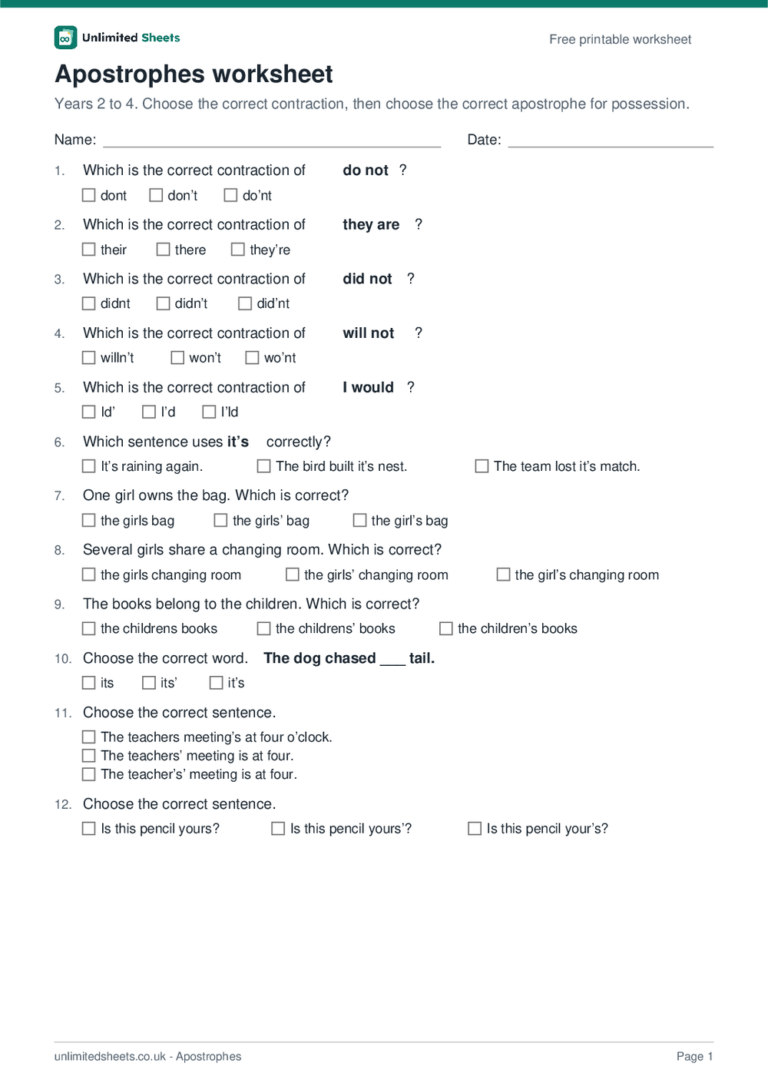
Printable apostrophes worksheet
The worksheet mixes questions that ask your child to spot apostrophes with questions that ask them to use them, each with tick boxes, followed by an answer key. It is A4 and prints in black and white.
Related pages
- By year: Year 2 punctuation, Year 4 punctuation.
- More in Punctuation: Inverted Commas, Parenthesis.
- Other grammar terms: Modal Verbs, Conjunctions, Prepositions, Determiners, Relative Clauses, Active and Passive Voice. See them all on the KS2 grammar page.
Sources
National curriculum in England: English programmes of study, including English Appendix 2: vocabulary, grammar and punctuation, Department for Education, GOV.UK.
Updated 23 November 2026.