
Common exception words are everyday words that children cannot yet spell by sounding them out, such as said, the and friend. The national curriculum lists 45 of them for Year 1 and 64 for Year 2. This page has both lists, practice that reads the words aloud, and printable sheets.
Choose a level. Hear it says each word, and short words that sound like other words are read in a sentence: to comes as “I am going to school”. Look, cover, write shows the word for three seconds and needs no sound.
Next exercise
Short original stories and information texts for Years 1 and 2, with questions.
What makes a word an exception word?
In Reception and Year 1, children learn phonics: which letters make which sounds. Most words can then be spelt by listening to each sound. Exception words break those patterns, or use a pattern that has not been taught yet. In said the sound /e/ is spelt ai; in friend it is spelt ie; in one nothing on the page tells you about the /w/ at the start. Because these words turn up in almost every sentence children write, learning them by heart early saves a lot of mistakes later.
Year 1 common exception words
| the | his | go | ask |
| a | has | so | friend |
| do | I | by | school |
| to | you | my | put |
| today | your | here | push |
| of | they | there | pull |
| said | be | where | full |
| says | he | love | house |
| are | me | come | our |
| were | she | some | |
| was | we | one | |
| is | no | once |
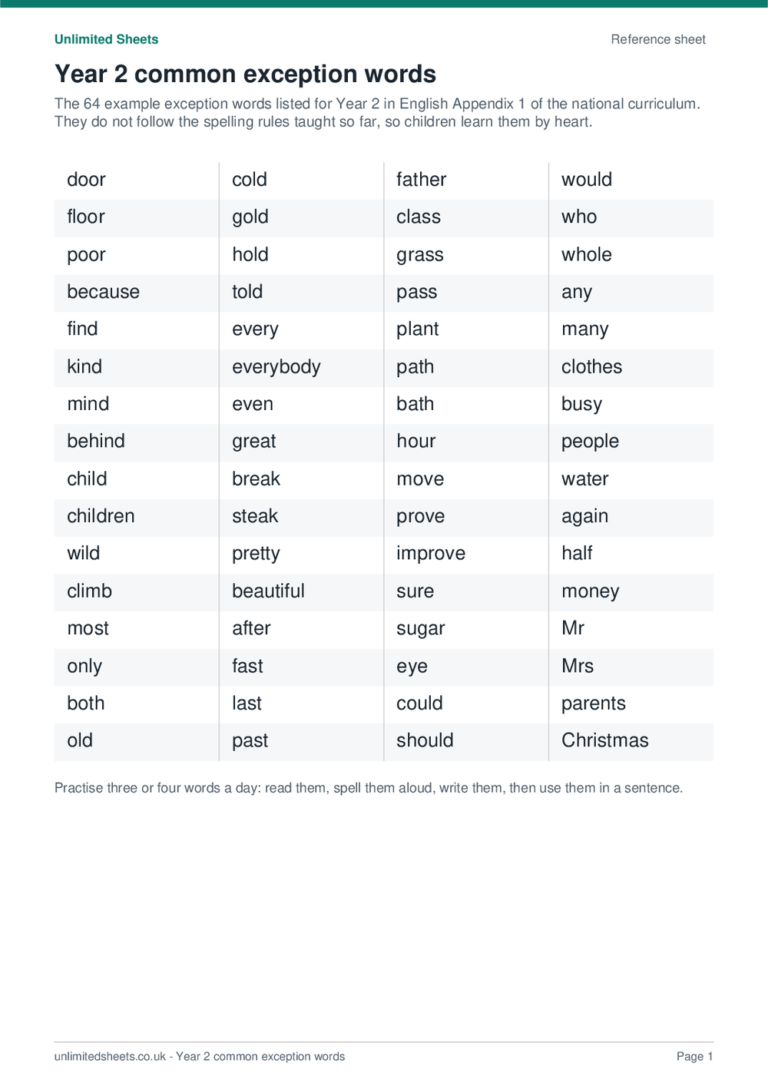
Year 2 common exception words
| door | cold | father | would |
| floor | gold | class | who |
| poor | hold | grass | whole |
| because | told | pass | any |
| find | every | plant | many |
| kind | everybody | path | clothes |
| mind | even | bath | busy |
| behind | great | hour | people |
| child | break | move | water |
| children | steak | prove | again |
| wild | pretty | improve | half |
| climb | beautiful | sure | money |
| most | after | sugar | Mr |
| only | fast | eye | Mrs |
| both | last | could | parents |
| old | past | should | Christmas |
Appendix 1 gives these words as examples and adds “and/or others, according to the programme used”, so your child’s school may teach a slightly different set alongside its phonics scheme. The curriculum also notes that children is not really an exception, but it is listed because of its link with child, and that fast, last, past, path and bath are only exceptions in accents where the a is said like the ar in car.
Each list on its own page
For a closer look at one year, with the words grouped by spelling pattern and a learning plan: Year 1 common exception words and Year 2 common exception words.
How to learn exception words
- Find the tricky part. Most of each word follows the rules. In said, only the ai is odd, so underline it.
- Group words that share a pattern. could, should and would; find, kind, mind and behind; old, cold, gold, hold and told.
- Say it the spelling way. Saying “Wed-nes-day” or “beau-ti-ful” as it is written helps some children remember the letters.
- Keep sessions short. Three or four words a day, with a quick check of last week’s words, works better than a long list once a week.
- Use them in sentences. Exception words are only useful if children spell them correctly in their own writing.
Common mistakes
- Spelling by sound: sed for said, becos for because, wos for was.
- Mixing up homophones: there and their, to and two, our and hour.
- Swapping letters: freind for friend, thay for they.
- Forgetting capital letters: I, Mr, Mrs and Christmas always start with a capital.
To practise these words as a game, try the spelling games.
Printable exception word worksheets
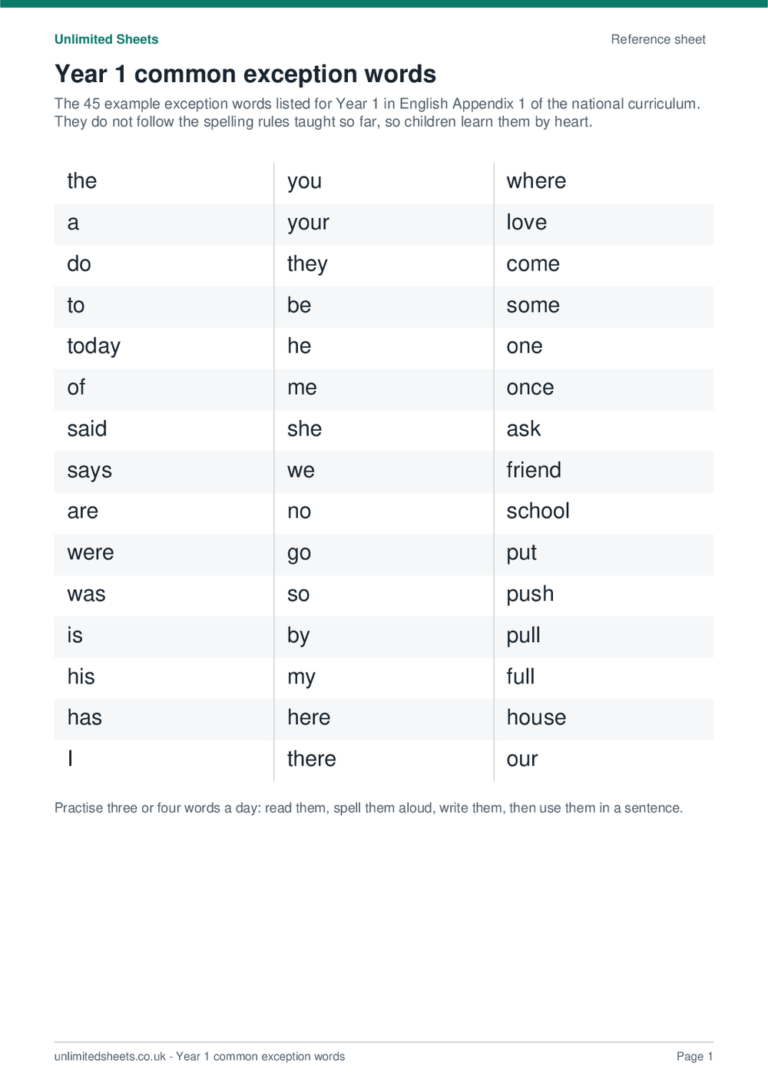
- Year 1 common exception words (Reference). All 45 Year 1 exception words in large print, in the order the curriculum lists them, to stick on the fridge or in a reading record.
- Year 2 common exception words (Reference). All 64 Year 2 exception words, from door and floor to beautiful and Christmas, on one A4 page.
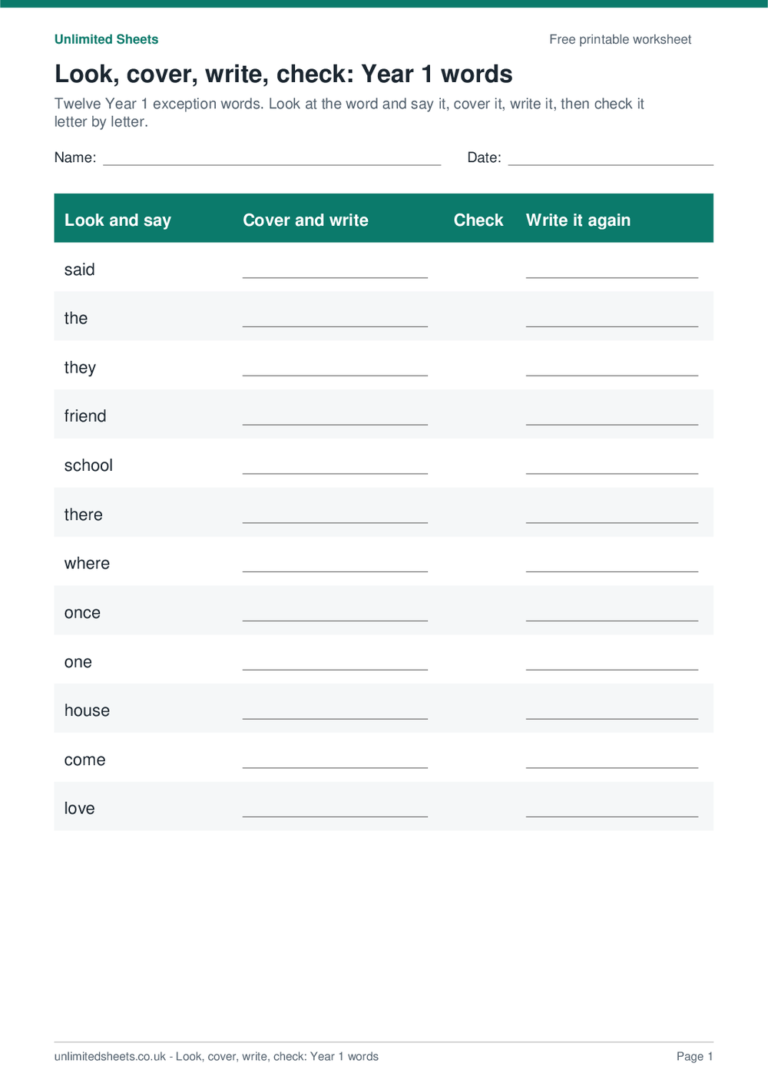
- Look, cover, write, check: Year 1 words (Year 1). Twelve of the Year 1 words children most often misspell, such as said, friend and once, in a four-column practice table.
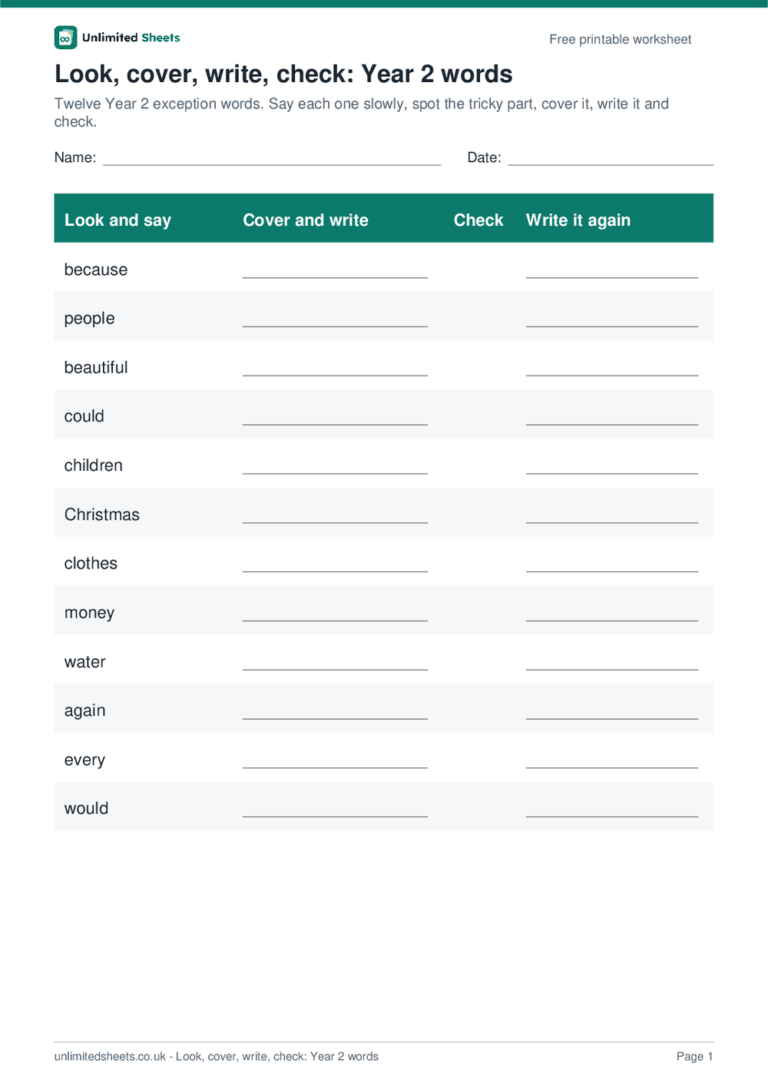
- Look, cover, write, check: Year 2 words (Year 2). Twelve Year 2 words with tricky parts, from because and people to beautiful and Christmas, ready to practise at home.
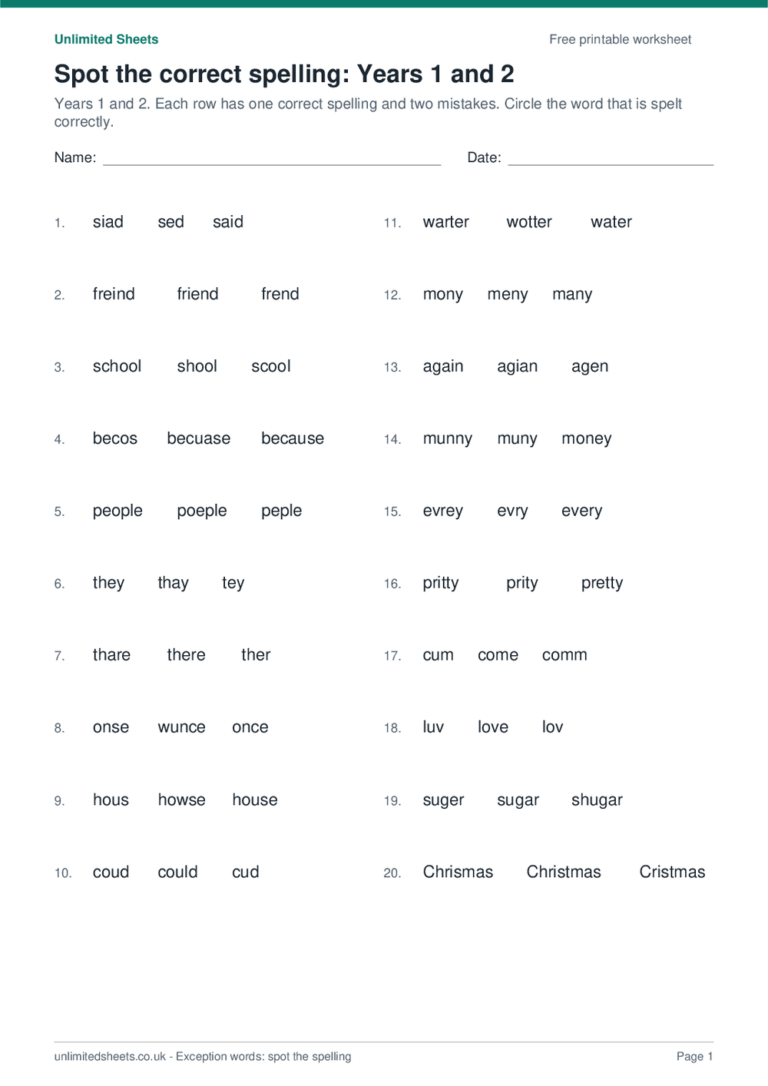
- Spot the correct spelling: Years 1 and 2 (Year 1–2). Twenty exception words, each beside two spellings children really write, such as sed for said and becos for because.
Exception word questions
How many common exception words are there in Year 1?
English Appendix 1 lists 45 example words for Year 1 and 64 for Year 2. Schools may add others, depending on the phonics programme they use.
Are common exception words the same as tricky words?
They are very similar. Many phonics programmes call them tricky words or red words. The national curriculum uses the term common exception words.
Is the Year 2 list harder than the Year 1 list?
Yes. Year 2 words are longer, such as beautiful and everybody, and include patterns like could, should and would.
What comes after the Year 2 words?
In Years 3 and 4 children move on to the statutory spelling list of 100 words, followed by another 100 words in Years 5 and 6.
Practice for each year group
Each year page brings this together with the rest of that year’s spelling work.
Keep practising
- Spelling words: Years 3 to 6
- Punctuation: capital letters and full stops
- Reading comprehension
- All English topics
Updated 23 November 2026.