
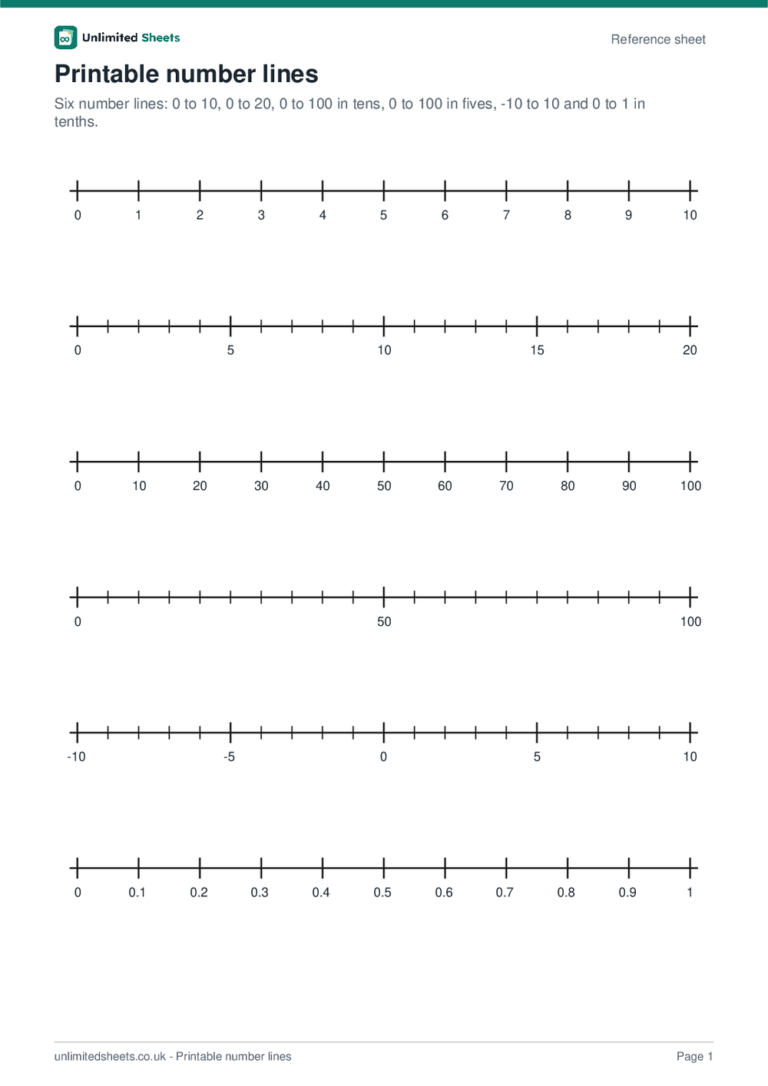
A number line shows numbers in order, evenly spaced along a straight line. It is one of the first maths tools children use, from counting to 20 in Year 1 to decimals and negative numbers later on. Below are printable number lines and practice in reading them.
How to read a number line
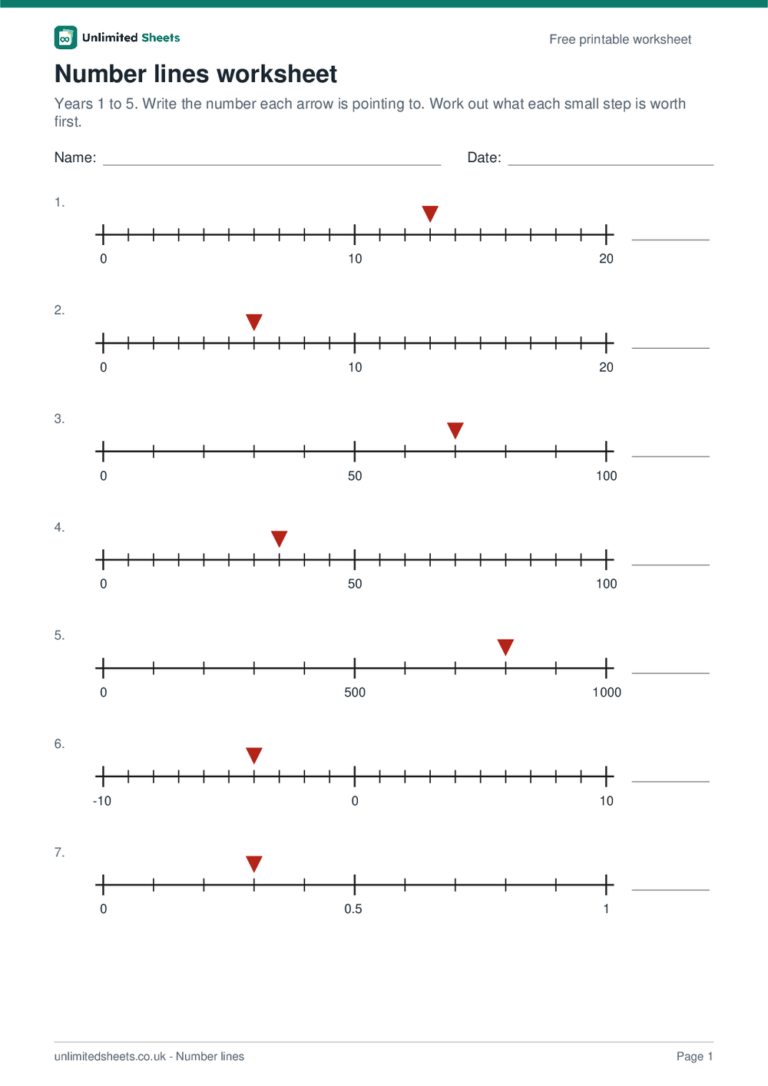
- Look at the numbers at each end and any labelled numbers in between.
- Count the equal steps between two labelled numbers.
- Divide to find what each step is worth: from 0 to 100 in 10 steps, each step is 10.
- Count the steps to the arrow.
Most mistakes come from assuming every step is worth 1. On a line from 0 to 1000 with ten steps, each step is worth 100.
What number lines are used for
- Counting on and back: 8 + 5 is five jumps right from 8; 13 − 5 is five jumps left.
- Bridging through 10: 8 + 5 = 8 + 2 + 3, jumping to 10 first.
- Rounding: 37 is nearer 40 than 30 on a line from 30 to 40.
- Negative numbers: numbers to the left of zero are below zero, as on a thermometer. See negative numbers.
- Fractions and decimals: 0.5 and ½ sit at the same point halfway between 0 and 1.
In the national curriculum
- Year 1: identify and represent numbers using objects and pictorial representations, including the number line.
- Year 2: identify, represent and estimate numbers using different representations, including the number line.
- Year 3: identify, represent and estimate numbers to 1000 using different representations.
- Year 4: count backwards through zero to include negative numbers, and work with tenths and hundredths.
Printable number lines and worksheet
Related pages
The 100 square, number bonds, place value and rounding, decimals and Year 1 counting.
Sources
National curriculum in England: mathematics programmes of study, Department for Education, GOV.UK.
Updated 23 November 2026.