
The national curriculum for England sets 100 words that children should learn to spell in Years 3 and 4, and another 100 for Years 5 and 6. This page gives both lists in full, three ways to practise them on screen and printable sheets for home or class.
Pick a level below. Hear it reads each word aloud and you type it. Look, cover, write flashes the word for three seconds, then hides it while you write it from memory. Spot it shows three spellings and only one is right.
Each list on its own page
For one list at a time, with the words grouped by the trap in each word and a two-year plan: the Year 3 and 4 spelling list and the Year 5 and 6 spelling list.
How the spelling practice works
The audio uses the voice built into your device and asks for a British English voice. If the device has none, the page says so and you can switch to Look, cover, write, which needs no sound. Words that sound like another word, such as reign (rain) or weight (wait), are read inside a short sentence so the meaning is clear.
Answers are marked when you press Check. Capital letters and spaces at the ends do not count against you, but every letter in the middle does. Open How to learn it under any word to see it letter by letter.
Year 3 and 4 spelling list
These are the words from English Appendix 1 for Years 3 and 4, in alphabetical order. Brackets show a second form to learn: accident(ally) means both accident and accidentally, and a slash joins two related words, such as busy/business.
| accident(ally) | disappear | interest | pressure |
| actual(ly) | early | island | probably |
| address | earth | knowledge | promise |
| answer | eight/eighth | learn | purpose |
| appear | enough | length | quarter |
| arrive | exercise | library | question |
| believe | experience | material | recent |
| bicycle | experiment | medicine | regular |
| breath | extreme | mention | reign |
| breathe | famous | minute | remember |
| build | favourite | natural | sentence |
| busy/business | February | naughty | separate |
| calendar | forward(s) | notice | special |
| caught | fruit | occasion(ally) | straight |
| centre | grammar | often | strange |
| century | group | opposite | strength |
| certain | guard | ordinary | suppose |
| circle | guide | particular | surprise |
| complete | heard | peculiar | therefore |
| consider | heart | perhaps | though/although |
| continue | height | popular | thought |
| decide | history | position | through |
| describe | imagine | possess(ion) | various |
| different | increase | possible | weight |
| difficult | important | potatoes | woman/women |
Year 5 and 6 spelling list
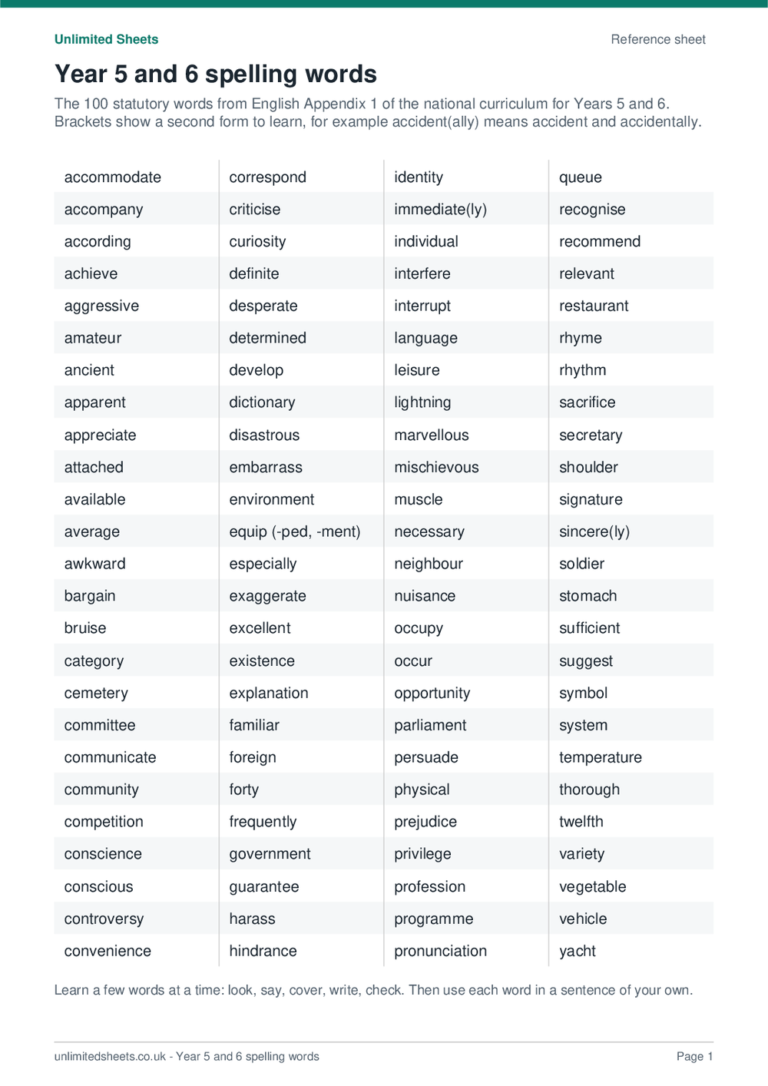
The Year 5 and 6 words are longer and include more silent letters, double consonants and unusual endings. Equip comes with equipped and equipment, and criticise is easier once you see it is critic plus ise.
| accommodate | correspond | identity | queue |
| accompany | criticise | immediate(ly) | recognise |
| according | curiosity | individual | recommend |
| achieve | definite | interfere | relevant |
| aggressive | desperate | interrupt | restaurant |
| amateur | determined | language | rhyme |
| ancient | develop | leisure | rhythm |
| apparent | dictionary | lightning | sacrifice |
| appreciate | disastrous | marvellous | secretary |
| attached | embarrass | mischievous | shoulder |
| available | environment | muscle | signature |
| average | equip (–ped, –ment) | necessary | sincere(ly) |
| awkward | especially | neighbour | soldier |
| bargain | exaggerate | nuisance | stomach |
| bruise | excellent | occupy | sufficient |
| category | existence | occur | suggest |
| cemetery | explanation | opportunity | symbol |
| committee | familiar | parliament | system |
| communicate | foreign | persuade | temperature |
| community | forty | physical | thorough |
| competition | frequently | prejudice | twelfth |
| conscience | government | privilege | variety |
| conscious | guarantee | profession | vegetable |
| controversy | harass | programme | vehicle |
| convenience | hindrance | pronunciation | yacht |
How to learn a spelling list
- Take five words a week, not twenty. Short, regular practice beats one long session.
- Look, say, cover, write, check. Say the word aloud, cover it, write it, then compare letter by letter.
- Find the tricky part. In separate it is the a in the middle; in February it is the first r. Underline it and practise only that part.
- Use word families. Know explains the silent k in knowledge; sign helps with signature.
- Put it in a sentence. Writing the word in a sentence of your own fixes the meaning as well as the spelling.
Patterns hiding in the lists
| Pattern | Examples from the lists |
|---|---|
| Double letters | address, different, embarrass, accommodate, committee |
| Silent letters | island, knowledge, rhythm, yacht, muscle |
| ie or ei | believe, height, weight, foreign, leisure |
| -ous endings | famous, various, disastrous, mischievous |
| British spellings | centre, favourite, neighbour, programme, recognise, marvellous |
Spelling in the national curriculum
Spelling is set out in English Appendix 1. Years 1 and 2 focus on phonics, common exception words and suffixes such as -ing and -ed. The two statutory word lists on this page belong to the Years 3 and 4 band and the Years 5 and 6 band, so a school can choose which words to teach in which of the two years. Teachers also use the lists to check that children can spell the words in their own writing, not only in a test.
Common spelling mistakes
- Dropping a double letter: adress for address, neccessary with too many c’s.
- Swapping ie and ei: beleive for believe.
- Writing what you hear: Febuary, libary and probly miss letters that are often not pronounced.
- American spellings: center and favorite are correct in the US, but schools in England expect centre and favourite.
- Homophones: heard and herd, weight and wait sound the same but mean different things.
In more depth
Three spelling topics that run through the lists have their own pages, with practice and worksheets:
- Homophones: Homophones sound the same but have different spellings and meanings, so you choose the spelling by the meaning of the sentence.
- Prefixes: A prefix is a group of letters added to the start of a word to change its meaning. The spelling of the root word does not change: dis + appear = disappear, mis + spell = misspell.
- Suffixes: A suffix is added to the end of a word. Watch the root: drop a final e before a vowel suffix, change y to i after a consonant, and double the last consonant after a short vowel.
All the terms are collected on the KS2 grammar page.
To practise the lists as a game, try the spelling games: unscramble, missing letters and flash and write.
Printable spelling worksheets
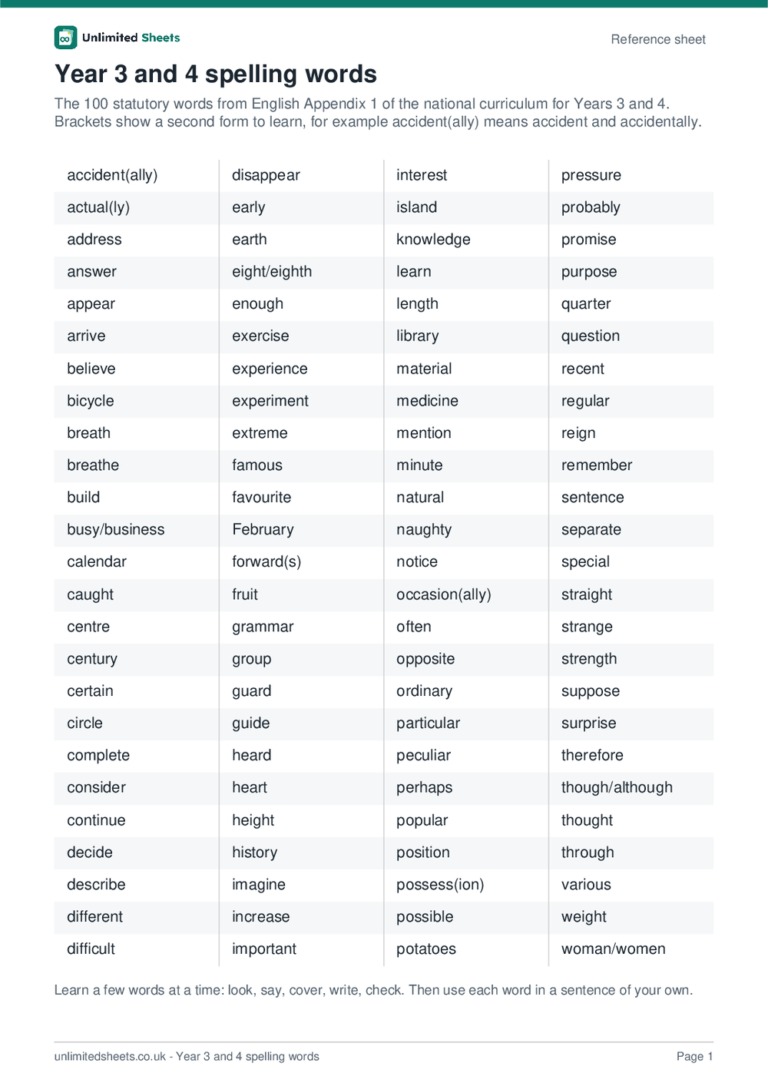
- Year 3 and 4 spelling words (Reference). All 100 words from the Year 3 and 4 statutory list on one A4 page, in the exact form the curriculum gives them.
- Year 5 and 6 spelling words (Reference). All 100 words from the Year 5 and 6 statutory list, from accommodate to yacht, ready to stick in a homework book.
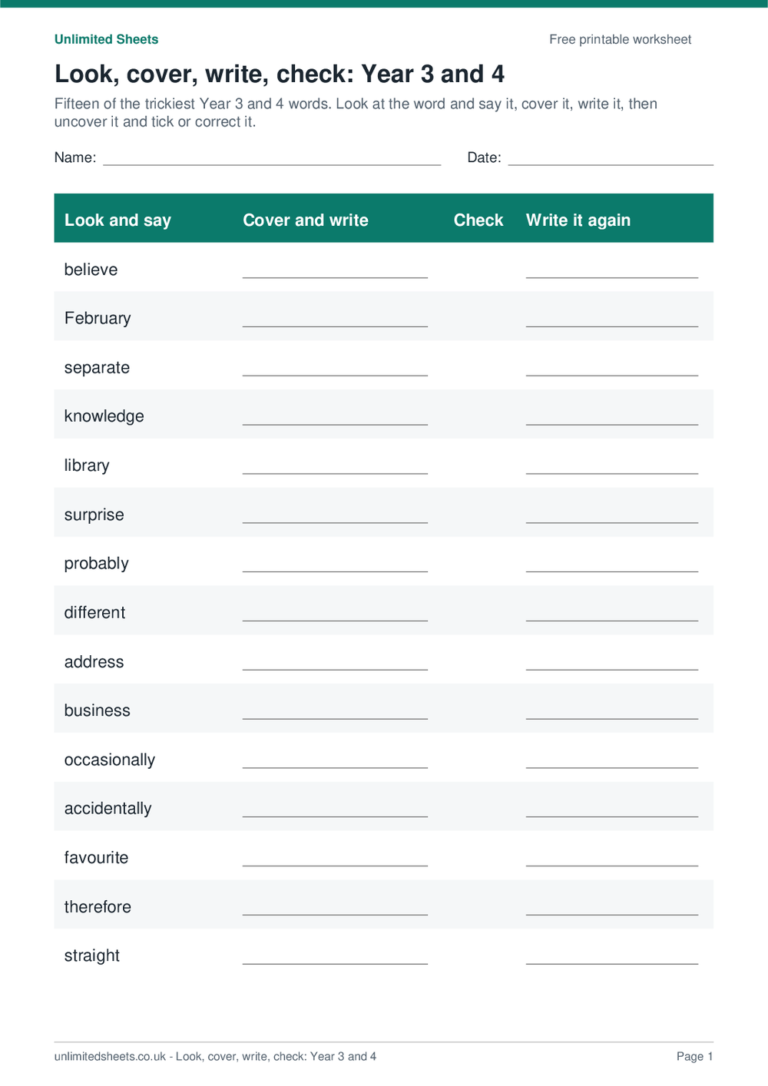
- Look, cover, write, check: Year 3 and 4 (Year 3–4). Fifteen words that children often get wrong, from February to occasionally, in the classic four-column practice table.
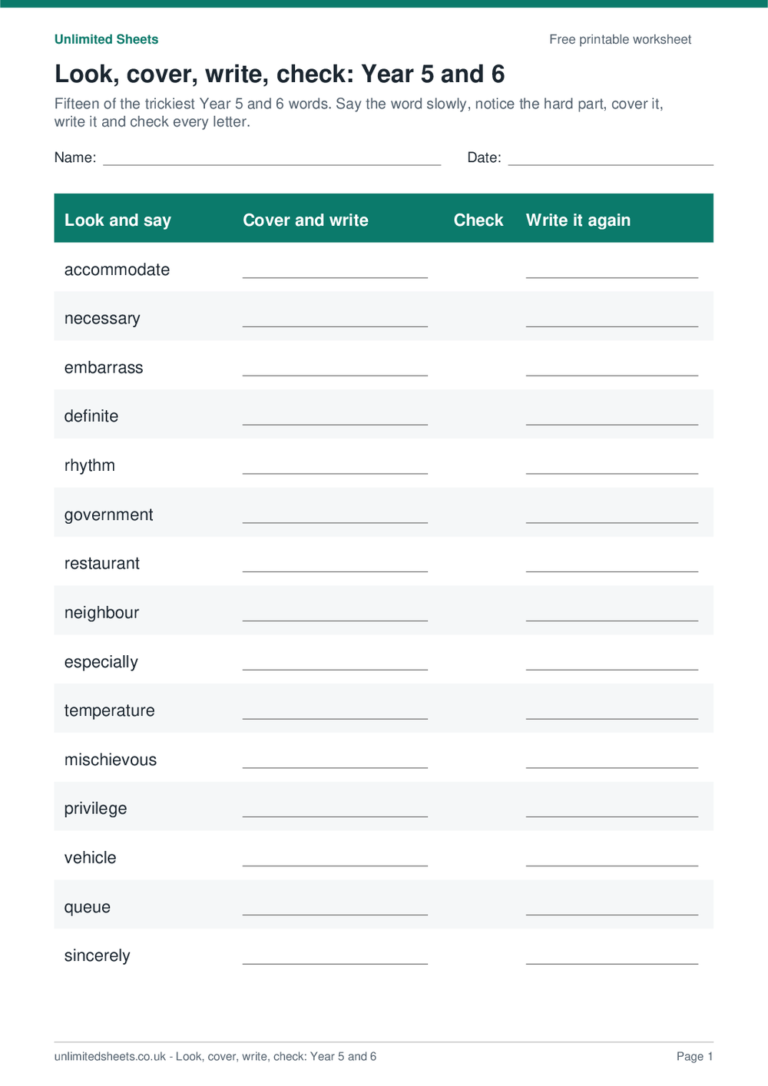
- Look, cover, write, check: Year 5 and 6 (Year 5–6). Fifteen hard Year 5 and 6 words with double letters, silent letters and unusual endings, in a four-column practice table.
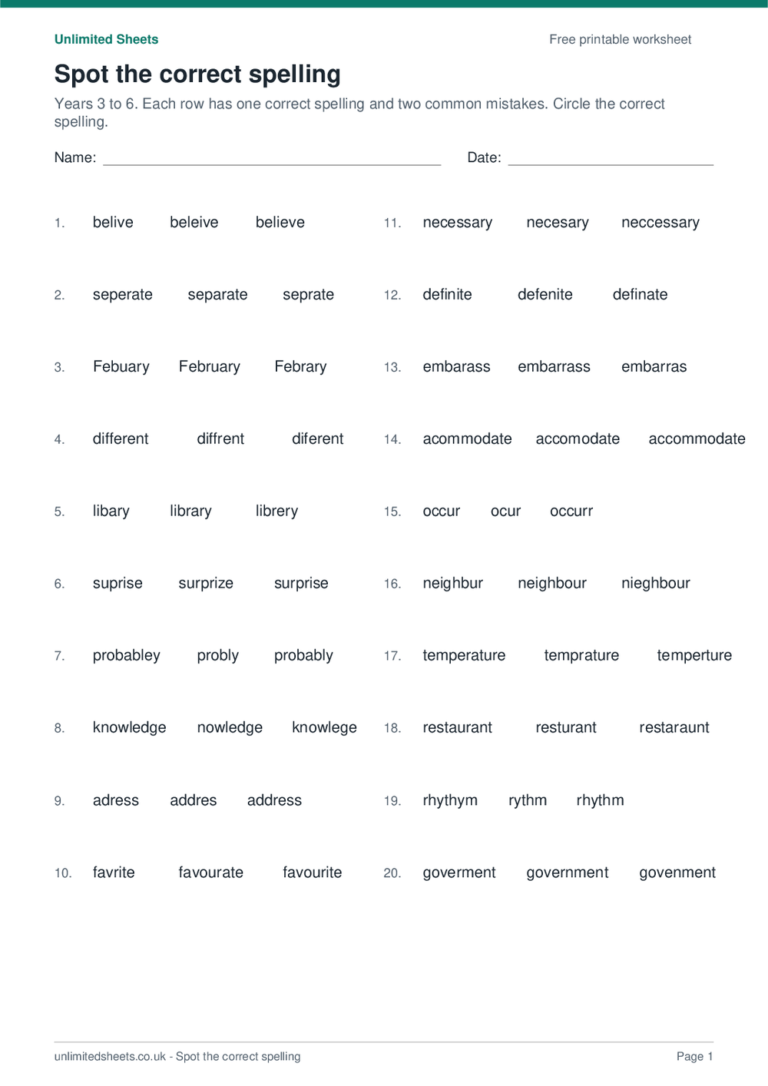
- Spot the correct spelling (Year 3–6). Twenty statutory words, each shown with two realistic mistakes, from library and February to rhythm and accommodate.
Spelling questions
How many words are on the Year 3 and 4 spelling list?
There are 100 words on the Year 3 and 4 list and another 100 on the Year 5 and 6 list. Some entries include a second form, such as accident(ally), so there are a few more words to learn than entries.
Do children have to learn the words in a set order?
No. Each list covers a two-year band, and schools decide which words to teach in which year. Many teach a handful each week alongside a spelling rule.
Why can I not hear the words?
The audio uses your device’s own voices. If it has no English voice, or the sound is off, choose the Look, cover, write level instead: it shows each word for three seconds and needs no audio.
Are American spellings marked wrong?
Yes. The practice follows the spellings used in English schools, so favourite, centre and neighbour are correct and favorite, center and neighbor are not.
Practice for each year group
Each page below has only the practice, curriculum objectives and worksheets for that year.
Keep practising
Updated 23 November 2026.