
Punctuation shows the reader where a sentence starts and stops, who owns what and who is speaking. This page covers the punctuation taught from Year 1 to Year 4: capital letters, full stops, question marks and exclamation marks, apostrophes for missing letters and for possession, and inverted commas for direct speech.
Each level marks itself. The mixed level brings everything together once your child is confident with each part.
Next exercise
The Year 3 to 6 statutory lists with audio and look-cover-write practice.
Capital letters and end marks
Every sentence starts with a capital letter and ends with a full stop, a question mark or an exclamation mark. Capital letters are also used for names of people and places, days of the week, months and the word I: On Friday Zara and I went to Cardiff.
Apostrophes for missing letters
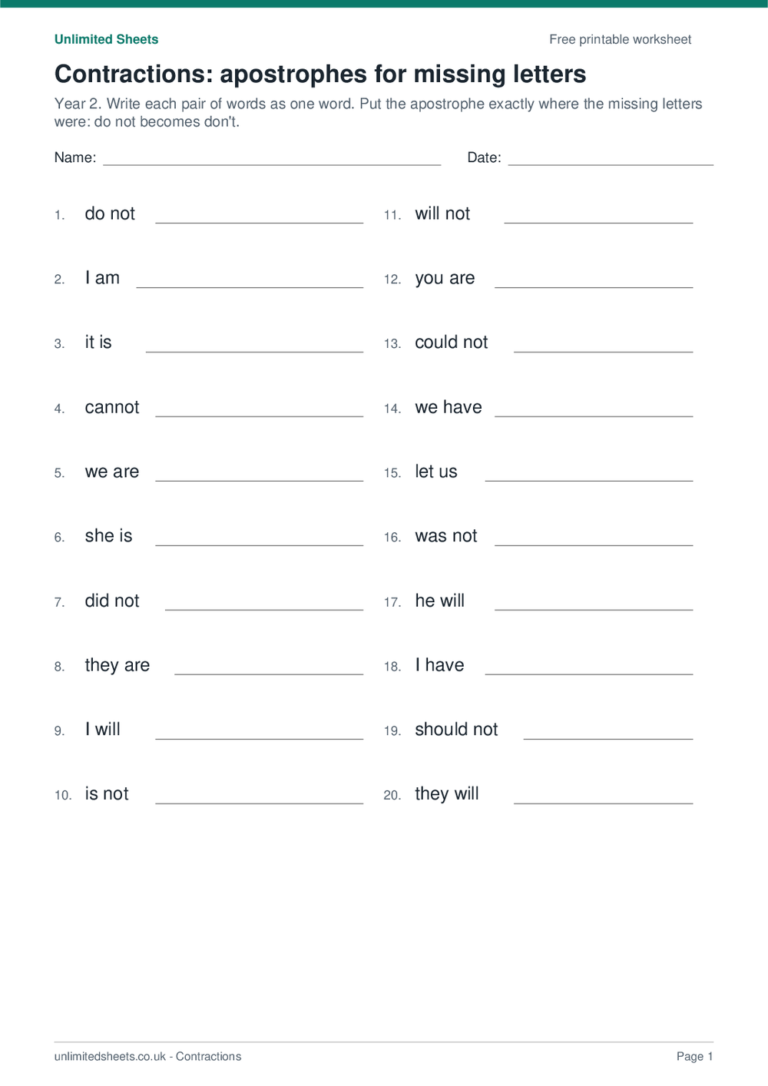
In a contraction two words are pushed together and the apostrophe goes where the letters were removed: do not becomes don’t, we are becomes we’re. Two contractions change more than that: will not becomes won’t, and cannot becomes can’t.
Apostrophes for possession
| Owner | Rule | Example |
|---|---|---|
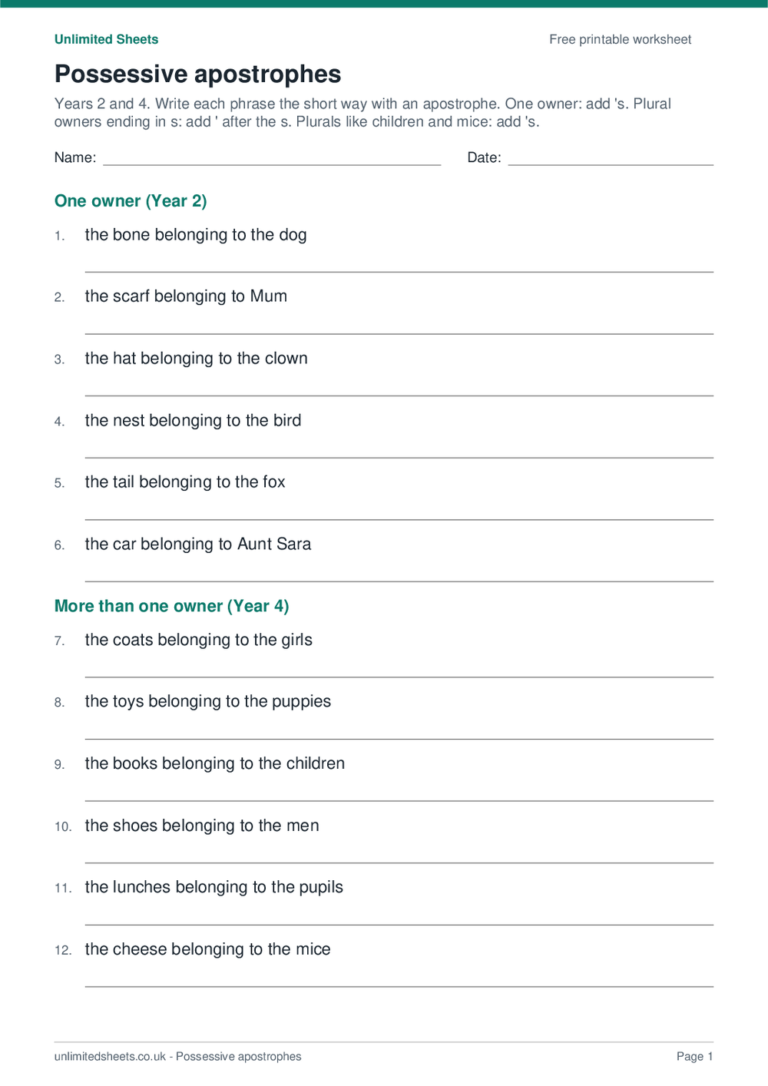
| One owner (Year 2) | Add ’s | the dog’s bone, Mum’s scarf |
| Plural ending in s (Year 4) | Add ’ after the s | the girls’ coats, the puppies’ toys |
| Plural not ending in s (Year 4) | Add ’s | the children’s books, the mice’s cheese |
Plural nouns that do not show ownership never take an apostrophe: I bought three apples, not apple’s.
It’s or its?
It’s always means it is or it has: It’s raining. Its shows belonging and has no apostrophe, like his and hers: The cat licked its paw. If you can say it is in its place, use the apostrophe.
Inverted commas for direct speech
Inverted commas, often called speech marks, go around the words someone actually says. The spoken words start with a capital letter, and the comma, full stop, question mark or exclamation mark goes inside the closing inverted commas.
- Speaker first: Mum said, “It is time for bed.”
- Speaker last: “It is time for bed,” said Mum.
- Question: “Where are my shoes?” asked Ruby.
Year 3 pupils are introduced to inverted commas; by Year 4 they use them with all the other punctuation of speech.
Punctuation by year group
- Year 1: capital letters, full stops, question marks and exclamation marks; capital letters for names and for I.
- Year 2: commas in lists, apostrophes for missing letters and for one owner.
- Year 3: inverted commas to punctuate direct speech.
- Year 4: full punctuation of speech, apostrophes for plural possession, commas after fronted adverbials.
- Year 5: brackets, dashes and commas for parenthesis; commas to make meaning clear.
- Year 6: semicolons, colons, dashes, hyphens and bullet points.
Common mistakes
- Missing capital letters for names and places, or a lower-case i on its own.
- Putting an apostrophe in a plain plural: banana’s for sale.
- Writing the girl’s coats when the coats belong to several girls.
- Putting the end mark outside the speech: “We are late”. The full stop belongs inside.
- Forgetting the comma between the spoken words and said.
In more depth
For more on the punctuation children find hardest, each of these has its own page with practice and a worksheet:
- Apostrophes: An apostrophe shows missing letters (can’t = cannot) or belonging (the girl’s bag, the girls’ bags). Plurals without belonging never need one.
- Inverted Commas: Inverted commas go around the exact words spoken. The punctuation that ends the speech goes inside them, and a new speaker starts a new line.
- Parenthesis: Parenthesis is extra information added to a sentence inside a pair of brackets, dashes or commas. Take it out and the sentence still makes sense.
All the terms are collected on the KS2 grammar page.
Printable punctuation worksheets


- Capital letters and full stops (Year 1–2). Twelve sentences with names, places, days, months and the word I to correct, ending with either a full stop or a question mark.
- Contractions (Year 2). Twenty contractions, including the irregular won't and can't, with the apostrophe standing in for the missing letters.
- Possessive apostrophes (Year 2–4). Six singular owners for Year 2, then six plural owners for Year 4, including the irregular plurals children, men and mice.
- Inverted commas and direct speech (Year 3–4). Ten sentences of speech to punctuate, with the reporting clause sometimes before and sometimes after the spoken words.
Punctuation questions
Are inverted commas the same as speech marks?
Yes. The national curriculum uses the term inverted commas; many teachers and parents call them speech marks. They can be single or double, as long as you use the same kind all the way through.
Where does the apostrophe go for more than one owner?
If the plural ends in s, put the apostrophe after the s: the girls’ coats. If the plural does not end in s, add an apostrophe and s: the children’s books.
When should children use exclamation marks?
Exclamation marks are introduced in Year 1. In Year 2 children learn that an exclamation sentence starts with What or How, such as What a lovely day it is!
Is it don’t or dont?
Don’t, with an apostrophe where the o of not has been taken out. Every contraction needs an apostrophe.
Practice for each year group
Each page below has only the practice, curriculum objectives and worksheets for that year.
Keep practising
Updated 23 November 2026.