
Word classes are the jobs that words do in a sentence: nouns name things, verbs show actions, adjectives describe nouns and adverbs tell you more about verbs. Children meet nouns, verbs, adjectives and adverbs in Year 2, prepositions and conjunctions in Year 3, and determiners and pronouns in Year 4.
Choose a level and click the word asked for. Every sentence is built so that the word you need appears exactly once.
Nouns
A noun names a person, animal, place or thing: teacher, rabbit, Leeds, pencil. Proper nouns, such as names, towns and days of the week, start with a capital letter. A noun phrase is a noun with words added to tell you more about it: the muddy football in the garden.
Verbs
A verb is a doing or being word. In The puppy splashed the verb is splashed. Verbs change to show tense: I jump, I jumped, I am jumping. Every full sentence has at least one verb.
Adjectives
An adjective describes a noun. It usually comes just before the noun (a grumpy dragon) or after a verb such as is (the dragon is grumpy).
Adverbs
An adverb adds to a verb by telling you how, when, where or how often something happens: quietly, yesterday, outside, often. Many adverbs end in -ly, but not all do, and some words ending in -ly, such as friendly, are adjectives.
Prepositions and conjunctions
A preposition links a noun to the rest of the sentence, usually to show place or time: under the bridge, after lunch. A conjunction joins two clauses: We stayed in because it was raining. Co-ordinating conjunctions such as and, but and or join two equal clauses; subordinating conjunctions such as because, when, if and although add a clause that depends on the main one.
Determiners and pronouns
A determiner comes before a noun and tells you which one or how many: the, a, this, those, my, some, every. A pronoun stands in place of a noun so you do not repeat it: Grandma baked a cake. She put it on the table. Possessive pronouns, such as mine, yours and theirs, stand on their own: That pencil is mine.
Four types of sentence
| Type | What it does | Example |
|---|---|---|
| Statement | Tells you something. Ends with a full stop. | Penguins cannot fly. |
| Question | Asks something. Ends with a question mark. | How many legs does a spider have? |
| Command | Tells someone to do something, often starting with a verb. | Line up by the door. |
| Exclamation | Starts with What or How, is a full sentence and ends with an exclamation mark. | What a huge wave that was! |
The same word can be in different classes
A word’s class depends on its job in the sentence, not on the word itself. Light is a verb in Light the candle, a noun in Turn on the light and an adjective in a light bag. This is why the practice always asks about a word inside a sentence rather than a word on its own.
Word classes by year group
- Year 1: words, sentences and the idea of joining words with and.
- Year 2: nouns, noun phrases, verbs, adjectives, adverbs and the four sentence types.
- Year 3: prepositions and conjunctions; a or an before a vowel sound.
- Year 4: determiners, pronouns and possessive pronouns; adverbials.
- Year 5: modal verbs, relative pronouns and relative clauses.
- Year 6: subject and object; synonyms and antonyms; the passive voice.
Common mistakes
- Calling every -ly word an adverb: friendly, lovely and lonely describe nouns, so they are adjectives.
- Mixing up determiners and adjectives: the, my and those point to the noun; they do not describe it.
- Thinking a question must start with a question word: Is it time for lunch? is a question too.
- Calling any sentence with ! an exclamation: in grammar terms, an exclamation starts with What or How.
In more depth
Each of these word classes has its own page with more examples, practice and a worksheet:
- Modal Verbs: Modal verbs (can, could, may, might, shall, should, will, would, must) go before another verb and show how likely, possible or necessary something is.
- Conjunctions: A conjunction joins words or clauses. Coordinating conjunctions (and, but, or, so) join equal parts; subordinating conjunctions (because, when, if, although) start a subordinate clause.
- Prepositions: A preposition links a noun or pronoun to the rest of the sentence, often showing where or when: under the bridge, after lunch, with my friend.
- Determiners: A determiner comes before a noun (and any adjectives) to say which one or how many: the, a, an, this, my, some, every, two.
- Nouns: A noun names a person, animal, place, thing or idea. Proper nouns, such as names and places, start with a capital letter.
- Adjectives: An adjective describes a noun. It usually goes before the noun (a red kite) or after a verb such as is or seems (the kite is red).
- Adverbs: An adverb tells you more about a verb: how, when, where, how often or how likely something happens (slowly, tomorrow, outside, often, perhaps).
- Pronouns: A pronoun stands in place of a noun so you do not repeat it: Sam fed the cat, then he stroked it.
All the terms are collected on the KS2 grammar page.
Printable word class worksheets
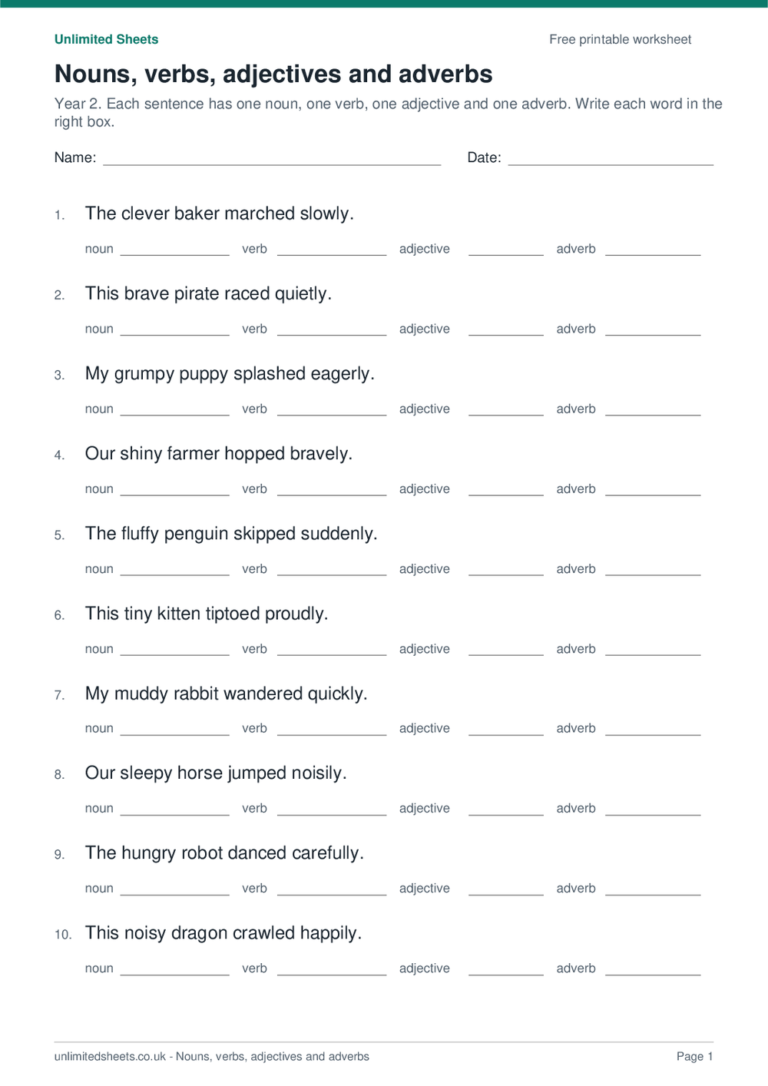
- Nouns, verbs, adjectives and adverbs (Year 2). Ten sentences built so that each word class appears exactly once, which makes the sorting fair and the answers certain.
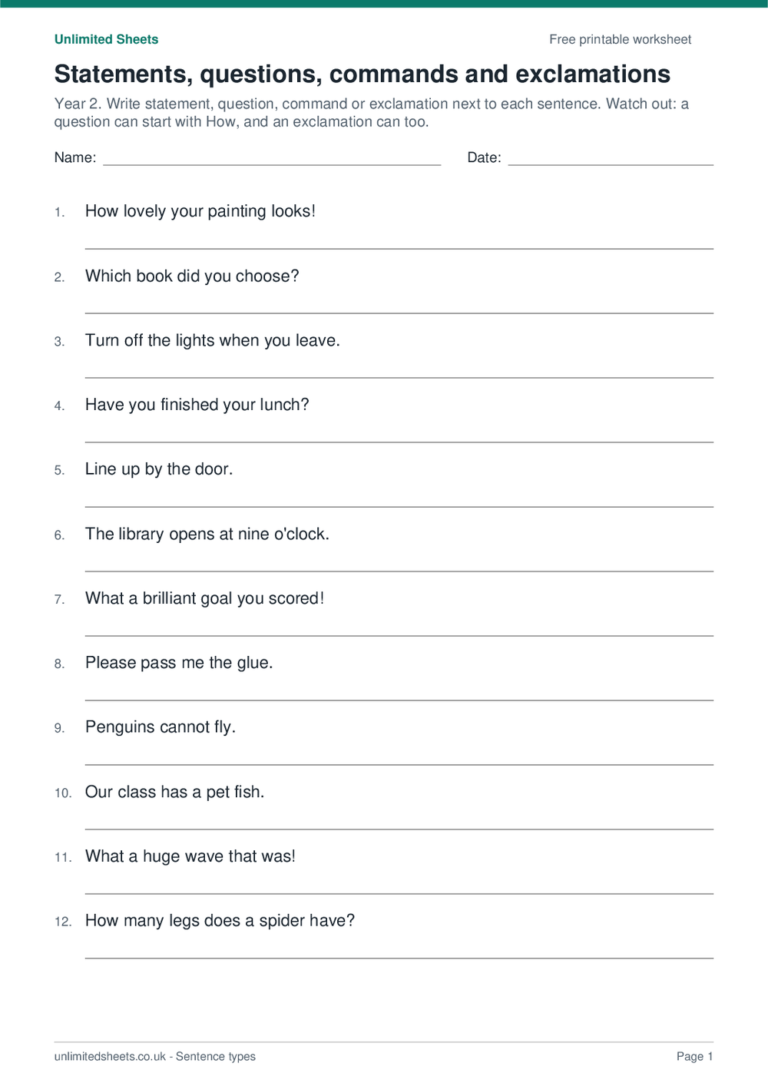
- Sentence types (Year 2). Twelve sentences, three of each type, including the tricky pair where both a question and an exclamation begin with How.
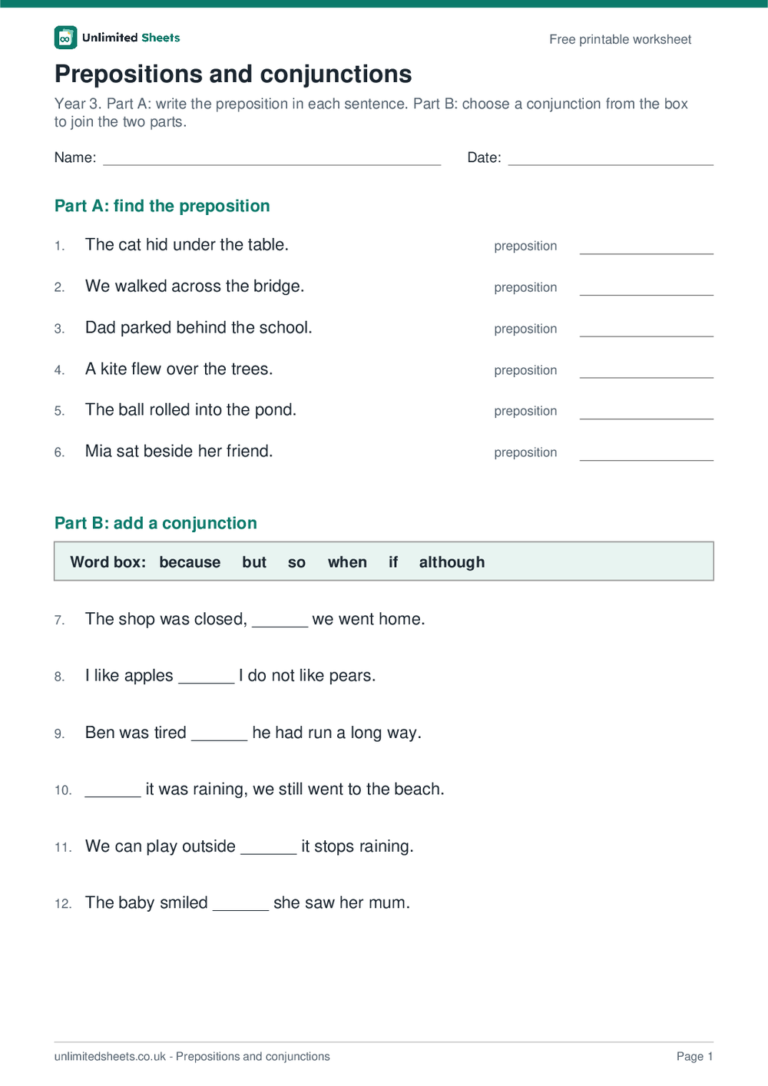
- Prepositions and conjunctions (Year 3). Find the preposition in six sentences, then join clauses with because, but, so, when, if or although. The key notes where two answers work.
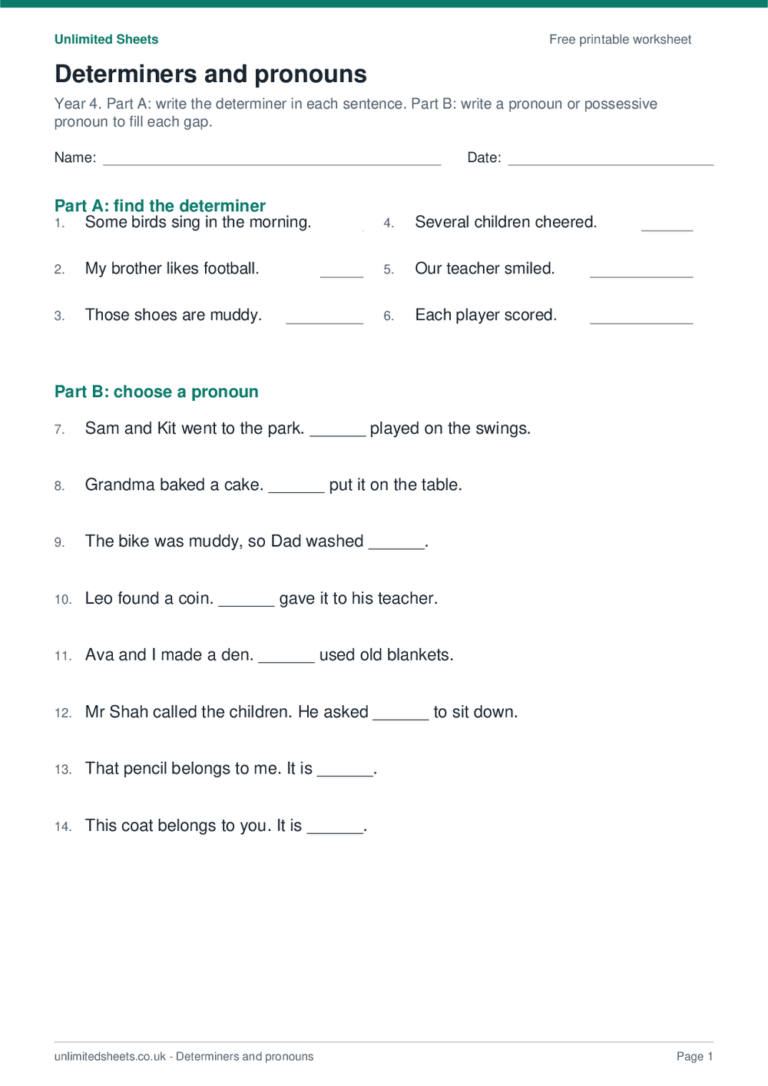
- Determiners and pronouns (Year 4). Each Part A sentence has exactly one determiner; Part B practises personal pronouns and the possessive pronouns mine and yours.
Word class questions
What are the eight word classes children learn in primary school?
Nouns, verbs, adjectives, adverbs, prepositions, conjunctions, determiners and pronouns. They are introduced between Year 2 and Year 4.
What is the difference between an adjective and an adverb?
An adjective describes a noun (a slow snail). An adverb tells you more about a verb (the snail moved slowly).
Is “the” an adjective?
No. The, a and an are determiners. They show which noun you mean but do not describe it.
When do children learn about conjunctions?
The term conjunction is taught in Year 3, although children start joining clauses with and in Year 1 and with because, when and if in Year 2.
Practice for each year group
Each page below has only the practice, curriculum objectives and worksheets for that year.
Keep practising
- Punctuation
- Spelling words: Years 3 to 6
- All English topics
- Maths practice
Updated 23 November 2026.